Bad driving habits cost Florida drivers over $10 billion annually in accidents, violations, and insurance hikes. The good news is that solid driver education safety tips can dramatically reduce your risk on the road.
At DriverEducators.com, we’ve helped thousands of drivers master the skills that matter most. This guide walks you through the fundamentals, real-world practice strategies, and the mistakes you absolutely need to avoid.
Master the Fundamentals of Safe Driving
Florida traffic laws form the foundation of safe driving, and knowing them isn’t optional-it’s the difference between a clean record and costly violations. At intersections, which account for roughly one-quarter of traffic fatalities in the U.S., you must obey right-of-way rules strictly. At a four-way stop, if two or more vehicles arrive simultaneously, the driver on the left shall yield the right-of-way to the vehicle on the right. When turning left on green, you cannot proceed unless oncoming traffic is clear or a left-turn arrow is present. School zones demand 15 mph during operating hours, and violations exceed $300 plus points on your license.
What Defensive Driving Really Means in Practice
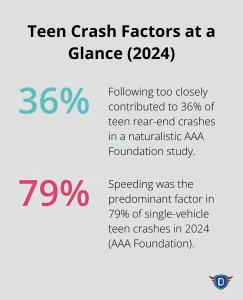
Defensive driving rests on three core skills that the National Safety Council identifies as foundational: maintaining proper following distance, constant environmental scanning, and anticipating hazards. Following distance matters far more than most drivers realize-keep at least three seconds behind the car ahead in normal conditions, roughly 120 feet at highway speeds above 55 mph. In rain or slick conditions, extend this to four to five seconds because tire grip drops dramatically. Scanning practice requires you to check mirrors every 5–10 seconds and look 20–30 seconds ahead; use peripheral vision and head-turns to monitor blind spots. Anticipation means you predict others’ moves based on their position and speed, then slow or adjust early when you notice brake lights or lane drift. This approach prevents panic braking and reduces rear-end crash risk, which a naturalistic study from the AAA Foundation for Traffic Safety found contributed to 36% of teen rear-end crashes.
Vehicle Control Starts With Positioning
Proper vehicle positioning gives you space to react when hazards appear. Stay centered in your lane, avoid hugging either edge, and maintain distance from parked cars that might open doors into traffic. Position your seat so you can fully depress pedals without stretching, adjust mirrors to eliminate blind spots, and grip the steering wheel at 9 and 3 o’clock for maximum control. Speeding destroys your ability to control the vehicle-in 2024, speeding was the predominant factor in 79% of single-vehicle teen crashes according to data from the AAA Foundation. Slow down in curves, wet conditions, and unfamiliar areas where you cannot predict hazards ahead. When fatigue sets in, pull over immediately; drowsy driving claimed 644 lives in 2024, making it as dangerous as impaired driving.
Why These Fundamentals Matter Before You Practice
Mastering these fundamentals now prevents costly mistakes later. Drivers who understand right-of-way rules, follow proper spacing, and control their speed avoid violations that spike insurance premiums and damage their driving record. The next section shows you how to apply these skills in real-world conditions where hazards test your reaction time and decision-making every single day.
Build Real-World Skills Through Practice and Experience
Spot Hazards Before They Demand Emergency Action
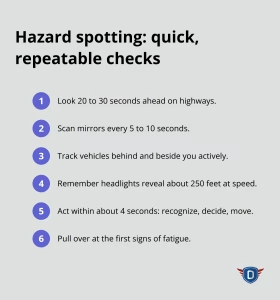
Hazard recognition separates safe drivers from accident statistics. You cannot react faster than you can see, which means your eyes must work ahead of your vehicle’s momentum. Look 20 to 30 seconds ahead on the highway-that’s roughly 4 to 5 car lengths at 55 mph-and identify potential problems before they demand emergency action. Scan your mirrors every 5 to 10 seconds, not out of habit but to track what’s happening behind and beside you. A naturalistic driving study using dashcam footage from 1,691 teens aged 16 to 19 found that failure to yield accounted for 43 percent of angle crashes, many of which could have been prevented with earlier hazard spotting. At typical highway speeds, your headlights illuminate only about 250 feet ahead, giving you roughly 4 seconds to spot a hazard and respond. In that window, you must recognize the danger, decide on action, and physically move the wheel or pedal. Fatigue collapses this timeline entirely. An estimated 6,400 people die annually in crashes involving drowsy driving according to the National Sleep Foundation, often because a fatigued driver simply did not see the hazard until it was too late.
Control Speed and Following Distance Together
Speed and following distance are not separate concerns-they work together to determine whether you crash. The three-second rule applies in normal conditions: stay three seconds behind the car ahead at any speed, which translates to roughly 120 feet at 55 mph. Rain or wet roads demand four to five seconds because your tires lose grip and your stopping distance increases dramatically. In 2024, speeding was the predominant factor in 79 percent of single-vehicle teen crashes according to the AAA Foundation for Traffic Safety. Aggressive drivers who tailgate and speed believe they save time, but they sacrifice control. When you follow too closely, you have zero reaction margin. If the car ahead brakes suddenly, you will hit them. The naturalistic study found following too closely contributed to 36 percent of rear-end teen crashes.
Master Right-of-Way Rules in Real Conditions
Right-of-way rules exist because intersections are where conflicting paths collide, and intersections account for roughly one-quarter of all U.S. traffic fatalities. Knowing the law is not enough-you must anticipate what other drivers will do and position yourself accordingly. At a four-way stop, the vehicle on the right has the right-of-way when two or more arrive simultaneously. On a left turn from green, you cannot proceed unless oncoming traffic is clear or a left-turn arrow is present. These rules sound simple until you face a driver who ignores them. Your job is not to argue about who is right; it is to yield and avoid the crash. School zones demand 15 mph during operating hours, and violations exceed 300 dollars plus points. Treat every zone like a place where a child might run into traffic, because in school zones, they do.
The skills you build through consistent practice-scanning ahead, managing speed relative to following distance, and respecting right-of-way-form the foundation for handling the mistakes other drivers make. Next, we examine the specific errors that lead to violations and how to avoid them entirely.
Avoid Common Driving Mistakes That Lead to Violations
Distracted Driving Destroys Your Attention Window
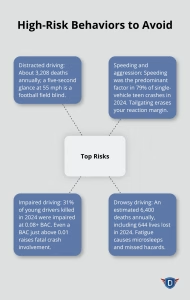
Distracted driving kills about 3,208 people annually in the U.S. according to NHTSA, and texting while driving raises crash risk by 23 times. Your phone costs you roughly 5 seconds of attention with one glance, which at 55 mph means you travel the length of a football field blind. Put your phone in the trunk before you start driving, not in the cupholder or passenger seat where temptation lives. Silence all notifications and set your navigation route before moving. If you must take a call, pull over completely.
Aggressive Driving Multiplies Your Crash Risk
Aggressive driving-tailgating, honking, cutting off others, or speeding-destroys your ability to recover from mistakes. Speeding and aggressive behaviors multiply crash risk exponentially. You cannot control what other drivers do, but you control your response. If someone cuts you off, you yield. If traffic slows, you adapt. Road rage costs nothing except your license, your insurance rates, and potentially your life.
Impaired Driving and Fatigue End Careers
Impaired driving and fatigue are equally catastrophic. In 2024, 31 percent of young drivers killed in crashes were impaired with a blood alcohol content of 0.08 or higher, according to NSC analysis of NHTSA data. Even tiny amounts of alcohol-a BAC just above 0.01-correlate with higher fatal crash involvement for teen drivers. If you drink, you do not drive.
Period. Call a rideshare, call a friend, call anyone.
Drowsy driving claimed 644 lives in 2024, making it as dangerous as alcohol. Fatigue collapses your hazard recognition, slows your reaction time, and causes microsleeps where you lose consciousness for seconds without realizing it. If your attention drifts, your eyelids feel heavy, or you miss exit signs, pull over immediately and rest. These mistakes are not minor errors-they are the direct path to violations, license suspension, and skyrocketing insurance premiums.
Final Thoughts
The fundamentals you’ve learned throughout this guide-respecting right-of-way, maintaining proper following distance, scanning ahead, and avoiding distraction-form the core of safe driving. These principles work together to reduce your crash risk, protect your driving record, and keep insurance premiums from skyrocketing. Speeding, distracted driving, and impaired driving remain the leading causes of violations and fatalities, yet they’re entirely preventable through conscious decision-making and consistent practice.
Driver education safety tips matter most when you apply them every time you drive, not just during your first weeks behind the wheel. The skills that prevent rear-end crashes, angle collisions, and single-vehicle accidents become automatic only through repetition. At DriverEducators.com, our Florida-approved courses blend clear explanations with real-life scenarios to help you master these habits for life.
Your next step is straightforward: enroll in a course that matches your needs, complete the curriculum at your own pace, and receive your certificate directly reported to the FLHSMV. Visit DriverEducators.com to explore our Basic Driver Improvement, Intermediate Driver Improvement, Aggressive Driver, and Mature Driver courses (each program reinforces the safety principles covered here and equips you with the knowledge to handle real-world driving challenges).