To figure out your total stopping distance, you need to add two crucial pieces together: your reaction distance and your braking distance. The first is how far you travel before you even hit the brakes, and the second is the distance the car covers once you've slammed them on. That total number is the real-world space you need to avoid a crash.
Why Stopping Distance Is a Critical Driving Skill
Picture this: you're cruising down a busy Florida highway, and the car in front of you suddenly lights up its brake lights. That gap you left between your bumper and theirs? That's your safety margin, and it's dictated by pure physics.
Knowing how to calculate your stopping distance isn't just for the driver's test; it's one of the most practical, life-saving skills you can have. It turns abstract ideas like speed and reaction time into a concrete measurement you can use every time you get behind the wheel.
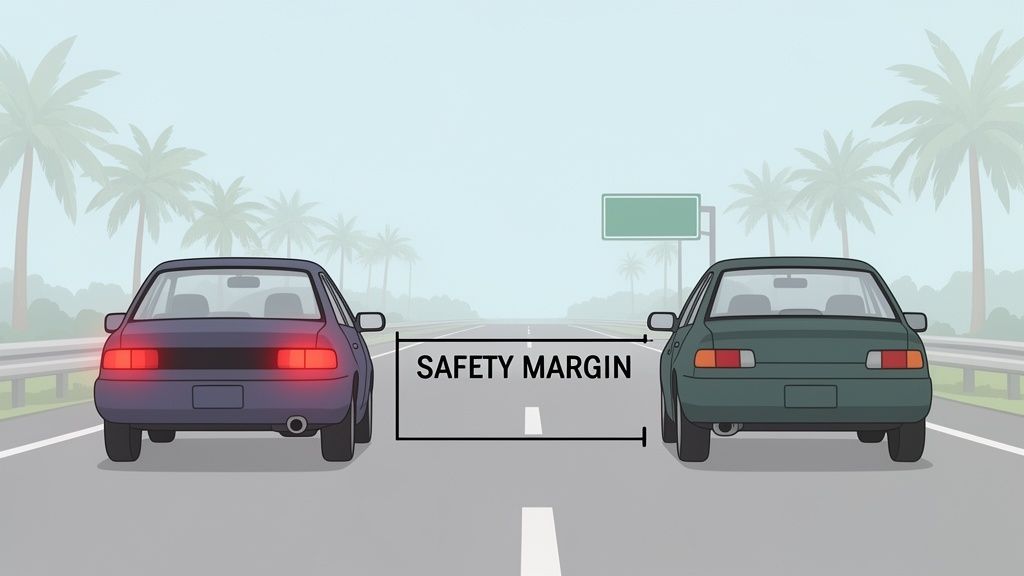
This guide is all about that critical gap—the total feet your car travels from the instant you see a problem to the moment you come to a dead stop. We'll break down the two parts of the equation:
- Reaction Distance: The asphalt you cover while your brain spots a hazard and tells your foot to move.
- Braking Distance: The journey your car takes after the brake pedal is pushed to the floor.
Getting a handle on this is more than just a good idea—it’s a cornerstone of defensive driving.
The Real-World Impact on Safety
Your stopping distance directly impacts how far you should follow the car ahead, how you adjust your speed in bad weather, and your overall situational awareness. But the biggest factor, by far, is speed. As you go faster, the distance you need to stop doesn't just increase—it skyrockets. So many drivers completely miss this point.
A common mistake is thinking that if you double your speed, you just double your stopping distance. The reality is, thanks to physics, doubling your speed roughly quadruples your braking distance.
This is exactly why going just a few miles per hour over the speed limit can be the difference between a close call and a devastating collision. It’s also why Florida traffic laws are so strict about speeding, especially near schools or construction zones where every split-second counts. As our guide on how to avoid car accidents explains, that buffer zone is your best defense.
More Than Just a Number
Ultimately, learning to calculate stopping distance gives you the power to make smarter, safer choices on the road. It helps you truly visualize the space your vehicle needs and respect the powerful forces you're controlling.
Whether you're a new driver just getting your license or a seasoned pro dealing with a sudden downpour on I-95, this skill is non-negotiable. We’ll get into the formulas, walk through real-world examples, and give you actionable tips to stay safe on Florida's unpredictable roads. This isn't about memorizing facts; it's about protecting yourself, your passengers, and everyone else who shares the road with you.
The Two Halves of the Equation: Reaction and Braking
Bringing your car to a complete stop isn't a single event. It’s actually a two-part story that plays out in the critical seconds after you spot a hazard. To really get a grip on how much road you need to stop safely, you have to look at both pieces of the puzzle.
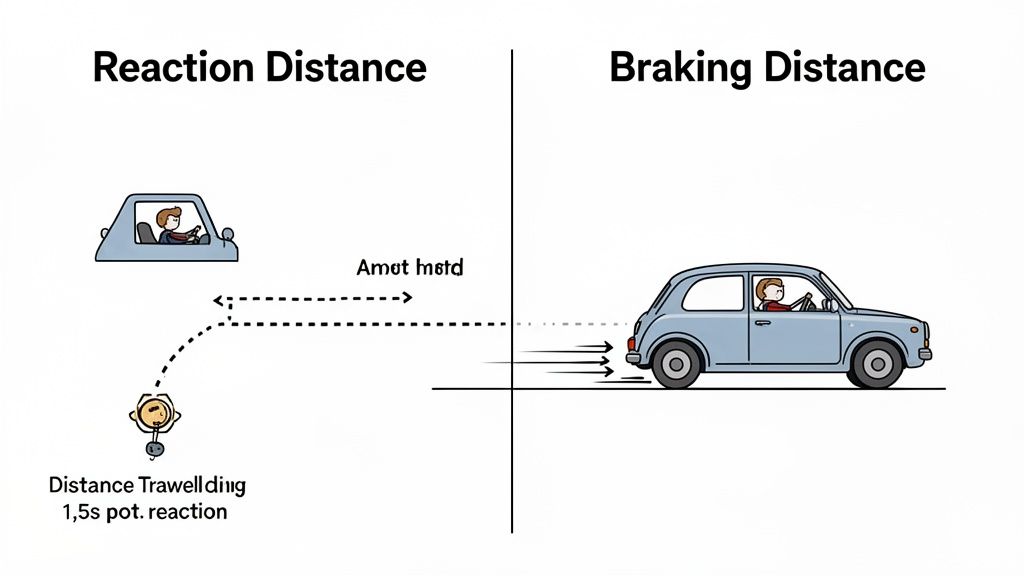
First up is your reaction distance. This is the space your car travels while your brain is catching up. It’s the gap between "Whoa, that car stopped short!" and the moment your foot actually hits the brake pedal. This isn't just about reflexes; it's a whole sequence of seeing, processing, deciding, and acting.
For a focused driver, that entire process takes about 1.5 seconds. Doesn't sound like much, right? But if you're cruising at 50 mph, your car will have already traveled over 110 feet—longer than a pro basketball court—before your brakes even begin to do their job.
Your Brain on the Road
That reaction time is surprisingly delicate. A lot of things can slow it down, stretching out your reaction distance to dangerous lengths.
- Fatigue: Driving drowsy is no joke. It can impair your judgment and slow your response time just as much as driving under the influence.
- Distractions: That "quick glance" at a text is a killer. It can easily add precious seconds to your reaction time, turning a near-miss into a guaranteed collision.
- Age and Physical Condition: As we get older, natural changes in our vision, motor skills, and cognitive processing can impact how quickly we're able to react behind the wheel.
The effect of a delayed reaction is huge. Just a one-second delay when you're driving 60 mph means you travel an extra 88 feet before you even start to slow down. Our full guide on distracted driving awareness dives deep into how these tiny lapses can have devastating outcomes.
The Physics of Braking Distance
The second half of the equation is braking distance—the ground your car covers after you’ve slammed on the brakes. At this point, physics takes over completely, and one thing rules the outcome: your speed.
The energy your car is carrying—its kinetic energy—is tied to the square of your speed. That’s a fancy way of saying if you double your speed from 30 mph to 60 mph, your braking distance doesn't just double. It quadruples. Your brakes have to work four times as hard to bleed off all that forward momentum.
This exponential relationship is probably the most misunderstood part of safe driving. A small jump in speed creates a massive, disproportionate increase in the distance you need to stop.
This is why speeding tickets in Florida are so serious. The laws aren't just about collecting fines; they're based on the real-world dangers that speed creates. For every 1 mph you increase your speed, you add nearly four feet to your total stopping distance. At 60 mph, you could easily need over 230 feet (70+ meters) to come to a halt, and that’s on a good day with perfect conditions.
It’s this harsh reality of physics that makes "just a little speeding" so risky. The extra 10 mph you’re carrying into an emergency doesn't just add a few feet to your stopping distance—it adds a ton, shrinking your margin for error down to almost nothing.
Putting the Formulas into Practice with Real Speeds
It's one thing to see formulas in a textbook, but it’s another to understand what they mean on the actual asphalt. Let's ground this theory in the real world by looking at everyday driving scenarios right here in Florida. We're going to break down the stopping distances for three common speeds you encounter daily.
We'll look at city driving, cruising on a highway, and flying down the interstate. This isn't just a math exercise; it’s about building a gut feeling for the space your car needs to be safe. You’ll be surprised how much room it really takes.
Scenario 1: Driving at 30 MPH in the City
Picture this: you're driving through a residential neighborhood at 30 mph. It feels slow, but this is where hazards pop up without warning—a kid chasing a ball, a car backing out of a driveway, a cyclist swerving.
So, how much room do you need? First, let's estimate your reaction distance. A simple, back-of-the-napkin trick is to use your speed as a rough estimate for the feet you'll travel before you even hit the brakes. At 30 mph, that's about 30 feet gone in a blink.
Next up is the braking distance. For this, we can use a handy shortcut called the "squared rule." Take the first digit of your speed (3), square it (3 x 3 = 9), and then multiply that by five. That gives you a braking distance of 45 feet.
Let's add it all up:
- Reaction Distance: ~30 feet
- Braking Distance: ~45 feet
- Total Stopping Distance: 75 feet
What does 75 feet look like? Imagine five mid-sized cars parked end-to-end. That's the space you need to stop from just 30 mph on a good day. It's a lot more than you think.
Scenario 2: Cruising at 50 MPH on a Highway
Okay, let's pick up the pace to 50 mph. This is a common speed on Florida highways like US-1 or a major county road. At this speed, everything happens much faster, and the distances involved get a whole lot bigger.
Using our rule of thumb, your reaction distance is now about 50 feet. That's half a bowling alley gone before your foot even moves to the brake pedal.
Now for the braking distance, let’s apply the squared rule again. Take the first digit of the speed (5), square it (5 x 5 = 25), and multiply by five. Your braking distance jumps to a whopping 125 feet.
Here's the total breakdown:
- Reaction Distance: ~50 feet
- Braking Distance: ~125 feet
- Total Stopping Distance: 175 feet
175 feet is more than half the length of a football field. That’s the minimum clear path you need to come to a full stop from 50 mph, and that's assuming your tires are good, your brakes are perfect, and the road is dry.
Scenario 3: Interstate Driving at 70 MPH
Finally, let's bring it up to interstate speed. At 70 mph on I-95 or I-4, you are covering a massive amount of ground every single second—over 102 feet, to be exact. The physics at play are immense, and your margin for error is razor-thin.
Your reaction distance is now approximately 70 feet. That's the distance you'll travel while your brain simply processes the sight of brake lights ahead.
The braking distance is where the power of speed really becomes terrifying. Using the squared rule, we take the first digit (7), square it (7 x 7 = 49), and multiply by five. That gives us a staggering braking distance of 245 feet.
Let's combine them for a truly sobering number:
- Reaction Distance: ~70 feet
- Braking Distance: ~245 feet
- Total Stopping Distance: 315 feet
At 315 feet, your total stopping distance is longer than an entire football field, including both end zones. This is precisely why chain-reaction crashes on the interstate are so devastating. Once one driver brakes hard, there simply isn't enough space for the cars behind to react and stop in time.
Quick Reference: Stopping Distances at a Glance
Sometimes, seeing the numbers side-by-side makes the biggest impact. Here’s a quick-reference chart to help you visualize these distances.
This reference chart illustrates the reaction, braking, and total stopping distances for typical driving speeds, assuming an average driver reaction time of 1.5 seconds on a dry, level road.
Estimated Stopping Distances at Common Speeds on Dry Roads
| Speed (mph) | Reaction Distance (ft) | Braking Distance (ft) | Total Stopping Distance (ft) | Real-World Comparison |
|---|---|---|---|---|
| 30 | 44 | 45 | 89 | Almost 6 car lengths |
| 40 | 59 | 80 | 139 | About 9 car lengths |
| 50 | 74 | 125 | 199 | Over half a football field |
| 60 | 88 | 180 | 268 | About 17 car lengths |
| 70 | 103 | 245 | 348 | Longer than a football field |
Note: These are estimates. Real-world conditions can and will change these numbers significantly.
As you can see, the relationship isn't linear. Doubling your speed doesn't just double your stopping distance—it nearly quadruples it. A little extra gas requires a lot of extra road. Understanding these numbers isn't just for a driving test; it's a fundamental part of keeping yourself and others safe every time you get behind the wheel.
How Road Conditions and Your Car Change the Math
The numbers we’ve worked through so far are great for a perfect day on a perfect road. But if you’ve spent any time driving in Florida, you know "perfect" is rarely on the menu. The real world is messy. It's filled with variables that can throw your stopping distance calculations right out the window, turning what seemed like a safe following distance into the scene of an accident.
This is where a good driver becomes a great defensive driver. It’s not just about knowing the formulas; it's about instinctively understanding that the math is constantly shifting with the world around you and the car you're in.
The Impact of Adverse Weather
Weather is the ultimate wild card. A classic Florida downpour doesn't just make it harder to see; it completely changes the physics between your tires and the asphalt, making your braking distance a dangerous guessing game.
- Wet Roads: Think of water on the road as a lubricant. On a wet surface, your braking distance can easily double. That 125-foot braking distance at 50 mph? It just jumped to 250 feet or even more.
- Hydroplaning: This is when your car literally floats on a layer of water, losing all contact with the road. When you're hydroplaning, you're essentially in a boat. Hitting the brakes does nothing until your tires find pavement again.
- Gravel and Debris: Loose stuff on the road—gravel, sand, even a patch of wet leaves—kills your tire grip. Your car will slide much, much farther than on clean asphalt, so you have to anticipate this and slow down long before you need to stop.
Getting through these situations safely is all about being proactive. For a deeper dive, our guide on driving in the rain is packed with specific techniques for staying in control when the weather turns on you.
This chart drives home just how much speed affects your stopping distance, even when conditions are ideal.
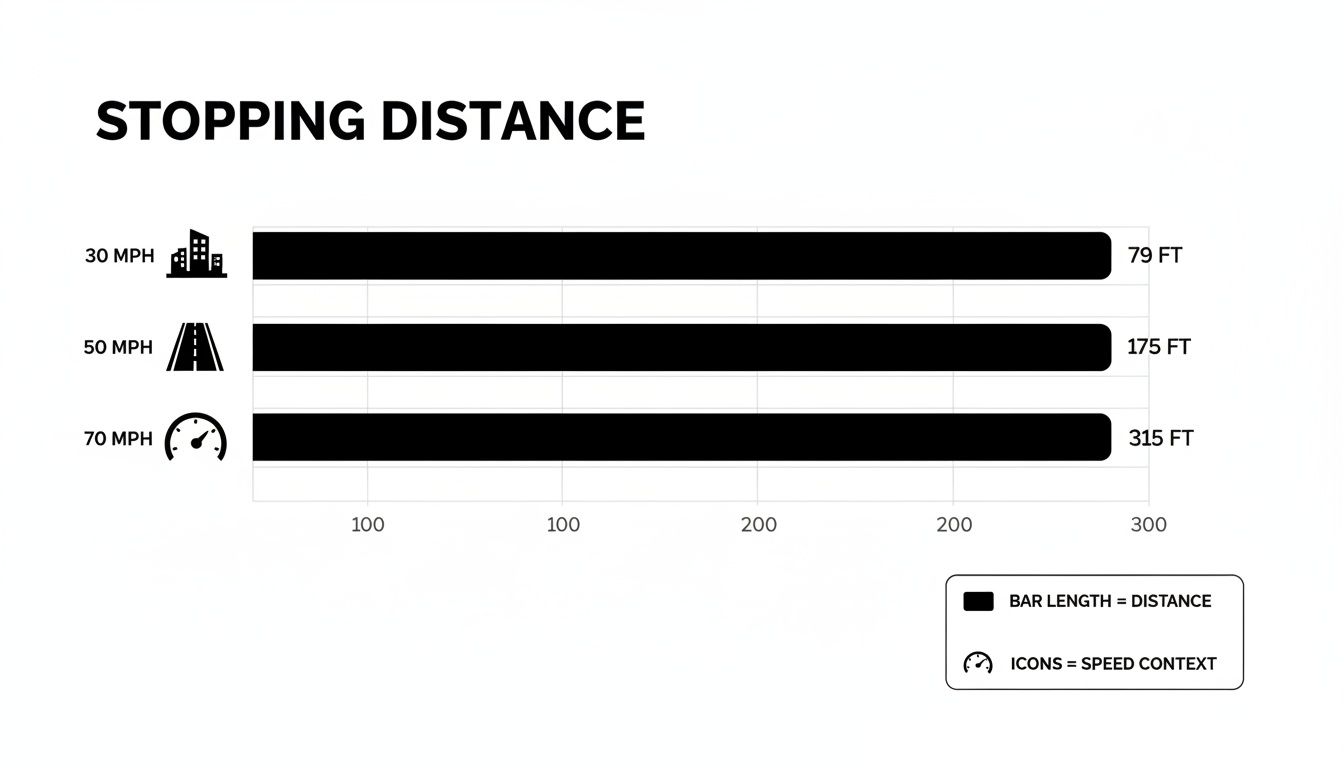
Look at that jump. The gap between 50 and 70 mph is way bigger than the one between 30 and 50 mph. It’s not a straight line; the danger grows exponentially.
Your Vehicle's Condition Matters
You can have the reaction time of a fighter pilot, but if your car isn't maintained, it won't matter. Your vehicle's ability to stop is only as strong as its weakest component.
Tires are Everything
Seriously. Your tires are the only four small patches of rubber connecting you to the road. Their condition is a direct line to your ability to stop safely.
- Tread Depth: Those grooves in your tires aren't for looks; they're designed to push water out from under the tire. On worn-out, bald tires, that water has nowhere to go. This massively increases your risk of hydroplaning and sends your wet-road stopping distance through the roof.
- Tire Pressure: Too little air? Too much air? Either way, you're shrinking the "contact patch"—the amount of rubber actually gripping the road. A smaller contact patch means less grip and unpredictable handling, especially when you slam on the brakes.
Brake System Health
Beyond the tires, the brake system itself needs to be in fighting shape. Worn pads or low fluid mean your car simply can't generate the force needed to stop quickly. If you hear squealing or the pedal feels soft and spongy, those are warning signs you can't afford to ignore.
Here’s a stark way to think about it: Driving at 40 mph on a dry road is one thing. Double your speed to 80 mph, and the laws of kinetic energy mean your braking distance doesn't just double—it quadruples. Now, put that on a wet Florida road like I-95, which sees over 70,000 wet-road incidents every year, and that knowledge becomes a literal lifesaver.
It’s also worth noting that many modern Advanced Driver-Assistance Systems depend on sensors in your windshield. If you've had a replacement, proper ADAS Windshield Calibration is essential for those systems to work correctly and help you stop in time.
The Driver Factor Revisited
Finally, it all comes back to you, the person behind the wheel. That 1.5-second reaction time we use as a baseline? That assumes you're alert, focused, and ready for anything. But life isn't always like that.
A tired, stressed, or distracted driver’s reaction time can easily stretch to 2.5 seconds or more. At 60 mph, that single extra second of delay means your car travels another 88 feet before your foot even hits the brake pedal. That’s more than six car lengths of lost ground—a massive gap that can be the difference between a close call and a devastating collision.
This is exactly why a core principle we teach in every BDI School course is the non-negotiable need to maintain 100% focus on the task of driving.
Practical Ways to Improve Your Stopping Power
Understanding the math behind stopping distance is one thing. Actually reducing it on the road? That's what separates a good driver from a great one. The good news is that those numbers we've been calculating aren't set in stone. You have far more control than you might think.
It all boils down to a few proactive habits. These aren't complicated tricks, just fundamental practices that give you more time, more space, and a better-performing vehicle when it counts.
Master Your Following Distance
The most powerful tool you have for improving your stopping power is space. Give yourself more of it.
This is where the classic "three-second rule" comes into play, and it’s a lifesaver for a reason. Pick a fixed point on the road ahead—a sign, a tree, an overpass—and watch the car in front of you pass it. Then, start counting: "one-one-thousand, two-one-thousand, three-one-thousand." You shouldn't pass that same point before you finish counting.
If rain is pouring or visibility is poor, stretch that to four or five seconds. This simple technique automatically scales your safety buffer to your speed.
Think of that buffer as your pre-packaged reaction and braking distance. By maintaining it, you're giving yourself the room to maneuver and stop without panic if the unexpected happens.
Keep Your Vehicle in Peak Condition
Your car can't save you if its most critical safety components are neglected. When it comes to stopping power, proactive maintenance is everything.
- Tires Are Your Foundation: Your four tires are the only things connecting your vehicle to the asphalt. Check your tire pressure regularly and keep an eye on the tread depth. Bald or underinflated tires can't grip the road or clear water properly, which can easily double your stopping distance on a wet day.
- Brakes Are Your Lifeline: Your ears are a great diagnostic tool. Listen for any squealing, grinding, or other strange noises when you apply the brakes. If the pedal feels spongy or sinks to the floor, that’s a major red flag. For a full breakdown, our guide on Florida vehicle maintenance covers all the essential checks you need to perform.
For those behind the wheel of a commercial vehicle, preventing air brake system leaks and ensuring the entire system is in top shape is absolutely critical for managing the immense forces involved in stopping a heavy truck.
Sharpen Your Driving Habits
Beyond the machine, the driver is the most important variable. The real secret to shorter stopping distances is seeing trouble before it starts.
Scan Far Ahead
Don't get tunnel vision by staring at the bumper in front of you. Lift your gaze and scan the road 12 to 15 seconds ahead. In city driving, that's about a block; on the highway, it's a quarter-mile.
This lets you spot problems in the making—brake lights flashing three cars ahead, a traffic jam forming, or debris in your lane. When you anticipate, you can ease off the gas and slow down smoothly instead of being forced into a panic stop.
Eliminate All Distractions
A distracted brain means a delayed reaction. It's that simple. Every moment your eyes or mind are off the task of driving, you're letting your reaction distance creep up.
Put your phone away. Set the GPS before you pull out of the driveway. Never, ever drive when you're fatigued—a tired driver's reaction time can be just as slow and dangerous as someone who's been drinking. These are the non-negotiable habits that define a true defensive driver.
Your Top Questions About Stopping Distance Answered
Even with all the formulas and charts, some questions always pop up when you try to apply this stuff to real-world driving. Getting a handle on these details is what really cements the knowledge, turning you from someone who just passed the test into a genuinely safe driver.
Let's dive into the questions I hear most often.
What’s the Easiest Way to Judge a Safe Following Distance?
Forget trying to guess car lengths. The single best method is the "three-second rule." It’s simple and it works at any speed.
Just pick a fixed object on the side of the road, like a sign or a tree. When the car in front of you passes it, start counting: "one-one-thousand, two-one-thousand, three-one-thousand." If you pass that same object before you finish counting, you're following too closely.
The beauty of this trick is that it scales with your speed. Three seconds at 60 mph is a much longer distance than three seconds at 30 mph, so it adjusts automatically. And if the weather turns nasty, like during a classic Florida thunderstorm, you absolutely need to stretch that to four or even five seconds.
Does a Heavier Car Take Longer to Stop?
This is a great question, and the answer surprises a lot of people. For everyday cars, SUVs, and light trucks, the impact of weight is pretty small. It feels like a heavier car should take longer to stop because it has more momentum, right?
But here's the other side of that coin: a heavier car also pushes down on its tires harder, creating more grip. In most situations, these two effects nearly cancel each other out.
When it comes to your car, the things that truly matter are speed, the condition of your brakes and tires, and the road surface. Now, this logic goes out the window for massive vehicles like semi-trucks—they need a ton more room to stop.
Will Anti-Lock Brakes (ABS) Help Me Stop Shorter?
Not necessarily, but that's not their primary purpose. The real magic of an Anti-Lock Braking System (ABS) is that it gives you the ability to steer during a panic stop.
By pulsing the brakes rapidly, ABS prevents your wheels from locking up and skidding. This means you can slam on the brakes and swerve to avoid hitting whatever is in front of you. On dry pavement, a pro driver might be able to stop a non-ABS car a tiny bit faster. But on wet or icy roads, ABS is a true lifesaver, keeping you in control when you need it most.
Why Does Doubling My Speed Actually Quadruple My Braking Distance?
This is all about the physics of kinetic energy. The formula your high school science teacher taught you was KE = ½mv², where 'm' is the car's mass and 'v' is its velocity, or speed. Your brakes have one job: to turn all that forward-moving energy into heat.
Look closely at the formula—the velocity is squared. That little '²' is a huge deal. It means if you double your speed from 30 mph to 60 mph, you've created four times the amount of energy for your brakes to deal with. This is why a small increase in speed has such a massive and dangerous impact on your stopping distance.
Understanding these principles isn't just for passing a test; it's fundamental to being a safe, defensive driver. At BDISchool, we specialize in making these crucial lessons stick. Our Florida-approved online courses are perfect for handling a traffic ticket or even lowering your insurance rates, all on your own schedule.
Ready to take control? Enroll today at https://bdischool.com and sharpen your skills.