Changing lanes on a bustling Florida highway seems simple enough, but one wrong move can be a high-stakes mistake. The secret to how to change lanes properly isn't complicated—it's about following a proven system every single time. You signal your intent early, check your mirrors, glance over your shoulder for that notorious blind spot, and only then do you go.
Mastering this sequence is a cornerstone of defensive driving. It's what keeps you, and everyone around you, safe on the road.
Why Mastering Lane Changes Is a Non-Negotiable Florida Driving Skill
If you’ve ever driven on the Florida Turnpike or I-4, you know it's a constant dance with other vehicles. Lane changes are one of the most common moves you'll make, and while it feels routine, it's an action packed with potential danger. A single moment of distraction, a missed blind spot, or a misjudged gap can lead to a world of trouble.
The hard truth is that many drivers get complacent. They treat a lane change like an afterthought instead of the deliberate, multi-step process it is. This casual attitude is a huge contributor to collisions that are, frankly, almost always preventable.
The Real Risks of a Bad Lane Change
It’s easy to downplay the danger until you look at the stats. Unsafe lane changes are a bigger problem than most people think, causing 4 to 10% of all crashes nationwide. That number translates into hundreds of thousands of incidents and at least 60,000 injuries every year.
Even more shocking? Studies show that drivers only use their turn signals about half the time. That's a staggering failure for such a basic safety signal.
This all points to a critical truth for anyone driving in Florida: a proper lane change is more than just finding an open spot. It’s about clear communication and complete awareness of your surroundings.
Key Takeaway: A safe lane change is a conversation with the cars around you. Your signal is your opening statement, and your careful movement is the follow-through. Without both, you're creating a dangerous misunderstanding.
Building a Foundation for Safety
The best way to avoid becoming a statistic is to turn this complex action into an automatic, reliable habit. This is where the SMOG method becomes your best friend. It’s a simple acronym that serves as your mental checklist for every single lane change.
The SMOG method is a straightforward framework that helps you build a safe, repeatable habit. It ensures you don't miss a single critical step.
The SMOG Method: Your Framework For A Perfect Lane Change
| Step | Action Required | The Reason It's Critical |
|---|---|---|
| Signal | Activate your turn signal at least 3-5 seconds before you intend to move. | This is your way of telling other drivers what you're planning to do. It gives them time to react, slow down, or create space for you. |
| Mirrors | Check your rearview mirror first, then your side mirror for the lane you want to enter. | This gives you the big picture. You're looking for the size of the gap and the speed of the approaching traffic. |
| Over-the-shoulder | Quickly glance over your shoulder into the blind spot of the lane you are moving into. | This is the most-skipped and most crucial step. Mirrors don't see everything. This head check confirms no one is lurking where you can't see them. |
| Go | If the path is clear, smoothly and gradually steer into the new lane. Then, turn off your signal. | Once you've confirmed it's safe, you can make your move. A gradual transition is much safer and more predictable than a sudden jerk of the wheel. |
Following this every time transforms a risky maneuver into a confident, controlled action.
Of course, knowing what's happening around you is only half the battle. You also need to understand what your own car can—and can't—do. A huge part of that is knowing how much room you need to maneuver, which is directly tied to your vehicle's stopping capabilities. In fact, you can learn more about how to calculate stopping distance to become an even better judge of the space you need.
Putting It All Together: Your Step-by-Step Guide to a Perfect Lane Change
Knowing the theory is one thing, but making a smooth, safe lane change in real-time traffic is what really counts. The goal here isn't to just follow a robotic checklist; it's to build muscle memory and good habits so the whole process becomes second nature. It's about turning a potentially stressful moment into a confident, controlled maneuver.
A great lane change actually starts long before you even think about hitting your turn signal. It begins with situational awareness. You need to be constantly aware of the "story" of the traffic around you. Are cars ahead braking? Is the lane next to you moving faster? Answering these little questions helps you spot your opportunity to move, rather than trying to force one.
Pre-Maneuver Prep: Getting Ready to Move
Before you even consider moving over, you have to be able to see clearly. It sounds obvious, but a dirty windshield can create glare and distortion that makes checking your mirrors and blind spots tricky. Learning how to achieve a streak-free windshield is a simple but effective step toward safer driving.
With a clear view, you can properly size up the traffic in your target lane. You're searching for a safe gap—a space big enough for your car that won't make the driver behind you slam on their brakes. A good rule of thumb I always use: if you can see the entire front of the car behind you in your rearview mirror, you likely have enough room.
Make Your Intentions Known (and Do It Early!)
Your turn signal is how you talk to other drivers on the road. Flipping it on early isn't just polite; it's a critical safety signal that tells everyone what you're about to do.
Under Florida law, you’re required to signal for at least 100 feet before making your move. At typical city speeds, that works out to about 3-5 seconds. That little bit of advance warning gives other drivers plenty of time to react and adjust.
This simple breakdown shows the four key actions in every safe lane change.
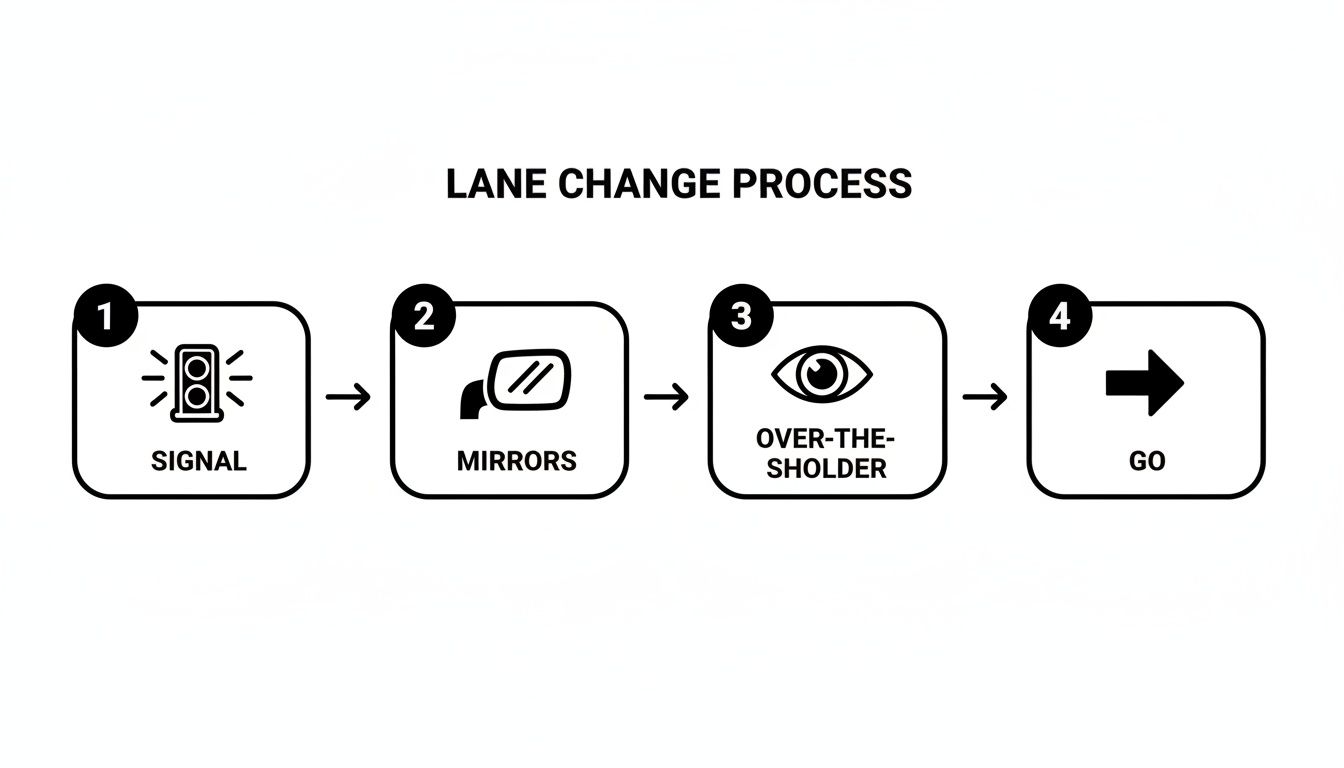
Each step flows into the next, creating a system that keeps you safe. For a deeper dive into the rules, check out our guide on https://bdischool.com/when-to-use-turn-signals/.
The Triple-Check: Scan, Verify, and Look Again
With your signal blinking, it’s time for the most important part of the entire process. This is where drivers often get into trouble by relying only on their mirrors. You need to perform a sequence of checks every single time.
- First, a quick glance at your rearview mirror. This gives you the big picture of what’s happening directly behind you.
- Next, check your side mirror. This is for the lane you want to move into. It helps you gauge the speed and distance of the cars over there.
- Finally, the head check. This is the non-negotiable step. A quick, decisive look over your shoulder into your blind spot confirms that no vehicle is lurking where your mirrors can’t see. It should be a fast turn of the head, not your whole upper body.
Expert Tip: Make it a personal rule to never hang out in another driver's blind spot. If you find yourself driving next to another car's rear door, either speed up a bit or ease off the gas to make sure they can see you. It's a simple defensive move that makes the road safer for everyone.
The Final Move: Smooth and Steady
Okay, you've signaled, you've done your triple-check, and the coast is clear. It's time to go.
The key here is smoothness. A safe lane change is a gentle glide, not a sudden jerk of the wheel. Ease your car over until you’re centered in the new lane. As you do, match the speed of the traffic you're joining. If they're going a little faster, you may need to press the accelerator slightly. If they're slower, you'll ease off.
Once you are fully and safely in the new lane, don't forget the last step: turn off your signal. A forgotten blinker is a source of major confusion for other drivers. Follow these steps every time, and you'll be making flawless lane changes without even thinking about it.
Adapting Your Lane Change for Challenging Road Conditions
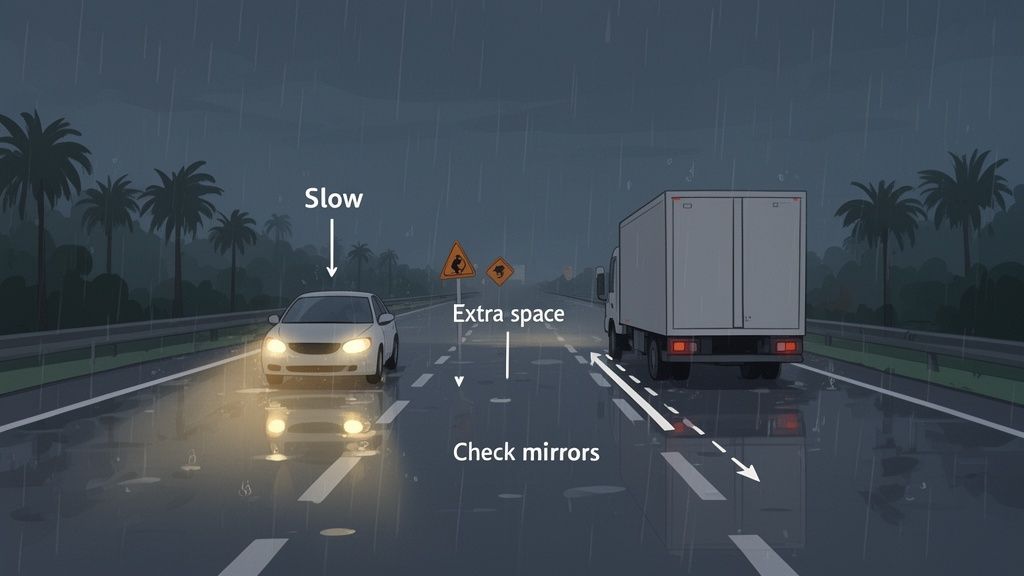
It’s one thing to change lanes on a sunny, clear day. It's another beast entirely to do it safely during a classic Florida downpour or on a clogged I-95 at night. The fundamentals don't change, but your execution has to be sharper, slower, and more deliberate.
Think of it as dialing up your defensive driving instincts. That comfortable safety cushion you normally use needs to get a lot bigger. Slower speeds, wider following distances, and more patient checks aren't just good ideas—they're what keep you safe when visibility drops and roads get slick.
Maneuvering in High-Speed Highway Traffic
On the highway, things happen fast. A gap that looked perfect a second ago can vanish in the blink of an eye. The key to a safe highway lane change is to be completely predictable to every other driver around you.
- Scan Far Ahead: Don't just watch the car directly in front. Your eyes should be scanning far down the road to anticipate slowdowns and spot potential openings well before you need them.
- Match the Flow: Get your speed up to match the traffic in the next lane before you even begin to merge. Merging too slowly is a classic mistake that forces everyone behind you to slam on their brakes.
- Respect the Big Rigs: Tractor-trailers have massive blind spots. Never, ever cut in front of one and then slow down. A good rule of thumb is to make sure you can see the truck's entire cab in your rearview mirror before you move over.
Navigating Stop-and-Go City Traffic
Changing lanes in bumper-to-bumper city traffic is an exercise in patience, not speed. The biggest risk here isn't a high-speed crash but a low-speed, high-frustration fender bender. Drivers are often distracted, impatient, and looking for any edge they can get.
Keep a sharp eye out for motorcycles or cyclists weaving between lanes—they can pop up out of nowhere. Use your signal generously, even if you’re just inching over. A slow, gentle drift into an open space is always safer than trying to force your way in.
A Sobering Reality: While the vast majority of lane changes go off without a hitch, the few that don't can cause serious chaos. Studies have shown that while 91% of lane changes are uneventful, the remaining handful are a major contributor to accidents. Keeping that statistic in mind makes you a more deliberate driver. You can read more about these driving behavior findings.
Adjusting for Florida Weather and Night Driving
Bad weather and darkness change all the rules. Rain, fog, or just the black of night can slash your visibility and reduce your car's grip on the road, making every move you make a little more treacherous.
When the skies open up, stretch your following distance to at least four to six seconds. That extra buffer is your best friend when you need to stop on wet pavement. At night, it becomes much harder to judge the speed and distance of other vehicles, so take your time and be absolutely certain before you commit to a lane change.
For a deeper dive, check out our guide to driving in adverse conditions for more detailed strategies.
Common Lane Change Mistakes and How to Correct Them
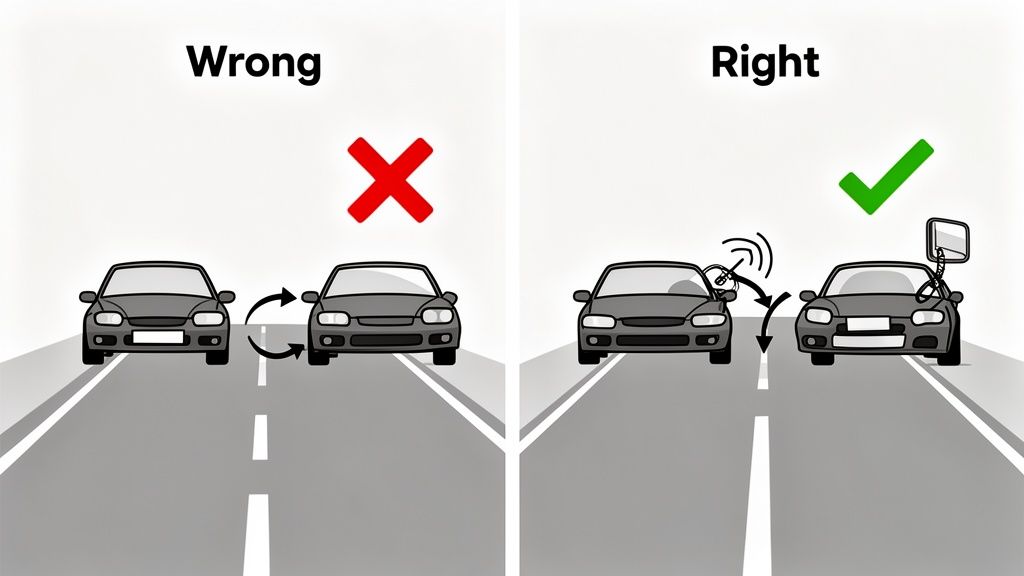
Even after years behind the wheel, it's easy to get a little complacent. We all develop habits, and sometimes, those habits aren't as safe as we think. A lane change that feels like second nature might actually be a risky move you've just been lucky with so far.
Pinpointing and fixing these common errors is one of the biggest steps you can take toward mastering how to change lanes properly. It’s all about swapping out bad habits for safer, more defensive driving techniques.
The Most Dangerous Habit: Forgetting the Blind Spot Check
If there’s one mistake that causes more collisions than any other during a lane change, this is it. Relying only on your mirrors gives you a dangerously incomplete picture of the road around you. Every single car has blind spots.
A quick shoulder check is the only way to be certain that space is truly clear. You might be surprised what’s hiding back there.
The Risk: You start moving over directly into the path of a smaller car or a motorcycle that was sitting perfectly in your blind spot. This is how terrifying sideswipe accidents happen, leaving neither driver with any time to react.
The Correction: Bake the over-the-shoulder glance into your muscle memory. It’s not a big, dramatic turn—just a quick, sharp twist of your head to see what the mirrors can't. Think of it as your final safety check before you commit: Signal, Mirrors, Glance, Go.
The Wrong Place: Changing Lanes Inside an Intersection
Intersections are already chaotic. You've got cross-traffic, cars turning, pedestrians, and cyclists all sharing a small space. Throwing an unexpected lane change into that mix is asking for trouble.
In a space where everyone is expecting predictable forward movement, swerving into another lane can easily cause a collision. While not always illegal in Florida, it can absolutely get you a "failure to maintain lane" ticket if it causes a problem.
Keep it Simple in Intersections: Your only job is to get through the intersection safely in your current lane. Do all your lane-changing well before you get there or wait until you're completely clear on the other side.
The Wrong Pace: Mismatching Your Speed
Another classic mistake is sliding into a lane while going much faster or slower than the cars already there. A smooth, safe lane change depends on blending in, not forcing others to react to you.
- Moving Too Slowly: This is a big one. When you merge into a lane going too slow, you force the car behind you to slam on their brakes, which can cause a rear-end collision. You see this all the time on highway on-ramps when drivers don't get up to speed.
- Moving Too Quickly: Shooting into a small gap at high speed is just as bad. You crowd the driver in front of you, eat up their safety cushion, and can startle them into making a mistake.
The Correction: Your goal is to match the pace of the lane you're entering before you start to move over. Sometimes this means a little acceleration; other times it means easing off the gas. You should feel like you're seamlessly joining the flow of traffic, not disrupting it.
Common Lane Change Errors and Their Solutions
We've all seen these mistakes out on the road—and maybe we've even been guilty of them ourselves. Here’s a quick breakdown of some bad habits, the dangers they create, and the simple fixes to make you a safer driver.
| The Common Mistake | The Risk You Create | The Correct Technique |
|---|---|---|
| No Turn Signal | You surprise other drivers, forcing them into last-second reactions to avoid you. | Signal for at least 100 feet before starting your maneuver to clearly communicate your intent. |
| Sudden, Jerky Movement | You create an unstable situation and reduce your own control over the vehicle. | Execute a smooth, gradual drift into the new lane over several seconds. |
| Forgetting to Cancel Signal | You confuse drivers behind you, who may slow down or hesitate, thinking you are about to move again. | Make it a habit to check and turn off your signal as soon as you are centered in the new lane. |
Breaking these habits takes conscious effort, but once the correct techniques become second nature, you'll be a more confident and predictable driver for everyone on the road.
Understanding Florida's Lane Change Laws
Knowing how to physically change lanes is one thing, but doing it legally is another ballgame entirely. Here in Florida, the rules are all about creating predictability on the road. Messing up a lane change isn't just about a potential close call—it can hit you with a pricey ticket, points on your license, and an insurance hike you definitely don't want.
At the heart of it all is Florida Statute 316.085. The language is direct: you can’t move from your lane until you're absolutely certain the move can be made safely. That puts all the responsibility squarely on your shoulders as the driver making the move.
The 100-Foot Signal Rule
This is the one that gets a lot of drivers. In Florida, you are legally required to have your turn signal on for at least the last 100 feet before you actually start changing lanes.
Let's be clear: this isn't a suggestion. A last-second flick of the lever as you’re already halfway into the next lane doesn't cut it. That 100-foot warning gives everyone around you enough time to see what you're planning and adjust. It’s the foundation of a safe, predictable lane change.
What Does 100 Feet Actually Look Like?
It's hard to visualize, right? Think of it this way: At 30 mph in the city, 100 feet is about two car lengths, and you cover it in just over two seconds. On the highway at 60 mph, you blow through that same distance in about one second. This is precisely why signaling early is so critical—it's over before you know it at higher speeds.
What Is An Unsafe Lane Change
So what does "unsafe" actually mean? While it can be a judgment call, an unsafe lane change is basically any move that forces another driver to slam on their brakes or swerve to avoid hitting you.
Common examples police look for include:
- Cutting someone off: This is the big one. You have to leave a safe following distance for the car behind you in the lane you're entering.
- Weaving through traffic: Making a series of quick, aggressive lane changes is a surefire way to get pulled over.
- Forgetting the blind spot: Moving over without that crucial head check and nearly causing a collision is an immediate red flag.
An officer has every right to write you a ticket if they see you pull a maneuver that puts others at risk. The best way to stay out of trouble is to always be deliberate, smooth, and communicate your intentions early. For a deeper dive into all the rules of the road, it’s a good idea to refresh yourself with a guide on Florida state driving laws.
Your Lane Change Questions Answered
Even when you know the basics, real-world driving throws curveballs. Let's tackle some of the most common questions drivers have about changing lanes to clear up any confusion and keep you safe on the road.
How Far Ahead Should I Signal in Florida?
Florida law is black and white on this one. According to Florida Statute 316.085, you must signal your intent continuously for at least 100 feet before you actually start to move over.
What does that look like in practice? If you're driving around town at 30 mph, you need that blinker on for a good two to three seconds before your wheels cross the line. This isn't just a suggestion; it's a critical heads-up for everyone around you, preventing the kind of last-second surprises that cause collisions.
Can I Change Lanes in an Intersection?
Technically, no specific Florida law says you can't. But in reality? It's a terrible idea and you should avoid it completely.
Intersections are already chaotic zones filled with turning cars, cross-traffic, and pedestrians. Throwing an unexpected lane change into that mix is just asking for trouble. It dramatically spikes the risk of an accident and could easily get you cited for making an unsafe move if another driver has to slam on their brakes because of you.
The Golden Rule: Get your lane change done well before you enter an intersection, or wait until you're completely through it. The middle of an intersection is the worst place to make a move.
What Should I Do If a Car Is in My Blind Spot?
You glance over your shoulder and—yep, there's a car right there. The answer is simple: abort the lane change. Your plan is on pause until that space is clear.
You have a couple of safe ways to handle this:
- Ease Up: The easiest and often safest move is to just lift your foot off the gas for a moment. Let the other car pass you, creating a new opening behind it.
- Speed Up: If the lane ahead is wide open, you can accelerate slightly to get ahead of the vehicle in your blind spot, creating a safe gap for you to merge into.
Whatever you do, don't try to squeeze in or assume the other driver will slow down for you. Patience is key. Wait until you can see the entire car in your rearview mirror before starting your safety checks all over again.
At BDISchool, we know that confident, safe driving is built on a foundation of solid knowledge. Our state-approved courses are designed to sharpen your skills and help you handle Florida's roads with certainty. Whether you're looking to dismiss a ticket or just become a more defensive driver, we're here to help. Check out our courses at https://bdischool.com.