You just got a traffic ticket, and now your mind is racing.
Do you pay it right away. Will points hit your license. Do you need court. Can traffic school fix it. Those are the questions I hear every day from Florida drivers, especially busy adults who are trying to handle the problem fast without making it worse.
The good news is that a Basic Driver Improvement course is usually a manageable process. If your situation qualifies, it gives you a practical way to respond to a non-criminal moving violation, protect your driving record, and refresh the skills that help you avoid the next ticket.
What matters most is understanding the reason behind each step. Once you know why Florida uses this process, the jargon gets a lot less intimidating.
What Is the Florida Basic Driver Improvement Course
A Florida Basic Driver Improvement course is a short, state-approved traffic safety course used after certain non-criminal moving violations.
In Florida, the BDI course is 4 hours long and is designed to teach defensive driving and traffic-law compliance after a non-criminal moving violation, as explained by Driver Educators’ overview of the 4-hour BDI course. That matters because this isn’t a full driver training program for someone learning from scratch. It’s a focused refresher meant to correct a problem while it’s still small.
What the course is really for
Most drivers hear “traffic school” and assume punishment. That’s not the best way to think about it.
A BDI course works more like an intervention. You got cited for something that needs correction, and the state gives eligible drivers a structured way to address it quickly. The course focuses on habits that commonly lead to tickets, such as inattention, poor judgment at intersections, unsafe following, or misunderstanding right-of-way.
If you’d like a plain-English comparison, this quick guide on what traffic school means in practice can help separate the common terms people mix together.
Practical rule: BDI isn’t meant to turn you into a brand-new driver. It’s meant to help you make better choices the next time you’re in the same road situation.
Why Florida keeps it short
The 4-hour format is important. It tells you the state wants a fast, targeted response, not weeks of retraining.
That short format also makes the course easier for working adults, parents, and drivers with packed schedules. You can deal with the citation, complete the educational requirement, and move on with a stronger understanding of how to avoid a repeat issue.
When drivers usually take it
Drivers usually encounter the BDI course in one of these situations:
- After an eligible moving violation: They want to handle the ticket in a way that may help protect their record.
- Because the court requires it: Some violations trigger a judge’s order to complete a driver improvement course.
- For insurance-related reasons: Some drivers take an approved course for policy-related purposes.
The key point is simple. A Florida basic driver improvement course is a tool. If you understand how to use it, the ticket becomes a problem you can manage, not a mystery hanging over your head.
Are You Eligible to Take the BDI Course
Eligibility is where many drivers get tripped up.
They assume that if a course exists, they can automatically sign up and have the ticket handled. That’s not how regulated driver-improvement programs work. These programs are controlled by state rules, which means the type of violation, the timing, and your license status all matter.
Start with the type of ticket
In plain terms, the BDI course is generally connected to non-criminal moving violations.
If your case is more serious, or if the court gives you specific instructions, don’t guess. Read the citation carefully and check what the clerk or court notice states. A driver can waste time and money by enrolling first and verifying later.
One useful overview of the possible paths after a citation is this page on Florida traffic ticket options.
Why deadlines and conditions matter
A good way to understand Florida’s logic is to look at how another state structures a similar program. Michigan’s BDIC model allows only certain in-state, non-criminal violations, requires a valid non-commercial Michigan license, requires enrollment within a 60-day window after state notice, requires a minimum of 4 hours of instruction, and requires a passing written exam before completion is reported, according to the Michigan Secretary of State BDIC requirements.
Florida’s process has its own rules, but the lesson is the same. These courses are not generic classes. They are regulatory tools with conditions attached.
Miss the required window, choose the wrong course type, or misunderstand your court instructions, and you can lose the benefit you were counting on.
A quick self-check
Ask yourself these questions before you enroll:
- Was the ticket for a non-criminal moving violation: If not, the standard BDI path may not fit.
- Did the court or clerk give you a deadline: If yes, treat that date as your anchor for every next step.
- Are you trying to elect the course yourself, or were you ordered to take it: Those are different situations.
- Are you using the course for points, court compliance, or insurance: The purpose affects what kind of provider and reporting you need.
The confusion most drivers have
Many people use the terms “traffic school,” “defensive driving,” and “BDI” as if they all mean the same thing.
Sometimes they overlap in casual conversation. Legally and administratively, they may not. That’s why I always tell students to match the course to the reason they’re taking it. The court cares about the exact requirement, not the nickname people use for it.
If you’re unsure, slow down and verify first. That one habit prevents most enrollment mistakes.
The Triple Benefits of BDI Course Completion
When a driver asks me whether taking the course is worth it, I tell them to look at the three practical payoffs.
For the right situation, a BDI course can help with your record, your court obligations, and your overall driving future. It’s not just about getting through a requirement. It’s about choosing the option that creates the least long-term friction.
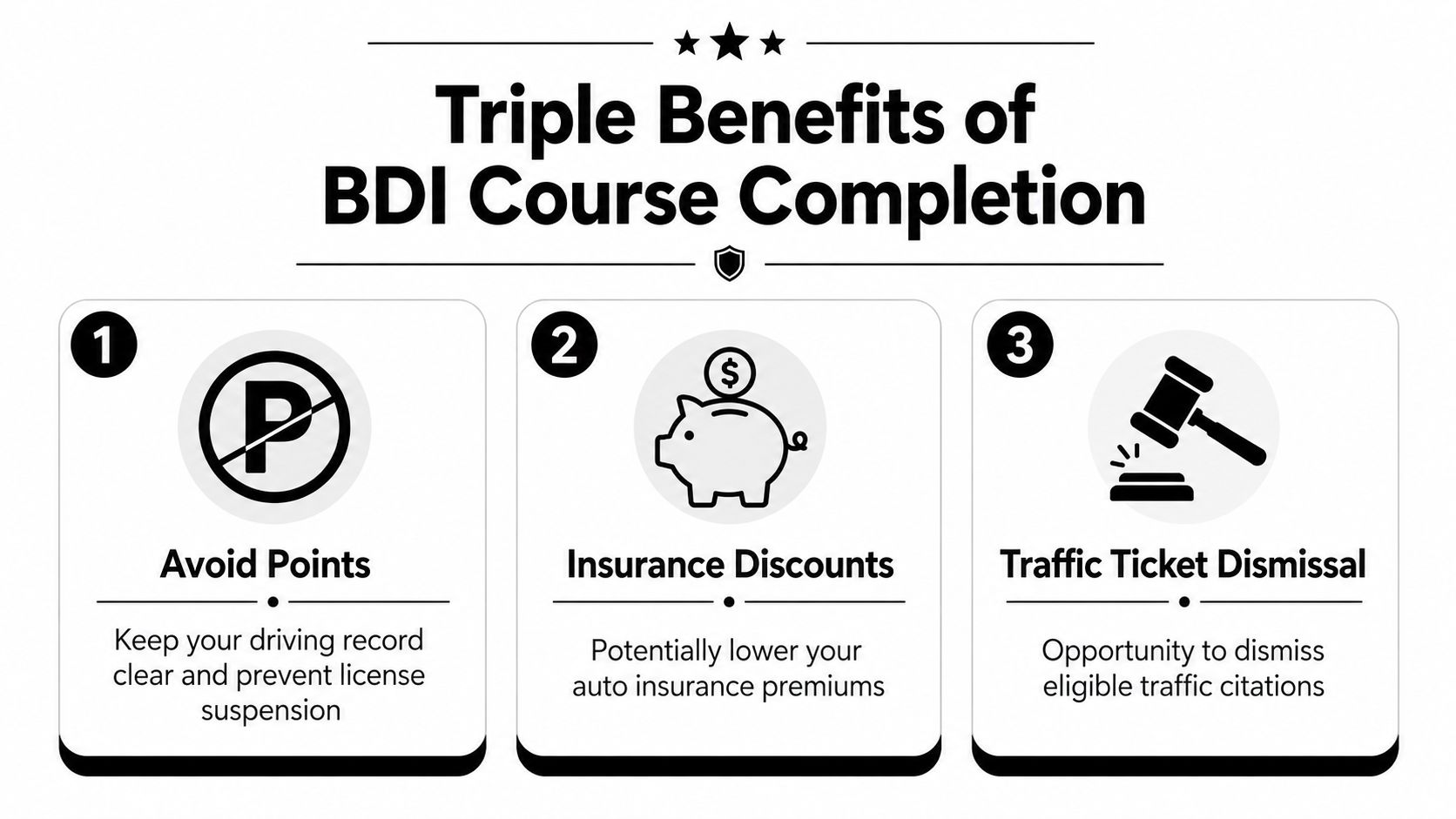
Benefit one is record protection
In Florida, successful completion can prevent points from being added for one violation and may qualify the driver for an 18% civil penalty reduction, according to Florida traffic school guidance.
That first part is usually what gets people’s attention. Points can affect how clean your record looks and can create bigger headaches if more violations happen later. Avoiding points on an eligible citation is often the most immediate benefit.
Benefit two is court compliance
Sometimes the course isn’t optional in the practical sense. A court may require driver improvement as part of resolving the case.
When that happens, the benefit isn’t just educational. It’s procedural. Completing the right course shows that you followed the instruction given in your case, which helps close the loop properly.
Here is the fast summary many drivers need:
| Reason for Taking Course | Primary Benefit | Key Consideration |
|---|---|---|
| Electing after an eligible ticket | May prevent points from being added for one violation | You must follow the court or clerk process correctly |
| Court-ordered requirement | Helps satisfy the court’s instruction | The exact course type matters |
| Insurance-related purpose | May support insurance-related goals | Ask your insurer what they accept |
For a fuller explanation of the record-related side, this page on how drivers try to remove points from a license is a helpful companion.
Benefit three is a skills reset
The course also gives you a chance to reset how you drive.
That may sound less urgent than points or court paperwork, but it’s the part that can matter most over time. A ticket often comes from a pattern. Maybe you’re rushing through yellow lights, missing signs because you’re distracted, or making rolling assumptions in heavy traffic. The course puts those habits back under the microscope.
A BDI course helps most when you treat it as a correction, not just a checkbox.
Enrolling in Your BDI Course A Step-by-Step Guide
Enrollment feels complicated when you’re staring at the ticket for the first time. In practice, it’s a sequence. Handle each part in order, and the process becomes much easier.
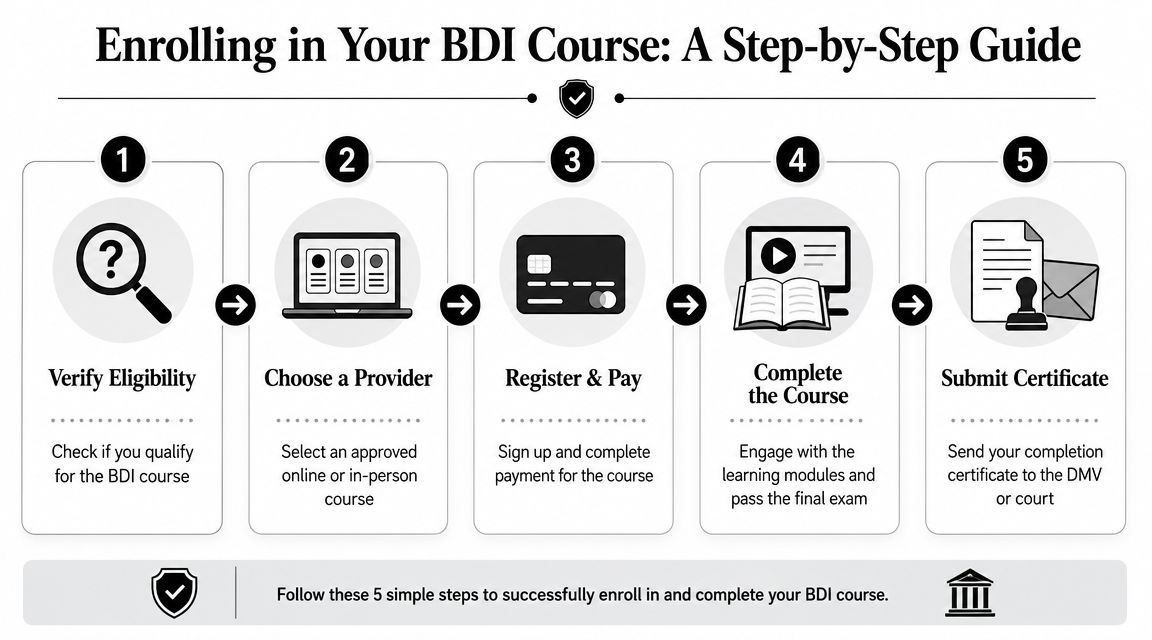
Step one is confirming what your ticket requires
Before you register anywhere, read the citation and any court instructions carefully.
You need to know whether you’re electing a course for an eligible ticket, complying with a court order, or taking it for another reason. That “why” determines the rest of your decisions. If the clerk must be notified, do that first according to the instructions on your case.
Step two is choosing an approved provider
In this context, many drivers move too fast.
Florida’s Safety Council states that the 4-hour BDI is offered online or in a classroom, and that in the classroom version no test is required, while rules in other states can be stricter. The same source notes that format rules differ sharply, so provider approval matters, especially for busy adults and non-native speakers who may need self-paced access or language support. You can review that on the Florida Safety Council Basic Driver Improvement page.
If you’re comparing schools, look for practical details:
- Approval status: Make sure the course is accepted for your Florida purpose.
- Format that fits your life: Online can be easier if you work irregular hours.
- Language support: English, Spanish, or Portuguese options can reduce mistakes.
- Reporting process: Know how proof of completion gets where it needs to go.
One online option to review is Florida-approved online traffic school, which explains the approval and enrollment process in plain language.
Step three is registering with accurate information
Use the same identifying details that appear on your ticket and license records.
A simple typo can create avoidable delays later. That’s especially important when course completion has to be matched to a court file or state record.
Step four is completing the course in the right format
Most adults prefer an online, self-paced setup because it lets them study around work, childcare, or travel.
If you’re curious how another state frames the broader value of this kind of education, this overview of Georgia defensive driving benefits is a useful comparison. The rules aren’t the same as Florida’s, but the underlying idea is similar. Drivers use these courses not only to satisfy a requirement, but also to sharpen judgment and reduce repeat mistakes.
Step five is making sure completion is reported properly
Finishing the lessons isn’t always the final administrative step.
Depending on your situation, you may need the completion reported to the proper agency or court. Don’t assume that “I passed the course” automatically means “my ticket is fully resolved.” Verify how reporting works before you start, not after.
What You Will Learn in a Florida BDI Course
Most students expect a lecture on rules. What they usually find is something more useful.
A Florida basic driver improvement course takes common driving mistakes and puts them into everyday situations. Instead of abstract legal language, the material tends to focus on moments drivers recognize from their commute, school pickup, or weekend errands.
The lesson behind a simple stop sign
Take a driver who gets cited after rolling through a neighborhood stop sign.
On the surface, that sounds like one mistake. In class, we break it down further. Was the driver distracted. Did they misjudge cross traffic. Were they used to an empty intersection and stopped scanning fully. That kind of analysis helps the student understand the behavior that created the violation.
Defensive driving in real life
A strong BDI curriculum usually covers practical topics like these:
- Safe following distance: Enough space gives you time to react instead of braking late.
- Right-of-way decisions: Many crashes and citations happen because one driver assumes instead of confirming.
- Distracted driving risks: Looking away for a moment can create a chain of bad decisions.
- Aggressive driving habits: Speeding up to “make it through” often leads to tickets and close calls.
- Florida traffic law refreshers: Rules are easier to follow when you understand why they exist.
Many tickets happen during ordinary trips, not dramatic emergencies. The safest drivers learn to notice the routine moments where attention slips.
Why the content matters after the ticket is gone
The value of the course isn’t only that it helps you deal with a citation.
It can also rebuild confidence. Drivers who feel embarrassed or frustrated after a ticket often calm down once they see that safe driving is a series of repeatable habits. Good scanning, better spacing, slower decisions at busy intersections, and fewer assumptions can make a huge difference in day-to-day driving.
That is why I encourage students to think beyond completion. If one concept from the course changes how you approach traffic lights, lane changes, or school zones, you’ve already gotten something important from the class.
Your Next Steps After Course Completion
Once you finish the course, don’t go on autopilot. Completion is important, but confirmation is what gives you peace of mind.
First, make sure your completion record goes where it needs to go. Some providers handle reporting electronically, while some situations may still require you to confirm with the clerk or court that everything has been received and processed correctly.
What to check after you finish
Use a short follow-up routine:
- Confirm reporting: Ask how the completion was sent and when it should appear.
- Check your case status: If your ticket involved court or clerk processing, verify the record was updated.
- Save your proof: Keep your certificate or confirmation email in case you need it later.
For drivers dealing with broader license problems, not just a single ticket, it can help to compare approaches in other states. This guide on Bryan Fagan suspended license advice offers a useful example of how reinstatement issues can require separate steps beyond course completion.
The bigger lesson after the paperwork
Most drivers feel relief once the course is done. That’s normal.
But the smartest next move is to treat the class as a reset point. If the course highlighted a pattern in your driving, such as rushing, distraction, or poor lane discipline, use that insight now while it’s still fresh. That is how a ticket turns into a lasting improvement instead of a temporary interruption.
Florida BDI Course Frequently Asked Questions
Do I have to complete the course all at once
Usually, many online courses are designed to be more flexible than a classroom schedule. The exact pacing depends on the provider and format, so check those details before you enroll.
Is the BDI course available in languages other than English
Some providers offer courses in English, Spanish, and Portuguese. If language access matters for you or a family member, confirm it before registering so you don’t end up in the wrong course.
Is online always the same as easy
Not always.
A course being online doesn’t automatically tell you whether there’s a test, how reporting works, or whether the format is accepted for your reason for taking it. Always verify approval, format, and completion handling first.
What happens if I wait too long to deal with the ticket
Deadlines matter. If you miss an election or completion deadline tied to your case, you may lose the option you were planning to use.
If you’re unsure about your deadline, contact the clerk or court listed on your ticket right away. Don’t rely on memory or assumptions.
How do I know I picked the right course
Match the course to your purpose.
If you’re taking it for an eligible ticket, make sure it is the correct Florida Basic Driver Improvement course. If you’re court-ordered, make sure the course satisfies that exact order. If you’re taking a class for insurance-related reasons, ask your insurer what they accept.
What if I’m nervous about taking the course
That’s common, especially for first-time students.
The material is meant to be understandable. Most drivers do fine once they slow down, read carefully, and focus on the practical driving situations the course is built around.
If you’re ready to handle your citation calmly and correctly, BDISchool offers Florida traffic school information and course options that can help you understand the process, choose the right class, and move forward with more confidence.