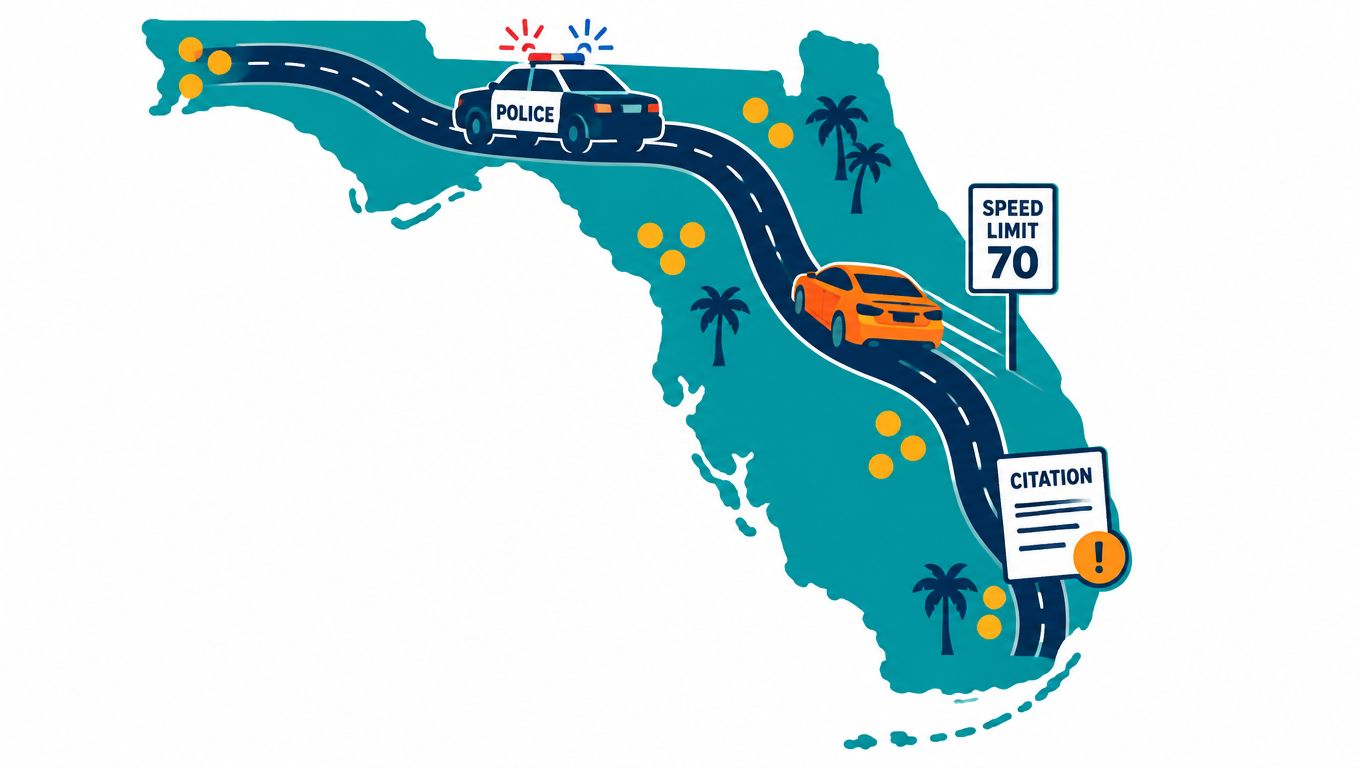
You saw the lights, pulled over, and now you’ve got that ticket sitting on your passenger seat or kitchen counter. Your first thought is usually the same: how bad is this, and what do I do next?
Take a breath. A first time speeding ticket in Florida is stressful, but it’s usually manageable if you act quickly and choose your option carefully. The mistake most drivers make is treating the ticket like a small fine and paying it immediately. That feels efficient. It often isn’t.
That Sinking Feeling Your First Florida Speeding Ticket
One minute you’re driving home from work, thinking about dinner or your next meeting. The next minute, blue lights flash in your mirror, your stomach drops, and you’re trying to remember exactly how fast you were going.
That reaction is normal. A first ticket feels personal, expensive, and confusing all at once.

What matters now is not panic. What matters is the next decision you make.
The ticket itself may not look devastating at first. But the numbers add up fast. The average cost of a speeding ticket in the United States is $150, but the true expense comes later. After a first-time speeding ticket, car insurance premiums can increase by a national average of 24%, potentially costing you hundreds of dollars each year at renewal, according to Direct Auto’s first-ticket overview.
Why paying fast is often the wrong move
A lot of first-time drivers think, “I’ll just pay it and move on.”
That sounds simple. In Florida, it can be the most expensive shortcut you take all year. Paying the fine usually means admitting the violation, accepting the record impact, and opening the door to insurance consequences.
Practical rule: Don’t treat a speeding ticket like a parking ticket. It affects your driving record, not just your wallet.
What actually matters in the next month
You don’t need to become a lawyer overnight. You do need to be organized.
Focus on these three things right away:
- Check the deadline: Florida tickets generally require action within 30 days.
- Figure out the county: Your response goes through the county listed on the citation.
- Avoid a rushed payment: Fast isn’t always smart.
You’re not trying to “win” an argument with the officer after the fact. You’re trying to protect your record and avoid turning one bad moment into a longer, more expensive problem.
How to Read and Understand Your Citation
That paper in your hand is a legal document. Read it that way.
If you miss a key detail, especially the deadline, you can create a bigger problem than the original ticket. Florida drivers get in trouble all the time because they focus on the fine amount and ignore the rest.
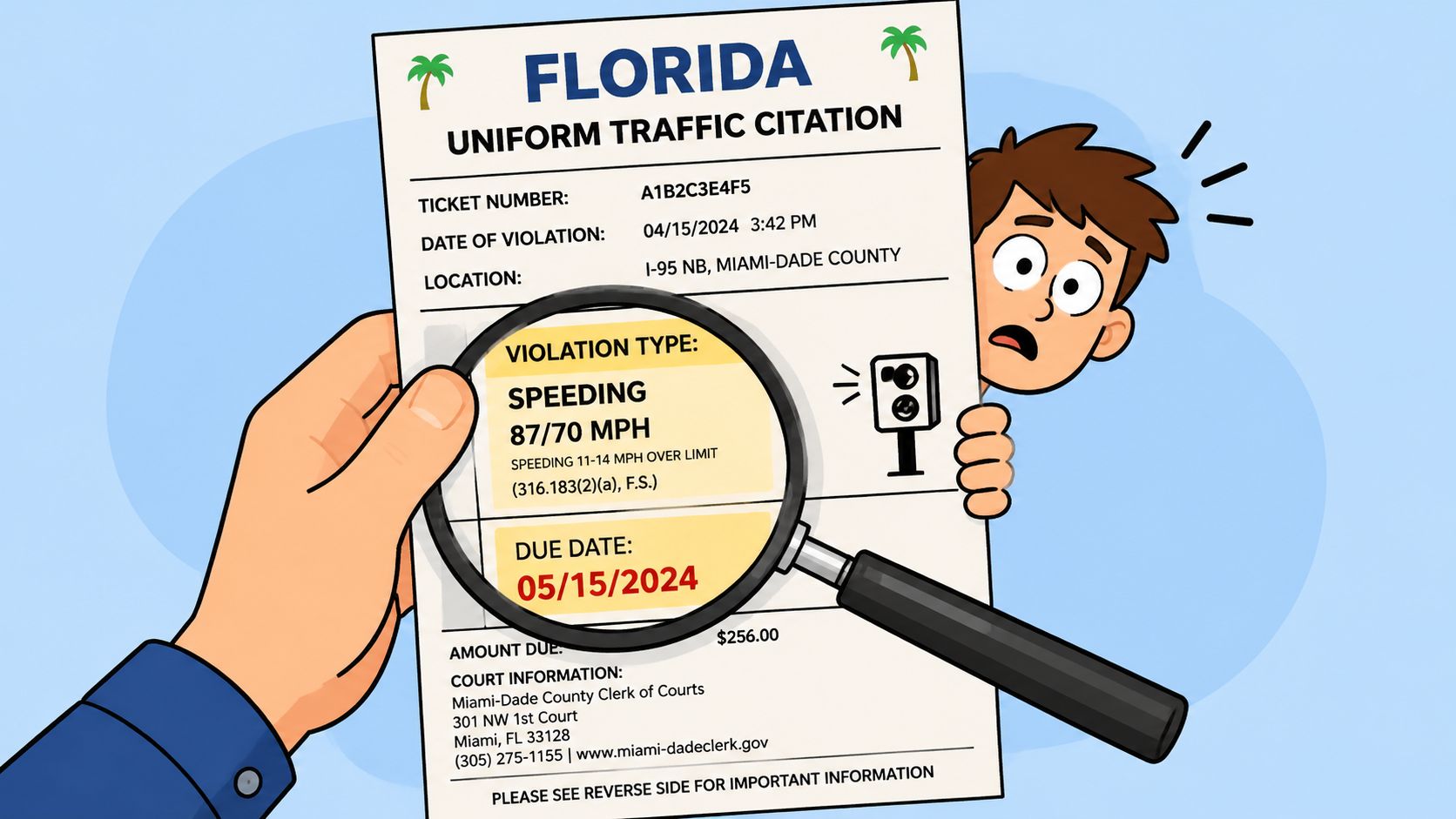
Start with the top half
Look for the basic identifiers first. These are the details you’ll need if you call the clerk, check your case status, or elect traffic school.
Find these items:
Citation number
This is the tracking number for the ticket. If you’re not sure where to find it, this guide on what a citation number means on a Florida ticket shows you what to look for.County of violation
This tells you which clerk’s office handles your case.Date issued
That helps you track your response window.
Then read the charge itself
The important line is the violation description. It should tell you the offense and often the speed involved.
You don’t need to decode every abbreviation perfectly, but you do need to know whether you’re dealing with ordinary speeding or something more serious. If the speed is very high, treat the ticket more carefully and don’t assume every standard option applies.
Your first job is accuracy. Read every line before you choose any response.
Find the action deadline
This is the part people skip, and it’s the part that causes avoidable damage.
Florida drivers generally need to respond within 30 days. That response could be paying the fine, electing a course, or taking another permitted action through the court. If you wait too long, you risk extra penalties and administrative trouble.
Use this quick review:
- Verify your name and license details: Errors should be addressed early.
- Confirm the violation description: Know exactly what you were cited for.
- Mark the deadline on your calendar: Don’t rely on memory.
- Save a photo or scan: Keep a clean copy before mailing or uploading anything.
Once you understand the citation, the stress usually drops. It stops being a mystery and becomes a decision.
Your Three Options and Their Real Costs
Florida usually gives you three paths after a first speeding ticket. They are not equal.
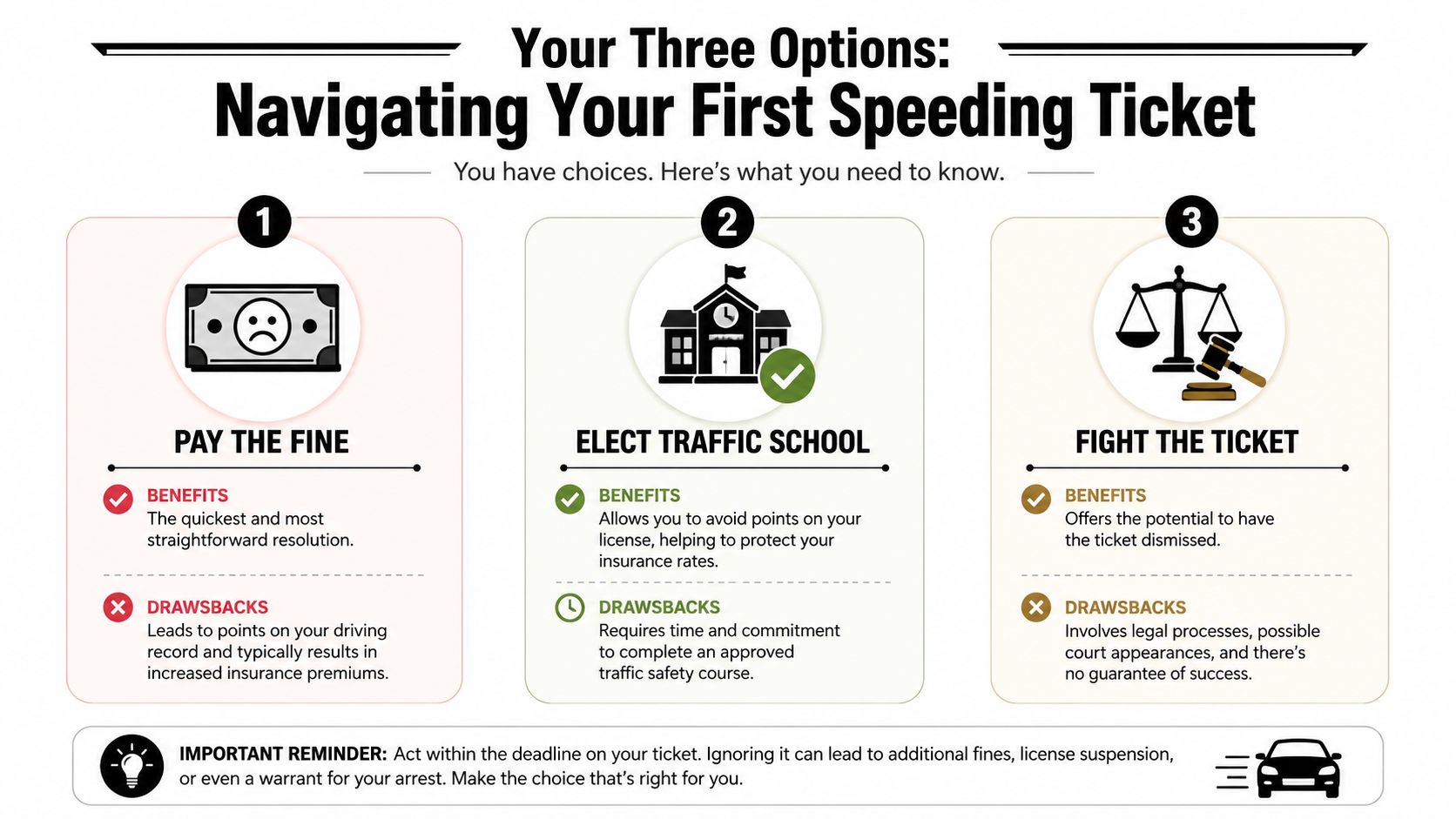
For a plain-English breakdown of fine ranges before you decide, this page on how much a speeding ticket can cost in Florida is useful. It helps you look beyond the amount printed on the citation.
Florida’s standard choices are straightforward on paper. You generally have three options for a first-time speeding ticket: pay the fine (admitting guilt and getting points), plead “no contest” in court, or elect Basic Driver Improvement (BDI) traffic school to have the points dismissed. For severe cases like speeding 30+ mph over, a new law makes it a criminal offense, and traffic school may not be an option, as explained in this Florida first-time high-speed case summary.
Florida Speeding Ticket Options Compared
| Outcome | Pay the Fine (Guilty) | Fight in Court | Elect Traffic School (BDI) |
|---|---|---|---|
| Speed | Fastest upfront | Slowest and least predictable | Usually straightforward |
| Record impact | You accept the violation | Depends on outcome | Built to avoid points in eligible cases |
| Insurance risk | Usually the highest concern | Still uncertain until resolved | Often the safer route for record protection |
| Time required | Minimal now, possible long-term cost later | Court process, paperwork, waiting | Course time, but on your schedule |
| Best fit | Rarely smart for a first ticket | Situations with a real defense or unusual facts | Most eligible first-time drivers |
Option one is easy, not smart
Paying the fine ends the immediate annoyance. It does not protect you.
You’re choosing convenience over strategy. For a first offender who wants to keep a clean-looking record and reduce future costs, that’s usually the wrong trade.
Option two can make sense, but don’t romanticize it
Fighting the ticket sounds appealing because nobody likes admitting fault. But court takes time, and the outcome isn’t guaranteed.
If your facts are unusual, or the speed allegation is severe, a court strategy may be necessary. High-speed cases deserve more caution if you were cited at 30+ mph over.
Option three is usually the practical move
If your case is eligible, electing traffic school is usually the cleanest path. You spend a little time now to avoid a much more annoying problem later.
If your goal is to protect your driving record, traffic school usually beats a guilty plea and avoids the uncertainty of court.
That’s the key point. A first time speeding ticket is rarely just about this month’s fine. It’s about whether you let one citation follow you into your insurance renewal.
Electing Traffic School The Smartest Move
If you’re eligible, this is the move I’d make in most ordinary first-ticket cases.
The reason is simple. In Florida, a speeding violation under 15 MPH over the limit adds 3 points to your record. These points can be removed by completing a state-approved 4-hour Basic Driver Improvement (BDI) course, an option you can use once every 12 months and up to five times in your lifetime.
How to elect traffic school
The process is not complicated, but you do need to do it correctly.
- Contact the clerk in the county on your ticket: That’s where you make your election.
- Tell them you want the course option: Don’t assume it happens automatically.
- Pay any required court or administrative amount: The court still needs its part handled.
- Complete the course on time: Missing the completion deadline defeats the point.
Why timing matters
Traffic school is a limited tool in Florida. You can’t use it endlessly, and that’s exactly why you should use it intentionally.
For a standard first ticket, electing the course is often the most orderly way to avoid points. It’s a controlled solution. You know what you need to do, and you can finish it on your own schedule instead of gambling on what happens in court.
For drivers who want a fully online option, Florida-approved online traffic school explains how the course process works. One available option is BDISchool’s 4-hour Basic Driver Improvement course, which is state-approved, self-paced, available in English, Spanish, and Portuguese, and can be completed from your phone, tablet, or computer.
A simple decision rule
Use this rule of thumb:
- Ordinary first speeding ticket: Elect traffic school if you’re eligible.
- Very high speed allegation: Slow down and get legal guidance before assuming the course applies.
- Missed deadline risk: Act with the clerk immediately. Delay is what creates messy outcomes.
Choose the option that protects your record first. Convenience should come second.
That’s the value of traffic school. It turns a reactive moment into a planned response.
Protecting Your Driving Record and Insurance Premiums
The course isn’t just about checking a box for the court. It’s about avoiding a longer financial headache.
Insurance companies look at your driving history when they price risk. A clean record helps. A record with points can cost you for years. This overview of Florida driver license points is worth reading if you want the plain version of how that chain reaction works.
The cost that sticks around
Here’s the part drivers regret after they’ve already paid the ticket. Drivers with points on their Florida record often see insurance premium increases between 15% and 30% at renewal. Some insurers may charge up to 50% more, and these higher rates can persist for the full 3-year period that points are visible to them.
That’s why I don’t look at a speeding ticket as a one-time cost. I look at it as a trigger.
Think like an insurer, not a stressed driver
A stressed driver asks, “What’s the fastest way to get rid of this?”
A smart driver asks, “What leaves the least damage behind?”
Those are different questions. Traffic school usually wins because it’s aimed at controlling the part that keeps costing money later.
If you’re reviewing your coverage while dealing with a citation, this overview of personal car insurance can help you think through policy basics and renewal issues in practical terms.
Why the math usually favors the course
You pay once for the course and move on.
You don’t keep paying a course fee every renewal cycle. Insurance increases, on the other hand, can keep showing up again and again while the violation remains relevant to the carrier.
- Short-term view: Paying the fine feels easier.
- Long-term view: Protecting the record is usually cheaper.
- Real-world result: The “easy” choice often becomes the expensive one.
That’s why I’m opinionated about this. For an eligible first time speeding ticket in Florida, treating traffic school as an investment is the more mature move.
Frequently Asked Questions About Your First Ticket
What if I miss the 30-day deadline
Don’t ignore it and hope it fixes itself. Contact the clerk in the county listed on the citation immediately.
Missing the deadline can create additional problems, including license issues and extra administrative trouble. The faster you address it, the better your chance of limiting the damage.
How does the court know I completed traffic school
The course provider handles reporting under the state process. You should still keep your confirmation and completion records until everything shows correctly.
If you complete the course, don’t assume all systems update instantly. Save your paperwork and verify that the result is reflected properly.
Keep every receipt, confirmation email, and completion notice until your case is fully closed.
Is the process different if I was going much faster than the limit
Yes, it can be.
A routine first ticket is one thing. A very high-speed citation is another. If the allegation is severe, don’t casually click “pay” or assume a course election will solve it. High-speed cases can carry different consequences and deserve closer review.
Can I get an extension
Sometimes the clerk may have procedures for extensions or deadline questions. Ask early, not after the deadline passes.
Be specific when you call. Have your citation number, county, and issue date ready.
Should I hire a lawyer for a first ticket
Sometimes yes. Usually only when the facts are more serious, the speed is unusually high, or there’s a complication you don’t understand.
For a standard first time speeding ticket, traffic school is often the cleaner route. For a more serious citation, legal advice may be the safer move.
Will traffic school erase the fact that I was stopped
It addresses the ticket outcome. It doesn’t erase reality.
What most drivers care about is practical protection. They want to avoid points, reduce insurance fallout, and keep the matter from growing legs. That’s exactly why the course option matters.
Is online traffic school harder than in-person class
No. For busy adults, online is usually easier because you can work through it on your own time.
That matters if you’re juggling work, family, or travel. A flexible format makes it much more likely you’ll finish on time.
What’s the smartest move for most first offenders
If the ticket is an ordinary speeding case and you’re eligible, elect traffic school promptly and complete it without delay.
That’s the calm, boring, financially sensible answer. And boring is good when you’re dealing with traffic court.
If you’re ready to handle this the sensible way, BDISchool offers Florida-approved online traffic school courses that fit around real life. Register, complete the course on your schedule, and deal with your first ticket before it becomes a bigger insurance problem.