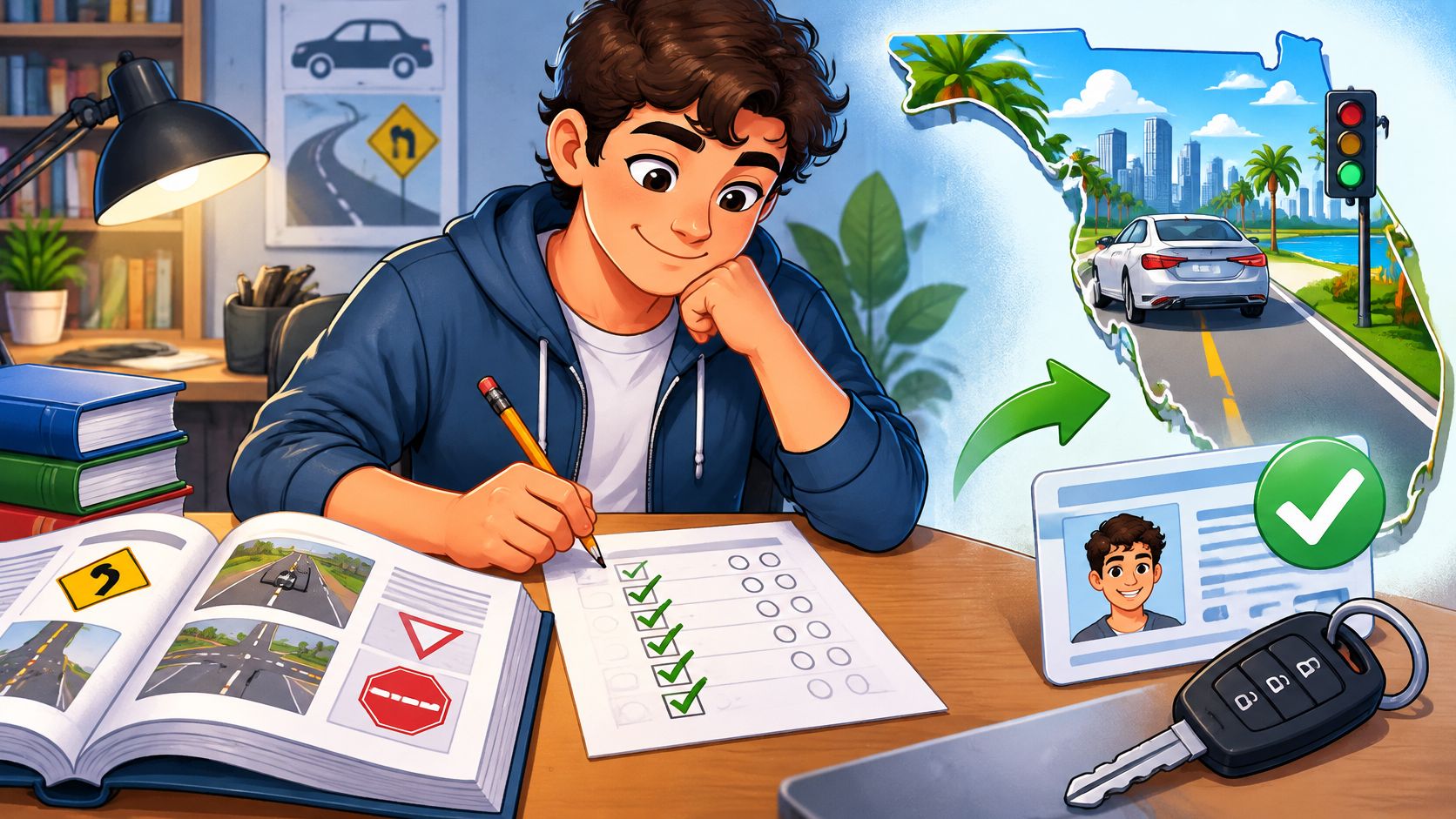
The Florida TLSAE drug and alcohol course is a 4-hour class that teaches how alcohol and drugs affect driving, plus the Florida traffic laws every new driver needs to know. TLSAE stands for Traffic Law and Substance Abuse Education. This guide walks through seven topics you can expect to study.
Most people take it as a licensing step. In a few cases, a court or the state may require it instead. Because every situation differs, always confirm your requirement with the court or the Florida Department of Highway Safety and Motor Vehicles (FLHSMV).
DriverEducators
Key Takeaways
- The Florida TLSAE drug and alcohol course is a 4-hour class for first-time drivers age 18 and older, while drivers under 18 take DETS (Driver Education Traffic Safety) instead.
- Alcohol is not the only concern: prescription drugs, over-the-counter medicine, and marijuana can also impair driving.
- Florida’s zero-tolerance rule suspends the license of a driver under 21 with a blood alcohol level of .02 or more.
- In some cases, a court or the state may require the course, so confirm your requirement with your court or FLHSMV.
- Your provider reports completion electronically to FLHSMV, which does not accept paper certificates for licensing.
Table of Contents
- Who has to take the Florida TLSAE drug and alcohol course?
- 1. How does alcohol affect your driving?
- 2. How do drugs and medicines change your ability to drive?
- 3. Why is mixing substances so risky?
- 4. What are Florida’s DUI laws and penalties?
- 5. What is Florida’s zero-tolerance rule for drivers under 21?
- 6. Which Florida traffic laws does the TLSAE course teach?
- 7. How does the course tie into your license steps and court orders?
- How can you get the most from the course?
- Our Perspective
- FAQ
- Sources
Who has to take the Florida TLSAE drug and alcohol course?
Drivers age 18 or older who have never held a driver license anywhere must complete a 4-hour TLSAE course before applying for a Florida license. Some county school board DELAP classes can substitute for it. Drivers under 18 take a different class, called DETS.
FLHSMV explains that drivers over 18 who have never held a license in any state or country must finish the course first. The same page says that Driver Education Licensing Assistance Program (DELAP) courses from some county school boards may substitute for it.
Teens should read our guide to the DETS course in Florida for the under-18 path. For a broader look at the adult requirement, see What Is a TLSAE Course in Florida?
The seven topics below show what the course teaches and why each one matters on the road.
1. How does alcohol affect your driving?
Alcohol slows your reaction time, weakens concentration, and makes it harder to judge distance and speed. These effects begin before a driver feels drunk. The course teaches you to spot these effects and to plan a sober ride before you take the first drink.
FLHSMV lists five signs of impairment from alcohol and drugs. According to the agency, drivers can have slow reaction time, limited short-term memory, decreased hand-eye coordination, weakened concentration, and trouble perceiving time and distance.
Why it matters: Impaired drivers often cannot judge their own condition. A plan made in advance, such as a designated driver or a ride service, removes the decision from a moment when judgment is already weak.
2. How do drugs and medicines change your ability to drive?
Illegal drugs, marijuana, prescription medicine, and over-the-counter products can all impair driving. Some cause drowsiness, dizziness, or blurred vision. The course explains that a drug being legal or prescribed does not make it safe to drive on, so you learn to read labels and ask a pharmacist.
NHTSA states that many substances can impair driving, including alcohol, some over-the-counter and prescription drugs, and illegal drugs. The CDC adds that cannabis can slow reaction time and decision making, impair coordination, and distort perception.
Why it matters: Many new drivers think “impaired driving” only means alcohol. A cold medicine or a sleep aid can also affect you. NHTSA advises that if you have taken an impairing substance such as prescription drugs, sleep medication, or marijuana, you should not drive.
3. Why is mixing substances so risky?
Combining alcohol with drugs, or two drugs together, can multiply impairment instead of simply adding it up. A medicine that is fine alone may become unsafe with a drink. The course teaches you to treat every combination as a reason not to drive.
NHTSA notes that using two or more drugs at the same time, including alcohol, can amplify the impairing effects of each drug. Its medication guidance also says that some medications may not impair you alone, but may cause impairment with a second medication or alcohol.
Why it matters: This topic changes everyday habits. Before you drive, you check what you took, not just how you feel.
4. What are Florida’s DUI laws and penalties?
In Florida, driving under the influence (DUI) is one offense whether it involves alcohol, chemical substances, or controlled substances. Police can prove it by impairment or by a blood or breath alcohol level of .08 or higher. The course covers these laws so you know the stakes.
The state explains that DUI is proved by impaired normal faculties or an unlawful alcohol level of .08 or above, and penalties are the same either way. FLHSMV also describes the implied consent law, noting that refusing a breath, urine, or blood test can be used as evidence in DUI criminal proceedings. Refusal also carries its own license suspension.
For a fuller look at the legal side, read What Is Impaired Driving? This article only describes the official rules and does not replace legal advice.
Why it matters: A single decision can affect your license, your finances, and your future. Knowing the rules before you are ever stopped is the safest approach.
5. What is Florida’s zero-tolerance rule for drivers under 21?
Florida suspends the license of a driver under 21 who has a blood alcohol level of .02 or higher. A first offense brings a six-month suspension, and a second brings one year. The course explains this rule because many new drivers are under 21.
FLHSMV’s teen page confirms that drivers under 21 with a blood alcohol level of .02% or more will have their license immediately suspended for six months. The agency also says that the TLSAE course is also required to reinstate a license for someone under 21 who gets a suspension notice for a level of .02 to .05.
That is one case where a state process, not a first license, leads to the course. Anyone in that position should confirm the exact steps with FLHSMV. Teens can also read What Every Teen Should Know About Impaired Driving.
Why it matters: The limit is very low. For a driver under 21, the safest choice is no alcohol at all.

6. Which Florida traffic laws does the TLSAE course teach?
The course reviews core Florida traffic rules, such as right-of-way, traffic signals, school bus and school zone laws, seat belts, and open container rules. These are the same rules that appear on the license knowledge exam. Learning them helps you drive safely, not just pass a test.
Two examples show the stakes. First, Florida increased school bus penalties. FLHSMV reports that passing a stopped school bus on the side where children enter and exit carries a $400 minimum fine and a mandatory court hearing. Second, open containers matter even if the driver has not been drinking. According to the state, drivers with an open container face a moving violation, a fine, and possible points.
The Florida Class E knowledge exam itself follows the TLSAE requirement for first-time applicants. For related reading, see our guides on what a yellow light means and Florida cell phone driving laws.
Why it matters: Traffic laws exist because small mistakes add up. Knowing them makes you a more predictable driver, and predictable drivers are safer.
7. How does the course tie into your license steps and court orders?
The course is a required step before a first Florida license, and in some cases a court or the state may require it. Your provider reports completion to FLHSMV electronically. If a court ordered the class, you must also notify the court and give it the needed documents.
FLHSMV states that providers electronically report completions and the state does not accept paper certificates for any licensing purpose. It also says that drivers ordered by a court to attend must notify the court once they finish and provide the necessary documentation. The agency asks drivers to allow 24 to 72 hours for completions to post.
Because court orders vary, confirm the exact course name, deadline, and proof with your court clerk. Our guide to satisfying a court-ordered driving course explains the general process. We cannot tell you what a judge will decide.
DriverEducators.com offers Florida TLSAE as a 4-hour course for qualifying applicants 18 and older. It is online, self-paced, mobile-friendly, and offered in English, Spanish, and Portuguese. Check the Florida TLSAE course page for refund details.
Why it matters: Finishing the class is only part of the job. Making sure the right agency receives your completion keeps your license or court deadline on track.
How can you get the most from the course?
Study in short sessions, take notes on the laws that surprise you, and apply them to your own habits. For example, decide now how you will get home if a friend has been drinking. Online courses let you pause and return, which helps retention.
Course length is set by state law, so no legitimate course can promise a faster finish. For more detail on what to expect, see the TLSAE Florida overview.
Our Perspective
We see the TLSAE course as more than a box to check. The goal is to change how a new driver thinks before the first solo drive. The strongest takeaway is simple: if you are impaired in any way, you do not drive.
We also hear from adults who assume the course is only about alcohol. It is not. Medicine, marijuana, and combinations all matter, and we encourage learners to apply that lesson to their daily routine, not just the final quiz.
If a court or the state told you to take the course, read the paperwork carefully and ask the court clerk or FLHSMV if anything is unclear. We cannot give legal advice, but we can help you take your class online and on your own schedule.
— The DriverEducators team
Ready to complete your course online, on your own schedule? Start with the Florida TLSAE course, find your state’s course at our courses page, or call 888-237-5669.
FAQ
Which online driving school in Florida offers a drug and alcohol course?
FLHSMV publishes a list of approved TLSAE providers, so check that list first. DriverEducators.com is one provider and offers a 4-hour Florida TLSAE course online, with completion reported electronically to FLHSMV. See the Florida TLSAE course page for details.
Where can I take a 4-hour defensive driving course online in Florida?
First, confirm which course you need. The 4-hour TLSAE is for first-time drivers 18 and older, and the 4-hour Basic Driver Improvement (BDI) course is for certain traffic tickets. DriverEducators.com offers both online, so see the Florida courses page and confirm your requirement with your court or FLHSMV.
Can I complete a TLSAE course online to get my Florida insurance discount?
No. TLSAE is a licensing course for first-time drivers, not an insurance discount course. FLHSMV says driver improvement providers can offer courses for licensing or an insurance discount, but these are separate courses. Ask your insurer which course it accepts. DriverEducators.com offers a separate Mature Driver Insurance Discount course, and discounts vary by insurer.
Is the TLSAE course the same as the DETS course?
No. TLSAE is for first-time applicants age 18 and older. FLHSMV says all first-time drivers under 18 must take and pass the DETS course. Read our guide to the TLSAE teen course for how the two differ.
Sources
- What is Traffic Law and Substance Abuse Education (TLSAE)? – FLHSMV
- Driver Improvement Schools – FLHSMV
- Florida DUI and Administrative Suspension Laws – FLHSMV
- Impaired Driving: Drive Sober or Game Over – FLHSMV
- Drug-Impaired Driving – NHTSA
- Impaired Driving – CDC
- Traffic Laws for Florida Teens – FLHSMV
- Commercial Driving Schools Overview – FLHSMV
- August Kicks-Off Child Safety Awareness Month – FLHSMV
- Prescription and Over-the-Counter Medicines – NHTSA
- Class E Knowledge Exam & Driving Skills Test – FLHSMV