Realizing your Florida driver's license has been suspended is a gut-punch moment, but getting back on the road is usually a straightforward, step-by-step process. The first thing you absolutely must do is figure out exactly why it was suspended in the first place. You can’t solve a problem until you know what it is.
Your First Steps to Getting Your Florida License Back
The journey to reinstatement starts online. You need to get the official story directly from the source.
The Florida Highway Safety and Motor Vehicles (FLHSMV) has an online portal that is your command center for this whole process. Using their tool to check your license status will give you a complete picture of every issue tied to your record. This isn't just a suggestion—it's the critical first step that defines everything you'll do next. If you're unsure how to start, you can find more detail on how to check to see if your license is suspended.
Figuring Out the "Why" Behind the Suspension
Once you pull up your record, the reason for the suspension will be spelled out. Was it for an unpaid ticket? Did you rack up too many points? Maybe it was a DUI or an insurance lapse. Each of these situations has its own unique road to reinstatement.
For instance, an unpaid traffic ticket usually triggers what’s called a “D6 suspension.” This means you have to go back to the county court that issued the ticket and settle up with them before the FLHSMV will even talk to you about reinstatement.
Pro Tip: Don't waste time guessing or relying on what you think the problem is. The only thing that matters is the official reason on your FLHSMV record. Acting on bad information is a surefire way to cause more delays and headaches.
Putting Together Your Game Plan
Now that you know the reason, you can build your action plan. Think of it like a checklist. You'll have specific tasks to complete, from paying fines to taking required courses.
Before you can officially get your license back, you’ll also need to meet the state's vision standards. It’s a good idea to know what’s coming so you can prepare for your DMV vision test and avoid any surprises.
To give you a head start, I've put together a quick guide that breaks down the most common reasons for suspension and what your immediate first move should be.
Florida License Suspension Quick Guide
| Reason for Suspension | Immediate First Step | Typical Reinstatement Fee Range | Required Course (If Applicable) |
|---|---|---|---|
| Unpaid Traffic Ticket | Pay the outstanding fine and court fees at the county clerk's office. | $60 (plus original ticket cost) | Basic Driver Improvement (BDI) |
| Too Many Points | Check your record to confirm the suspension length and course requirement. | $75 – $225 | Advanced Driver Improvement (ADI) |
| DUI Conviction | Fulfill all court-ordered sanctions (fines, jail time, community service). | $130 – $500+ | DUI Program / FR-44 Insurance |
| Failure to Maintain Insurance | Obtain valid insurance coverage and provide proof to the FLHSMV. | $150 – $500 | None |
This initial fact-finding mission is the most empowering part of the process. By taking these first steps, you're no longer just stuck with a suspended license—you're actively working on the solution to get back behind the wheel, legally and safely.
Before you can get back on the road, you first have to figure out exactly why you were taken off it. Getting your license back isn't a one-size-fits-all process. The path for an unpaid ticket is worlds away from what's required after a DUI.
Think of it as a diagnosis—you need to know the specific problem before you can find the right solution.
This flowchart gives you a quick visual on where to start.
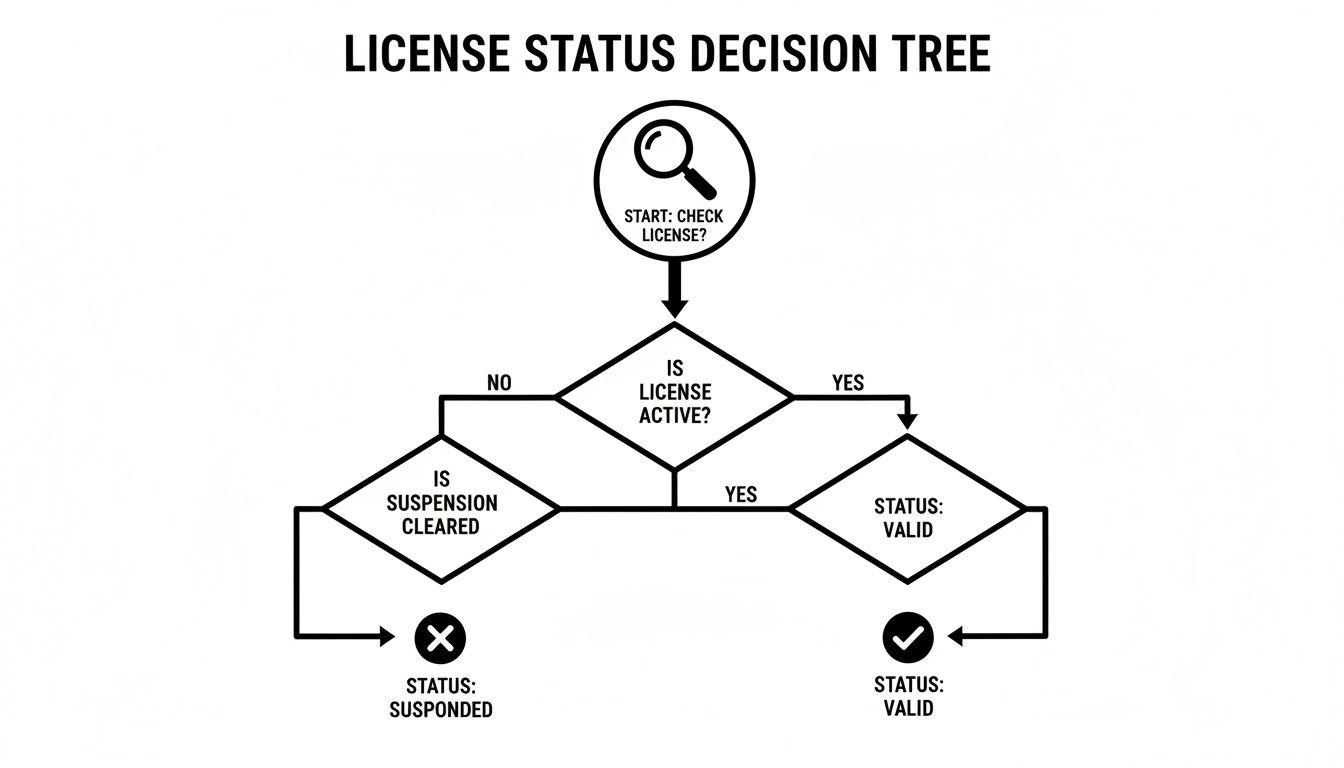
As you can see, everything hinges on that initial status check. So, let’s dig into the most common reasons drivers find themselves in this situation in Florida.
Unpaid Fines and Administrative Suspensions
This is, without a doubt, the number one reason for a license suspension in Florida. It usually starts with something simple: you get a ticket, you mean to pay it, but life gets in the way. Once that deadline passes, the court flags your license with the Florida Highway Safety and Motor Vehicles (FLHSMV), and boom—you're dealing with what's known as a D6 suspension.
And it's a massive issue. Roughly 2 million drivers in Florida have had their licenses suspended just for unpaid fines and fees. In fact, a staggering 72% of all suspension notices stem from court debt. For comparison, serious safety violations like DUIs make up less than 4%. This turns a simple fine into a major financial roadblock that can have real consequences.
To clear a D6 suspension, you'll need to:
- Get in touch with the Clerk of Court in the county where the ticket was issued.
- Settle up all the outstanding fines and any late fees.
- Make sure you get proof you've paid, which is called a D6 clearance.
- Finally, provide that clearance to the FLHSMV and pay the state's separate reinstatement fee.
Here's a classic scenario: Maria from Orlando got a speeding ticket. She tossed it on her desk, planning to pay it later, and completely forgot. Weeks later, she got a nasty surprise in the mail from the FLHSMV—her license was suspended. She had to call the Orange County Clerk of Courts, pay the original fine plus a late fee, get her D6 clearance receipt, and then go online to pay the $60 reinstatement fee to the state.
Suspensions from Racking Up Too Many Points
Florida keeps a close eye on repeat offenders through its driver's license point system. Every moving violation you're convicted of adds points to your record. If you get too many points in a set period, your license gets automatically suspended.
The suspension timelines are pretty straightforward:
- 12 points in 12 months = 30-day suspension
- 18 points in 18 months = 3-month suspension
- 24 points in 36 months = 1-year suspension
The best strategy here is to be proactive. Often, for a minor ticket, you can choose to take a Basic Driver Improvement (BDI) course to keep the points off your record entirely. But once that suspension hits, you're looking at completing a more intensive Advanced Driver Improvement (ADI) course and paying the reinstatement fee. If you want to get into the nitty-gritty, you can learn more about how many points it takes to get your license suspended.
Complex Suspensions: DUI and Insurance Issues
Now we're getting into more serious territory. Suspensions from a DUI or from letting your car insurance lapse come with much heavier requirements. These aren't just administrative hiccups; they involve a long list of legal and financial hurdles.
For a DUI, reinstatement is a long road that only starts after you’ve dealt with all the court's demands. This typically means:
- Completing a mandatory DUI substance abuse course.
- Serving any jail time or probation periods.
- Paying significant fines and court costs.
- Possibly having an ignition interlock device installed in your car.
- Securing FR-44 insurance, which is a high-risk policy with much higher coverage limits than standard insurance.
An insurance-related suspension is another common, and costly, problem. It usually happens if you're pulled over without proof of insurance or are in an accident without coverage. To get your license back, you'll have to get the right insurance—often requiring an SR-22 Certificate of Financial Responsibility—and have your insurance company file it directly with the FLHSMV. On top of that, you’ll have to pay a reinstatement fee that can jump as high as $500 for repeat offenses.
Tackling Your Required Traffic Course the Smart Way
More often than not, the path to getting your license back involves a detour through a state-approved traffic school. While it can feel like another hoop to jump through, picking and finishing the right course is a critical step that can make or break your timeline.
The secret is matching the course to your specific suspension. The Florida Highway Safety and Motor Vehicles (FLHSMV) has different requirements depending on why your license was suspended. Nailing this from the start will save you a world of time, money, and headaches.
Picking the Right Florida Driving Course
Florida's driver improvement courses aren't one-size-fits-all. Each one is built for a different purpose, whether it's for a simple ticket or a court order tied to a more serious offense.
Here’s a quick rundown of what you might encounter:
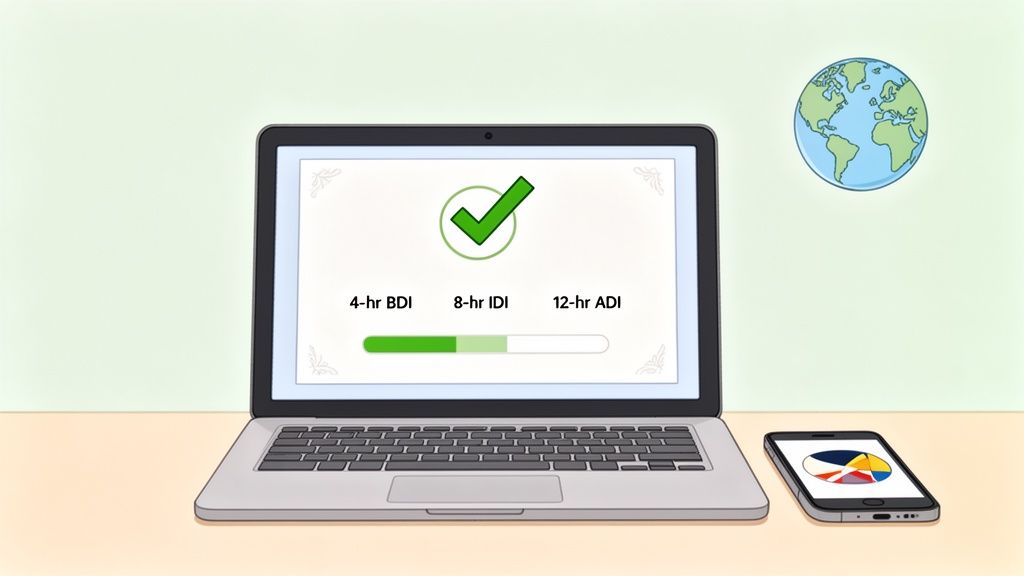
- 4-Hour Basic Driver Improvement (BDI): This is the most common one. Drivers often take it to keep points off their license after a minor ticket—a smart move to prevent a suspension in the first place. You can see how our 4-hour BDI traffic class helps protect your driving record.
- 8-Hour Intermediate Driver Improvement (IDI): A judge will usually order this course for more significant traffic violations. It’s a deeper dive into defensive driving and often a mandatory part of a plea agreement.
- 12-Hour Advanced Driver Improvement (ADI): This is the heavy hitter. It's typically required if your license was suspended for racking up too many points or if you've been labeled a Habitual Traffic Offender (HTO). Completing an ADI course is also a must before you can even apply for a hardship license.
The single biggest mistake you can make is signing up for the wrong class. If the court orders an 8-hour IDI and you take a 4-hour BDI, you haven't fulfilled your legal obligation. Your reinstatement will be denied, and you'll be back at square one. Always, always double-check your court papers or your FLHSMV notice.
The Clear Advantage of Online Traffic School
Forget about losing a whole Saturday sitting in a stuffy classroom. These days, the most efficient way to get your course done is online. Platforms like ours are fully approved by the FLHSMV and offer a level of flexibility you just can't get in person.
An online course means you can work at your own pace, wherever you have an internet connection. Knock out a chapter on your lunch break or finish it late at night after the kids are asleep. That kind of convenience is a lifesaver when you're already juggling work, family, and the stress of having a suspended license.
How Technology Gets You Back on the Road Faster
Modern online courses are about more than just convenience; they're about efficiency. When you pass your final exam, your completion certificate is automatically and electronically sent straight to the FLHSMV.
This direct reporting cuts out the old-school paperwork and the risk of mail delays, getting your compliance logged in the state's system far faster. You can move on to the next step, confident that this requirement is officially handled.
Just how much of an impact can this make? Look at Miami-Dade County. In 2022, they were dealing with an astonishing 915,424 suspended licenses, mostly from unpaid fines. By focusing on clearing these kinds of administrative hurdles, they cut that number by a massive 73% by 2025. It just goes to show that efficiently handling requirements like a traffic course is a huge part of helping drivers get their lives back on track.
Ultimately, completing your required course is more than just checking a box. It’s a chance to refresh your defensive driving skills and become a safer driver. By choosing a convenient, state-approved online option, you can get this step handled quickly and get that much closer to reinstating your Florida license.
Gathering Your Documents and Paying Fees
Alright, you've dealt with the main reason for your suspension—you paid that ticket or finished your course. Now comes the part that trips a lot of people up: the paperwork and payments. This is where you pull together everything the Florida Highway Safety and Motor Vehicles (FLHSMV) needs to officially get you back on the road.
Think of it as building your case for reinstatement. Getting this step wrong means delays, and nobody wants that. A missing document or paying the wrong fee can send you right back to square one, so let's get it right the first time.
Your Essential Document Checklist
The exact documents you'll need really depend on why your license was suspended in the first place. The best advice I can give is to check your official suspension notice or log into your FLHSMV record online. That will give you a personalized list.
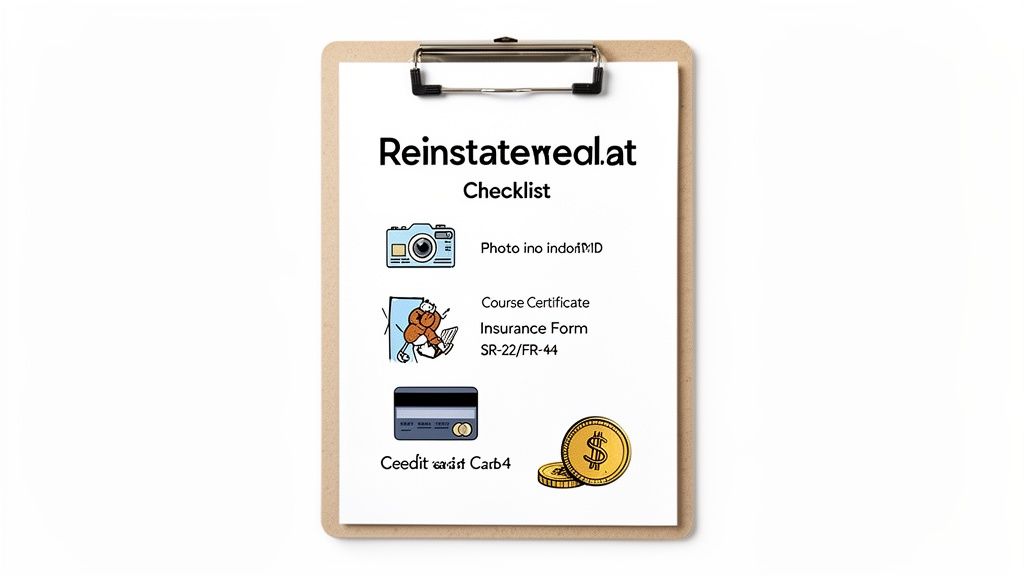
That said, most reinstatements require a core set of documents. Here’s what you should have ready:
- Proof of Identity: A valid U.S. passport, birth certificate, or permanent resident card works.
- Proof of Social Security Number: Your Social Security card itself or a W-2 form is perfect.
- Proof of Florida Residency: You'll need two separate documents. Think utility bills, a rental agreement, or a bank statement with your current Florida address.
- Course Completion Certificates: If you had to take a BDI, ADI, or DUI program, you need that official certificate. Good news—many online schools send this to the state electronically, which really speeds things up.
- Proof of Insurance (SR-22 or FR-44): This is absolutely mandatory for insurance or DUI-related suspensions. Your insurance company files this form directly with the FLHSMV to prove you have the right coverage.
A quick note: if any of your essential documents are in a language other than English, you'll need to get them professionally translated. Using certified drivers license translation services is the best way to ensure everything is accepted without a hitch.
Common Florida License Reinstatement Fees
Florida's policies on debt-based suspensions have a real impact. A 2019 report showed over 716,000 driving-age adults couldn't drive simply because of unpaid court debts. On top of that, a suspension can cause your insurance rates to jump by an average of 67% for three years. The good news is that programs like Operation Green Light and recent legislative changes are starting to offer some relief.
Now, let's talk numbers. The cost to get your license back can vary quite a bit. A simple fee for an unpaid ticket is one thing; a reinstatement after a DUI is another story entirely. It's critical to know the exact amount you owe.
To give you an idea of what to expect, here is a breakdown of the typical fees you'll encounter.
| Suspension Type | Standard Reinstatement Fee | Additional Potential Costs |
|---|---|---|
| Unpaid Traffic Ticket (D6) | $60 | Original ticket fine, court costs |
| Points-Related Suspension | $75 | ADI course fee |
| Insurance-Related (No proof) | $150 (first offense) | SR-22 insurance premiums |
| DUI-Related Suspension | $130 (first offense) | FR-44 insurance, DUI course fees, court fines |
These fees are just part of the picture, so be sure to account for any related court fines or course costs when you're budgeting for this process.
When it's time to pay, you have a few options:
- Online: By far the easiest way is through the FLHSMV's MyDMV Portal.
- In Person: You can visit a local driver license service center.
- By Mail: Send a check or money order to the address listed on your suspension notice.
In some situations, you might need a restricted license to get to work or school while finishing the reinstatement process. For more on that, check out our guide on how to apply for a hardship license in Florida.
The Final Lap: Confirming Your Reinstatement and Keeping Your License
You’ve paid the fines, sat through the courses, and turned in a mountain of paperwork. It feels like you’ve crossed the finish line, right? Not so fast. There’s one last, critical step before you can legally get back behind the wheel, and skipping it is a mistake I see people make all the time.
You absolutely must confirm that your license is officially valid in the state's system. Don't just take a clerk's word for it or assume that because you submitted everything, it's all been processed. You need to see it for yourself.
The only way to be 100% sure is to check your status directly through the Florida Highway Safety and Motor Vehicles (FLHSMV) MyDMV Portal. Log in and look for that magic word: "VALID." If it still says "SUSPENDED" or shows any other flags, something’s not right. The state is missing a document, a payment hasn't posted, or a course completion certificate hasn't been registered.
A Word of Caution from Experience: Your license isn't reinstated just because you think it should be. It's only reinstated when the FLHSMV's official record says so. If you drive before getting that confirmation, you're driving on a suspended license. That's a serious offense that could land you in jail and reset the clock on your suspension all over again.
Protecting Your Hard-Earned Driving Privileges
Getting your license back is a huge relief, but the real win is keeping it. Think of this whole frustrating process as an expensive lesson in how to avoid ever having to go through it again. Now’s the time to build some simple habits that will keep your driving record clean.
It’s not about being a perfect driver. It’s about being a responsible one. Let's walk through the key things that will keep you out of the DMV's crosshairs.
Keep Your Address Current. Seriously.
This sounds almost too basic to mention, but you'd be shocked how many suspensions start right here. If you move, Florida law gives you just 30 days to update your address with the FLHSMV.
Why does this matter so much? Every official notice—ticket warnings, renewal reminders, and yes, suspension alerts—gets mailed to whatever address they have on file. If you never get the letter, you can't respond to it. That's how a simple $100 ticket quietly snowballs into a full-blown license suspension without you even knowing it's happening.
Updating is easy:
- Do it online through the MyDMV Portal.
- Stop by a driver license service center in person.
Deal With Traffic Tickets Immediately
When it comes to traffic tickets, procrastination is your absolute worst enemy. The moment that citation is in your hand, a 30-day clock starts ticking. Your only choices are to pay it, elect traffic school, or fight it in court.
Ignoring the ticket is not an option. Doing nothing guarantees the court will report your failure to comply to the state, triggering an automatic suspension.
Here’s your game plan for any future tickets:
- Read it: As soon as you get home, read the entire ticket. Understand the violation, the fine, and the deadline.
- Decide fast: Don't let it marinate in your glove box. Are you paying it? Taking a course? Contesting it? Make a decision within a day or two.
- Follow through: Whatever you choose, see it through to completion and keep proof. Save your payment receipt or course certificate.
Never Let Your Insurance Lapse—Not Even for a Day
In Florida, driving without insurance is a fast track to a suspension. The state has an electronic system that constantly cross-references vehicle registrations with insurance databases.
If your policy cancels or expires, your insurance company is legally required to rat on you to the state. The FLHSMV will then mail you a notice demanding proof of new coverage. Fail to provide it in time, and they'll suspend your license, tag, and registration. Getting it all back can cost you up to $500 in reinstatement fees for repeat offenses.
The fix is simple:
- Use auto-pay for your insurance premiums. This eliminates the risk of forgetting a payment.
- Shop for a new policy before your old one ends. Don't leave even a 24-hour gap in coverage.
- Respond immediately to any letters from your insurer or the FLHSMV about your coverage.
By making these small adjustments, you shift from reacting to problems to preventing them entirely. You're not just fixing a past mistake; you're building a simple, responsible system to protect your freedom to drive for good.
Common Questions About Florida License Reinstatement
Getting your Florida driver's license suspended can be a confusing and stressful experience. You've got the main steps down, but specific situations often bring up more questions. Let's tackle some of the most common issues drivers run into during the reinstatement process.
How Long Does Reinstatement Take After I've Done Everything?
This is the big question on everyone's mind. The good news is, if you can handle everything online through the FLHSMV's MyDMV Portal, the process can be surprisingly fast. Many drivers see their license status switch back to "VALID" within 24 to 48 hours.
On the other hand, if your situation requires mailing in documents or waiting for a court to send clearance to the DHSMV, you’ll need to be more patient. These manual steps can easily add several business days, or sometimes even weeks, to the timeline. For the quickest turnaround, always try to complete your requirements online or in person at a driver's license service center. And a crucial piece of advice: never get behind the wheel until you've checked the portal and confirmed your license is officially valid again.
Can I Get a Hardship License to Drive to Work?
Yes, in many cases, a hardship license is an option. This is a restricted license that lets you drive for specific, necessary reasons—think commuting to your job, attending school, or getting to doctor's appointments. Whether you qualify, however, depends entirely on why your license was suspended in the first place and what your overall driving record looks like.
A hardship license isn't something you're automatically entitled to. You have to formally apply for it, and the state almost always requires you to complete a 12-hour Advanced Driver Improvement (ADI) course first. Keep in mind, for some of the most serious offenses, a hardship license is completely off the table.
What’s the Big Deal If I Drive on a Suspended License Anyway?
Driving while your license is suspended is a huge mistake in Florida. It’s not just another traffic ticket; it's a criminal offense with penalties that get worse each time you're caught.
- First Offense: You're looking at fines, an even longer suspension, and possibly jail time.
- Second or Third Offense: The consequences get much more severe, potentially leading to felony charges and a lengthy jail sentence.
Seriously, the risk is not worth it. The only safe and smart move is to complete the entire reinstatement process before you even think about driving.
How Do I Handle a Suspension Caused by a Ticket in Another State?
This is a tricky one that trips a lot of people up. If an out-of-state ticket is the root cause of your Florida suspension, you have to fix the problem where it started. The Florida DHSMV can't do anything until the other state officially clears you.
You'll need to contact the court in the specific county and state where you got the ticket. Usually, this means paying the fine and any associated court costs. Once that's settled, get official proof of compliance from that state—a court receipt or a clearance letter—and submit it to the Florida DHSMV. After that, you'll still need to pay Florida's own reinstatement fee to get the hold removed from your record here.
At BDISchool, we offer the state-approved online courses you need, like the Basic Driver Improvement (BDI) and Advanced Driver Improvement (ADI) classes. Our courses are self-paced and designed to help you check off those requirements quickly and easily so you can get back on the road. Find the right course and enroll today at BDISchool.com.