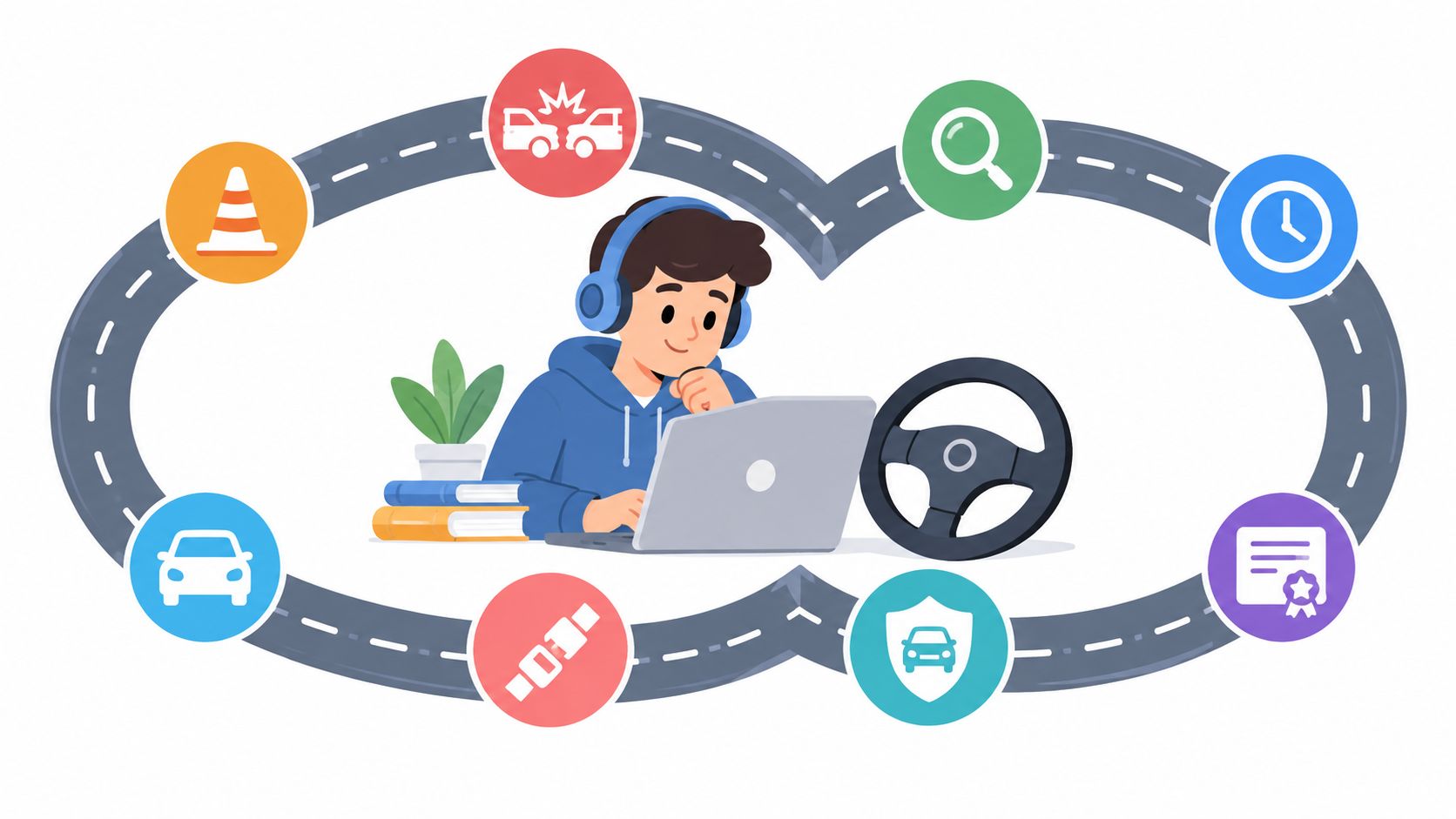
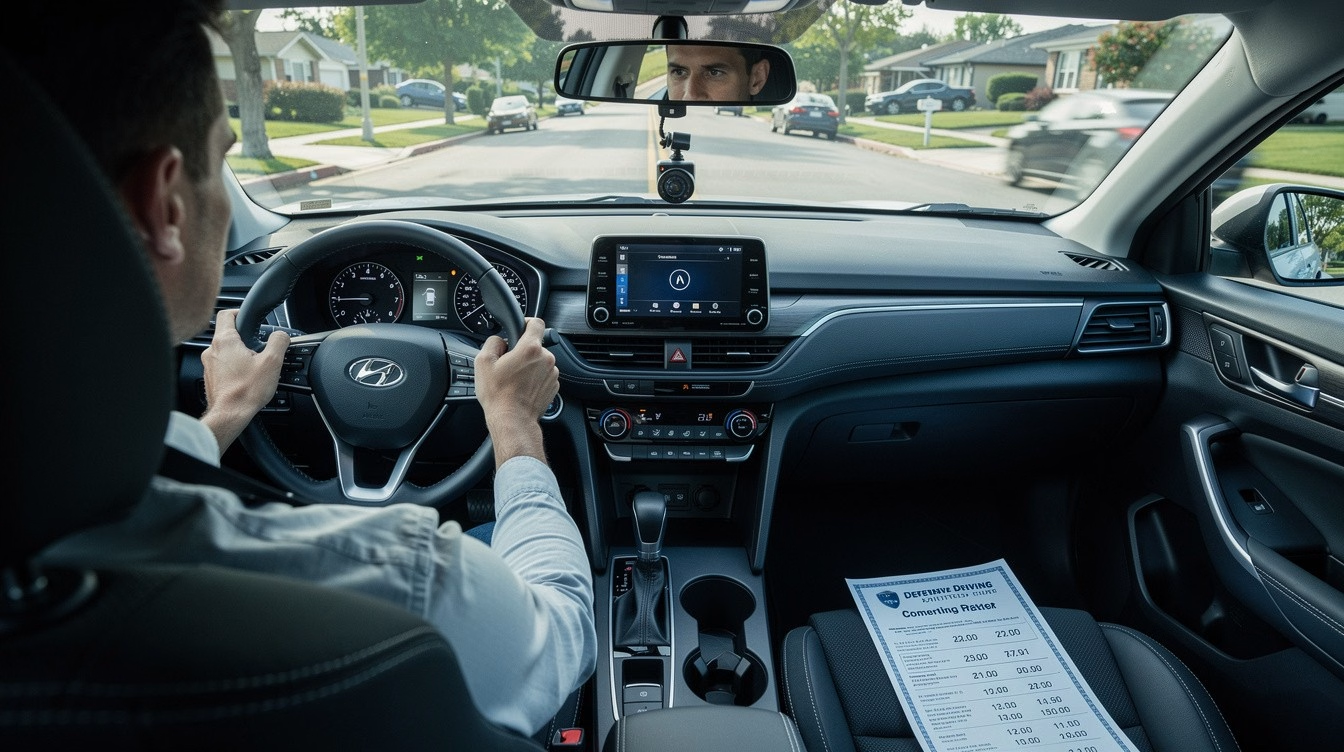
Your teen’s birthday is coming up. Or maybe you’re an adult finally deciding it’s time to drive in Florida after years of putting it off. You’ve probably got the same mix of feelings I hear from students all the time: excitement, nerves, and a lot of questions about what the DMV wants.
That’s normal.
The learner’s permit fl process can feel bigger than it really is because it involves several moving parts. A course. A test. Documents. A trip to the licensing office. Then months of supervised driving before the next step. Once you see the order clearly, it becomes much easier to handle.
For many families, there’s another layer. Parents may speak Spanish or Portuguese at home. A teen may understand road rules better in one language, but still feel pressure when facing forms, office staff, or test-day instructions in English. Adult learners often feel that same pressure for a different reason. They don’t want to look inexperienced. They just want clear, practical help.
That’s exactly how to approach this. One step at a time, with no guesswork.
The Journey to Your Florida Learner’s Permit Starts Here
It is Saturday morning. A parent has a folder of papers on the kitchen table. A teen is asking when they can start driving alone. An adult learner is wondering whether they will understand everything at the licensing office. Everyone wants the same thing: a clear first step.
That first step is easier to handle once you see what a learner’s permit really is. It works like the supervised phase of a sport. You do not start with the championship game. You start with practice, coaching, and repetition until the basics become automatic.
Practical rule: A permit is a training license, not a finish line.
That mindset changes how families prepare. The goal is not only to pass a test and leave with a card. The goal is to build habits early, before traffic, pressure, and distractions make driving harder.
One action helps more than families expect. Create a simple permit folder before anyone studies for the exam. Put one checklist in it for course completion, one for documents, and one for test-day questions. If your household uses Spanish or Portuguese at home, label each item in both languages so the student, parent, or older relative can review the same plan without confusion. Adult learners benefit from the same approach because it removes the stress of trying to remember every requirement at once.
Parents often wonder why Florida uses a staged system. New drivers need time behind the wheel with guidance, and Florida’s Graduated Driver Licensing rules for new drivers are built around that idea. The permit stage gives beginners room to practice scanning intersections, judging distance, and staying calm while a licensed adult is there to correct mistakes before they become habits.
That matters even more for families dealing with language barriers at the FLHSMV. A student may know the road signs but freeze when an instruction is given quickly in English. A parent may understand the process perfectly in Spanish or Portuguese, yet feel less comfortable asking questions at the counter. A good plan solves part of that problem before test day. Review terms in the language the learner understands best, write down any questions in advance, and bring an organized document set so the office visit feels more like checking boxes than guessing.
Start there. Clear folder. Clear timeline. Clear expectations. That is how the permit process becomes less intimidating and much more manageable.
Eligibility Requirements and Essential Documents
The fastest way to turn a simple DMV visit into a frustrating one is to show up with missing paperwork. I’ve seen students prepare for the test perfectly, then lose time because one document wasn’t accepted or a parent signature was missing.
The permit process gets easier when you separate it into two buckets. First, confirm that you’re eligible. Second, build your document stack before you leave home.
Start with eligibility
For teens, the key milestone is age. You can begin preparing before permit day, but you can’t receive the permit until you meet Florida’s age requirement at the licensing stage. Adult first-time drivers also need to follow the state’s requirements, but they won’t have the same parent consent issues that minors do.
One of the biggest points of confusion is the required education course. Florida requires a Traffic Law and Substance Abuse Education course, often called TLSAE, before many first-time applicants can move forward in the process. When you complete it through a state-approved provider, completion is electronically reported to the FLHSMV for verification.
If your household is bilingual or multilingual, smart planning proves useful. A student who learns better in Spanish or Portuguese shouldn’t force everything into English at the start. Understanding the material matters more than pretending language isn’t part of the process.
Families often save themselves stress by handling the course in the language the student understands best, then practicing common DMV terms in English before the appointment.
Gather documents before you book anything
The DMV doesn’t grade effort. It checks documents. That’s why I tell students to lay everything out on a table the night before, even if they’re sure they already have it.
Here’s a simple checklist.
| Document Category | Accepted Examples |
|---|---|
| Identity | Birth certificate, valid passport |
| Social Security number | Social Security card or approved proof showing the number |
| Residential address | Documents that show where you live in Florida |
| Minor consent | Parent or guardian consent form |
| Course proof | TLSAE or DETS completion reported to FLHSMV, plus any certificate copy you keep for your records |
For a fuller list of accepted paperwork, it helps to review a practical what to bring to the DMV checklist before your visit.
What minors usually need
If you’re under 18, expect more steps because Florida wants a parent or guardian involved. That doesn’t mean the process is harder. It just means the state wants clear consent and clean records.
Bring or confirm these items:
- Proof of identity: This tells the office who you are. A birth certificate or passport is commonly used.
- Social Security number: The office needs to verify it, so don’t assume a verbal number is enough.
- Florida residential address proof: Bring documents that clearly match your current address.
- Parental consent: If this form is missing or incomplete, your visit may stop right there.
- Course completion: Your TLSAE or DETS status should be in the system, but keeping your own confirmation is still smart.
What adult first-time drivers should watch for
Adult learners often think the permit process is only for teens. It isn’t. If you’re getting licensed for the first time, you still need to satisfy Florida’s testing and identification requirements. The difference is that you won’t need parent consent, and your path may feel more administrative than family-centered.
Adults also tend to underestimate the knowledge exam because they’ve been passengers for years. That’s a mistake. Knowing how traffic works isn’t the same as knowing what the Florida handbook and exam require.
Language help for Spanish and Portuguese speaking families
This part gets overlooked too often. Many families can handle the driving part just fine but get stuck on the paperwork and office language.
A few simple habits can make a big difference:
- Translate names exactly: Make sure the spelling of names matches across documents.
- Review key terms ahead of time: Words like “residence,” “consent,” “restriction,” and “knowledge exam” cause confusion when people meet them under pressure.
- Keep originals organized: Don’t rely on phone photos if originals are expected.
- Bring a calm helper when allowed: A parent or experienced adult can help the student stay focused, even if they can’t answer for them.
The best permit appointments usually look boring. Everything matches. Every document is ready. No one is scrambling in the parking lot.
That’s what you want.
Preparing for and Passing the FLHSMV Tests
A lot of families feel the stress peak the moment they walk into the FLHSMV office. A teen is nervous. A parent is trying to keep track of documents, test steps, and instructions at the same time. For Spanish and Portuguese speaking families, that pressure can grow fast if a single word or direction is unclear.
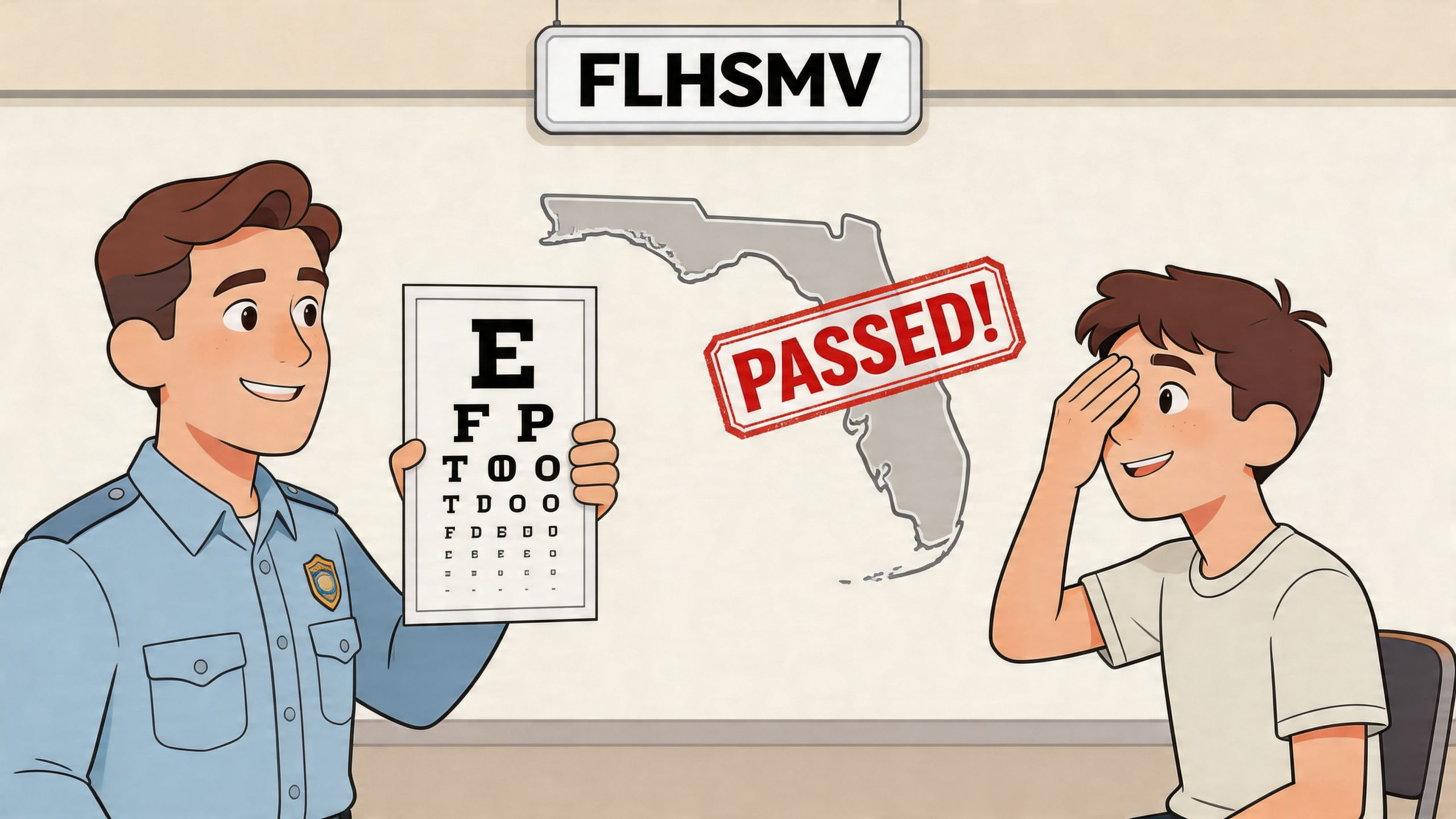
The good news is that the testing process is much more manageable once you know the order. For permit applicants, Florida usually checks three things: whether you can see well enough to drive, hear directions clearly, and understand the rules of the road through the Class E Knowledge Exam.
What happens at the office
The appointment usually moves in a simple sequence. Staff check your paperwork, complete the vision and hearing screenings, and then confirm your knowledge exam status based on where and how you took it.
The Class E Knowledge Exam has 50 multiple-choice questions and requires an 80% passing score, which means 40 correct answers, according to this guide to the Florida permit test format and scoring. That number catches students off guard because it leaves less room for careless mistakes than they expect.
Small misses add up quickly.
Why students struggle with the knowledge test
The hardest part for many applicants is not reading the questions. It is reading them carefully enough. Students often recognize a topic, such as right-of-way or road signs, and answer too fast before noticing what the question is really asking.
That happens with teens, but adult learners run into it too. Adults have years of experience watching traffic from the passenger seat, so the rules can feel familiar. Familiar is not the same as test-ready. The exam checks whether you can apply Florida rules to a specific situation, not whether the topic sounds recognizable.
Language can add another layer. A student may know the rule in Spanish or Portuguese but freeze when they see terms like “yield,” “blind intersection,” “revocation,” or “restrictions” in English. A smart way to prepare is to build a short vocabulary list before test day and review those words until they feel ordinary, not intimidating.
Students who pass most often are usually the ones who study in layers. First the rule, then the example, then the practice question.
A better way to study
Cramming treats the handbook like a pile of facts. Good preparation works more like building shelves in a closet. You sort topics, place them where they belong, and make it easy to find them again under pressure.
Try this study plan:
- Read in short sessions: Ten to fifteen focused minutes works better than one long, tired session.
- Separate topics: Study signs, right-of-way, lane markings, and DUI laws as different categories.
- Practice recall: Use a Florida DMV permit practice test to get used to answering under time pressure.
- Review mistakes slowly: If you miss a question, figure out why the correct answer is right.
- Translate tricky terms: For families more comfortable in Spanish or Portuguese, write the English term on one side and the home-language meaning on the other.
That last step helps more than people expect. Many wrong answers come from vocabulary confusion, not lack of ability.
Vision testing and simple prep before test day
The vision screening is basic, but it still trips up applicants who arrive unprepared. If you wear glasses or contacts, bring them. If your prescription feels outdated, fix that before your appointment. A delayed permit over a preventable vision issue is frustrating for everyone involved.
If you need a quick appointment before heading to the DMV, a local option for a same-day eye exam may help.
A calmer test day usually comes from simple habits:
- Sleep enough the night before: Tired students misread easy questions.
- Eat first: Hunger and nerves make concentration worse.
- Arrive early: A rushed start makes the whole appointment feel harder.
- Bring glasses or contacts: Use the correction you normally rely on.
- Read every question twice: One extra second can save a missed point.
This walkthrough gives a useful visual sense of the permit testing experience:
What to do if you fail
A failed attempt usually points to a study problem, not a driving future problem. Go back to the categories that gave you trouble and work those areas directly. If you were strong on signs but weak on right-of-way, spend your next study session on intersections, turns, and who goes first.
Adult learners often take a failed permit test personally. They should not. Licensing exams reward preparation and pattern recognition, not age. Teens need that reminder too.
Keep the goal simple. Learn the rule well enough to recognize it in real traffic, not just on a flashcard. That is how safer driving starts.
Understanding Your Learner’s Permit Driving Restrictions
Your teen passes the permit test, holds that new card, and immediately asks, “So when can I drive?” That question matters more than many families expect, especially if a parent is reading Florida rules in a second language or an adult learner is trying to sort out teen permit rules from regular licensing rules. The permit is permission to practice, not permission to drive alone whenever you want.
Florida uses permit restrictions the way a good coach uses drills. You do not start a beginner in the hardest part of the game. You build skill in smaller, safer steps first. As noted earlier, Florida’s graduated licensing approach was created to reduce the crash risks that come with inexperience.
The supervision rule that always applies
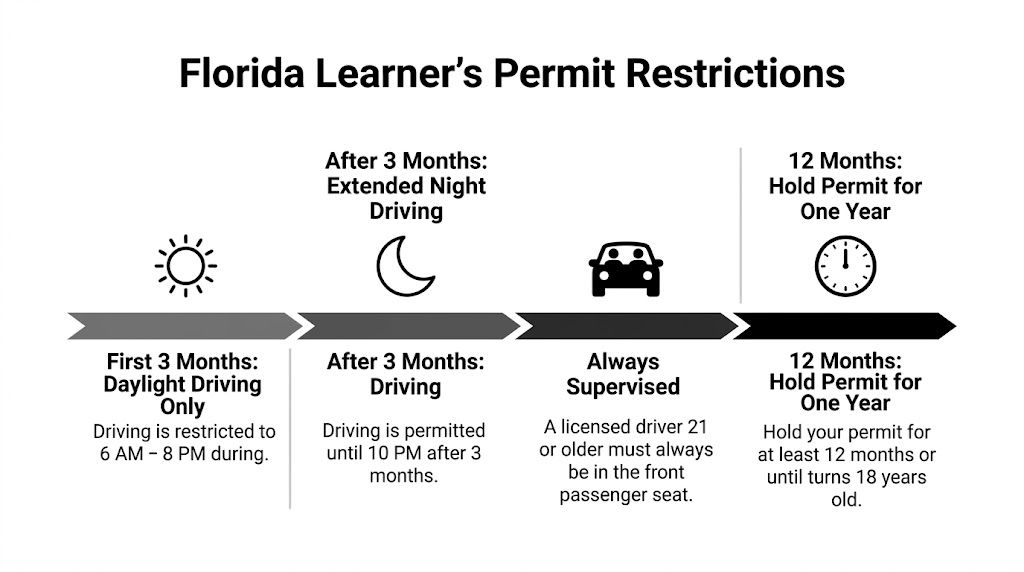
For permit holders under 18, driving must happen with a licensed adult in the front passenger seat. That adult needs to be alert enough to guide the driver during the trip, not just sit there.
That detail matters because beginners need correction in the moment. A supervisor might remind the driver to slow earlier for a red light, check the mirror before changing lanes, or watch for a pedestrian near a corner. Good supervision works like guardrails on a bridge. The guardrails do not drive the car, but they help keep a beginner from making a costly mistake.
For Spanish-speaking and Portuguese-speaking families, confusion often starts with vocabulary. “Supervision” does not mean following behind in another car. It means sitting in the front passenger seat and being ready to give calm, clear direction. If a parent is unsure, read the rule together in the state handbook and translate the key terms before the first practice drive. A simple shared understanding prevents arguments later.
Time-of-day limits are part of the training
Permit driving starts with more limited hours because daylight is easier for a new driver to read. Signs are clearer. Pedestrians are easier to spot. Intersections feel less rushed.
After the first part of the permit period, driving hours expand, but they still do not become unlimited. New drivers often want to practice at night right away because real life happens after dark. That makes sense. It is also why Florida introduces night driving slowly. Darkness reduces the time you have to recognize hazards, and glare from headlights can make a routine trip feel completely different.
Adult learners sometimes ask whether these teen permit hour limits apply to them in the same way. The answer depends on age and license type, so adult students should confirm the rule that matches their situation before assuming a teen restriction applies. If anything in the handbook feels unclear, use the Florida Driver’s Manual in plain, review-friendly form and compare the permit rules carefully with your age group.
Restrictions make practice safer and more useful
A beginner who tries heavy rain, fast traffic, night glare, and busy intersections too soon usually gets overloaded. Then the lesson turns into stress management instead of driving practice.
A better approach is progression.
| Situation | Why it should wait |
|---|---|
| Busy intersections | The driver needs stronger scanning and right-of-way judgment |
| Heavy rain | Visibility drops and stopping distance becomes harder to judge |
| Night driving | Hazards appear later and glare makes signs harder to read |
| High-speed roads | Small mistakes become more serious at higher speeds |
Parents often tell me their teen feels “ready for more” after a few smooth drives in the neighborhood. Sometimes they are. Sometimes they are only comfortable in one familiar setting. Those are not the same thing. Real readiness means the student can stay calm, observe well, and follow instructions even when the road changes.
Zero tolerance is a simple rule
For underage drivers, alcohol should never be part of the plan.
Families do not need complicated legal wording to understand the point. Safe driving starts before the key turns. If a teen has been around alcohol, the right choice is not to drive. That message should be clear in every language spoken at home.
House rules help the state rules work
The strongest practice plans include family rules that make permit driving easier to manage. A parent might limit early practice to familiar roads, postpone lessons when the student is tired, or keep siblings and friends out of the car during the first weeks.
That structure helps adult learners too. If English is not your first language, prepare each drive like a short lesson. Pick the route ahead of time. Review a few traffic words in English and in Spanish or Portuguese. Decide who will give directions and what phrases you will use, such as “slow down,” “check mirror,” or “stop completely.” Clear language lowers stress, and lower stress helps people learn faster.
The permit phase is temporary. The habits built here often stay with a driver for years.
How to Complete Your 50 Hours of Supervised Driving
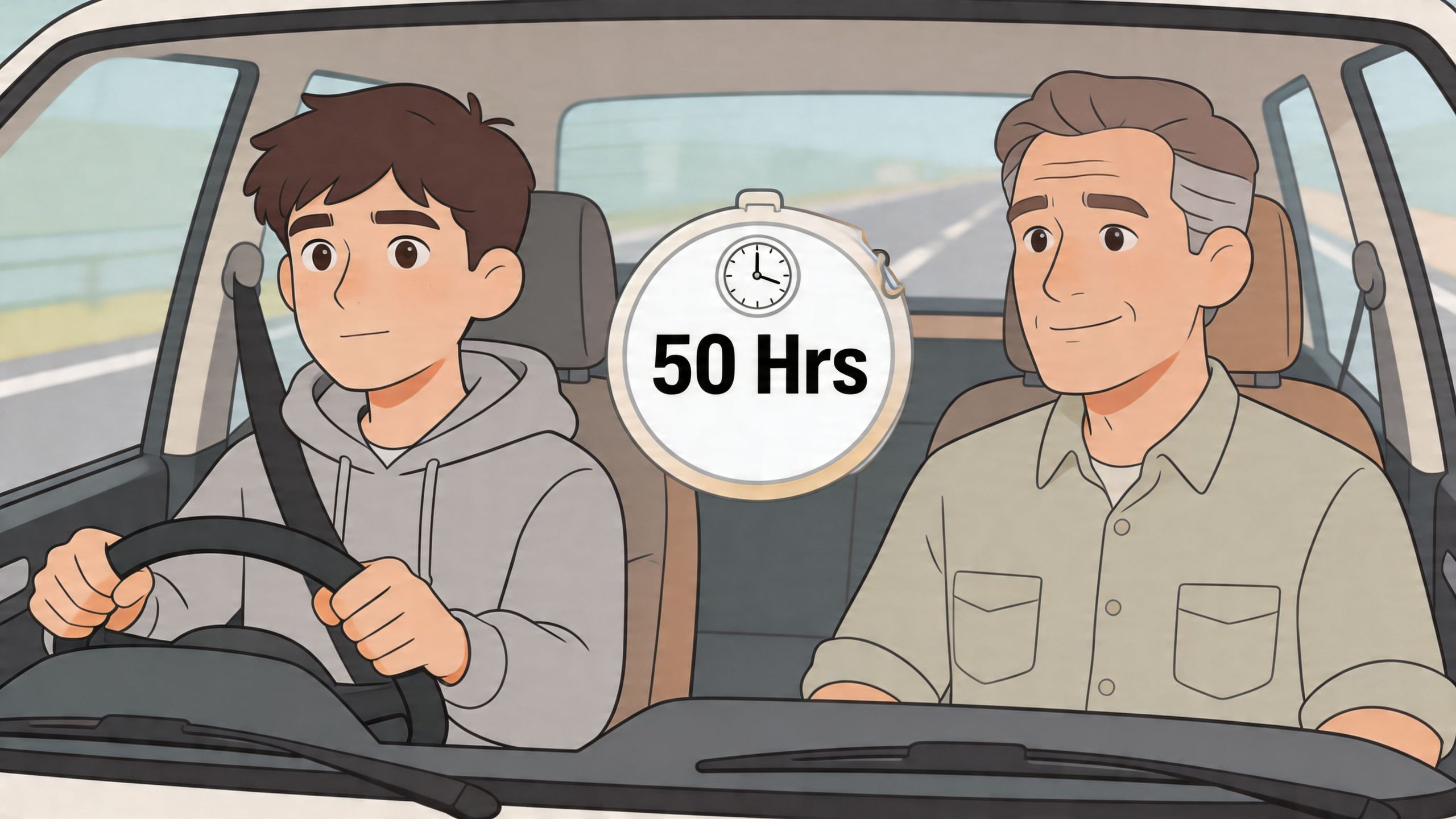
Once you have your permit, hands-on education starts in the car. Florida requires permit holders under 18 to complete 50 hours of certified behind-the-wheel practice, including 10 hours at night, before moving on to the next test, according to this Practice Tracker guide on the Florida learner’s permit practice requirement.
That sounds like a lot until you spread it out. A few steady sessions each week add up. The bigger challenge isn’t time. It’s making those hours useful.
Build skills in stages
The worst practice plan is jumping into difficult traffic too soon. That often leaves the student tense and the supervising adult frustrated.
A better plan looks like progression.
Stage one with almost no pressure
Start where the student can learn vehicle control without the stress of traffic. Empty parking lots and low-pressure areas help with:
- Steering control: Holding a line smoothly
- Braking: Stopping gently instead of suddenly
- Parking basics: Straight-in, backing out, and turning around
- Observation habits: Mirrors, shoulder checks, and scanning
Adults should stay quiet unless safety requires a correction. Too much talking early on overwhelms beginners.
Stage two on calm neighborhood roads
After basic control feels steady, move to residential streets. These roads teach decision-making at low speed.
Practice things like:
- approaching stop signs correctly
- watching for pedestrians and bikes
- keeping a safe following distance
- judging who has the right-of-way
Good practice doesn’t mean driving longer. It means repeating one skill until the student can do it calmly.
Stage three in real traffic conditions
Later, add busier roads, multilane turns, traffic lights, and higher-speed routes. Then work in night driving and poor weather when the student is ready.
This order matters because students learn faster when each new challenge builds on an older one.
Give each drive a purpose
A lot of families say, “We drove for an hour,” but can’t name what was practiced. That usually means the hour was too random.
Try assigning one focus per session:
| Practice drive | Main skill |
|---|---|
| Grocery route | Turns, lane position, parking |
| School route | Signs, speed changes, traffic flow |
| Evening drive | Glare, visibility, calm scanning |
| Rainy day with supervision | Following distance, smooth braking |
A focused drive helps the student notice progress. It also makes feedback easier for the adult.
Advice for the supervising adult
You don’t need to sound like a DMV examiner. You need to sound calm and clear.
A few habits help:
- Give instructions early: Say “turn right at the next light,” not “turn here” at the last second.
- Correct one thing at a time: Don’t flood the student with five mistakes at once.
- Debrief after parking: Save longer teaching points for the end of the drive.
- Model composure: If you panic easily, the student will too.
Don’t forget the paperwork
The driving hours need to be documented on the required certification form before the student advances. Keep the log updated instead of trying to reconstruct everything later from memory.
Night hours should be tracked carefully. Families often do plenty of driving but forget to note when it happened. That creates stress near the end when the student realizes the required breakdown isn’t clearly documented.
The best learners use these 50 hours to get comfortable with complexity. Intersections. Cyclists. Lane changes. Parking lots. Rain. Darkness. All the situations that can feel chaotic at first start becoming manageable through repetition.
That’s the core value of the permit phase. It turns unfamiliar situations into practiced ones.
Common Permit Pitfalls and Guidance for Special Cases
A parent takes time off work, a teen has the documents in a folder, and everyone arrives at the FLHSMV thinking they are ready. At the counter, one paper is missing, a name does not match exactly, or a test question feels harder in English than it did at home. The trip ends with frustration instead of a permit.
That kind of setback is common. It usually comes from small misunderstandings, not from a student being careless or incapable.
I see this often with teens, adult first-time drivers, and families who speak Spanish or Portuguese at home. The process can feel simple on the website and much harder in real life. A good way to handle it is to treat the permit process like assembling a puzzle. If one piece is missing, the picture does not come together yet. That does not mean you start over. It means you find the missing piece.
Common mistakes that delay a permit
A few problems show up again and again:
- Documents that are partly correct, but not complete: One ID is not enough if proof of address or parent consent is still missing.
- Underestimating the knowledge exam: Students sometimes study loosely because they already ride in a car every day. Riding is not the same as answering test questions accurately.
- Booking too early: An appointment does not fix an incomplete file.
- Mixing up permit rules and license rules: A learner can legally drive only under specific conditions, and families sometimes realize that too late.
The fix is simple. Slow the process down. Check each requirement one by one before the appointment instead of hoping the office will sort it out on the spot.
If English is not your strongest language
This is one of the biggest stress points, and many articles barely mention it.
Florida has a large Spanish-speaking population, and many Portuguese-speaking families also go through the permit process with limited support in their home language. That creates a predictable problem. The student may understand the driving concepts, but still get stuck on the wording of forms, test questions, or instructions at the counter.
Language barriers do not mean a family is unprepared. They mean the family needs a clearer system.
Ways to reduce language stress before your visit
- Study in the language you understand best first: Learn the rule clearly before trying to match it to English testing terms.
- Build a small DMV word list: Include words like residence, restriction, signature, traffic control device, suspension, and identification.
- Practice key terms in English too: Even if the course or discussion at home is in Spanish or Portuguese, road signs and official wording may appear differently.
- Call the office ahead of time: Ask what language help is available and confirm exactly which documents are accepted.
- Use one labeled folder for every paper: Organization lowers stress fast, especially when a parent and student are both translating in real time.
A labeled folder works like subtitles for the whole appointment. It helps everyone follow the same script.
If a parent speaks limited English, it also helps to write a short checklist in Spanish or Portuguese before leaving home. That way, no one has to rely on memory under pressure.
Guidance for adult first-time drivers
Adult learners often face a different problem. Pride gets in the way.
An adult may assume, “I have been around driving for years, so this part should be easy.” Then the written exam feels technical, the forms feel unfamiliar, and the first practice sessions feel awkward. That is normal.
Adults usually do better when they approach permit prep the same way they would approach job training. Learn the rules. Ask direct questions. Practice the weak spots. Repeat what feels uncomfortable until it becomes routine.
Three reminders help:
- Watching other drivers is not the same as knowing test language.
- Starting slowly is normal, especially if you are nervous.
- Adult anxiety is common, even for very responsible people.
Many adults are harder on themselves than teens are. That pressure makes learning harder, not better.
New residents, foreign documents, and mixed-record situations
Some cases need extra care. A student may have out-of-state records. An adult may have driven in another country but never finished licensing in Florida. A family may have documents in different languages, or names that appear slightly differently across records.
Those cases are manageable, but they require careful checking.
Match every name, address, and date before the appointment. If a document is in another language, find out in advance whether the FLHSMV will require additional documentation or translation support. Do not wait until you are at the counter to discover that one record does not line up with the others.
This matters even more for immigrant families and blended households, where paperwork may come from different systems and countries. Small inconsistencies can create big delays.
What to do if something goes wrong
A failed test, a rejected document, or a canceled appointment feels personal. Usually, it is procedural.
Pause and diagnose the exact problem:
- What document or step was missing?
- What instruction was misunderstood?
- Did language make the problem harder to catch?
- What can be verified before the next visit?
That approach saves time and stress. It also gives families something better than guesswork.
The permit process is much easier when you stop treating problems like dead ends and start treating them like fixable checklist items.
Next Steps on the Road to Your Full Florida License
A learner’s permit fl isn’t the finish line. It’s the stage where safe driving habits are built while the stakes are still controlled.
By the time a permit holder moves toward the next license, the foundation should already be there. The student should know the rules, handle common traffic situations calmly, respect driving restrictions, and complete the required supervised practice with care. For teens, that also means holding the permit for the required period, keeping a clean enough record to stay eligible, and arriving at the skills test with real confidence instead of hope.
That’s why I always encourage families to think bigger than “passing.” Passing the knowledge exam matters. Getting the permit matters. But the bigger win is producing a driver who checks mirrors without being reminded, slows down early at intersections, notices pedestrians, and doesn’t let friends or stress control the car.
The permit year isn’t a delay before driving starts. It’s where driving actually gets learned.
If you treat this stage seriously, the road test feels less like a gamble and more like a natural next step. That’s what you want for a teen, for a first-time adult driver, and for any family trying to make the DMV process feel manageable instead of intimidating.
If you want a clear, state-approved path through Florida driver education, BDISchool offers online courses designed for teens, adults, and families who need flexible learning in English, Spanish, and Portuguese. It’s a practical place to start if you want help meeting Florida requirements and building safe habits from the beginning.