Think of defensive driving as a mindset, not just a set of rules. It’s about driving to save lives, time, and money, no matter what’s happening on the road around you or what other drivers are doing.
The core idea is to anticipate danger before it ever becomes a real threat. It's about giving yourself the time and space you need to react and avoid a collision. Forget just following the rules of the road; this is more like playing chess on the highway, always thinking a few moves ahead.
Going Beyond the Rules of the Road
Most of us were taught that being a good driver means obeying traffic laws. Stop at red lights, use your turn signals, don't speed. Simple, right? While those things are absolutely critical, they're just the baseline—the bare minimum for getting behind the wheel.
This is where we see the real difference between a standard driver and a defensive one. A standard driver reacts to what's happening right in front of them. A defensive driver is constantly scanning the entire environment, actively looking for potential problems so they can prevent them from ever happening.
This proactive approach was officially codified back in 1964 when the National Safety Council (NSC) developed the first-ever Defensive Driving Course (DDC). The goal then is the same as it is now: teach drivers how to "save lives, time, and money in spite of the conditions around you and the actions of others." That single principle is still the heart of defensive driving today, shifting the focus from simply following rules to actively managing risk. You can explore the history of defensive driving to see how it evolved.
A defensive driver operates with a healthy sense of skepticism. They assume another driver might run that red light, forget to signal, or pull out in front of them, and they prepare for it. This isn't paranoia; it's preparedness.
A Tale of Two Mindsets
The difference between these two approaches really comes to life in everyday driving situations. One driver operates on the assumption that everyone else will follow the rules perfectly. The other prepares for the inevitable moment when someone doesn't.
Making that mental switch is the single most important step you can take toward becoming a truly safer driver.
To paint a clearer picture, let's look at how this change in perspective really plays out on the road. The table below shows how a defensive driver thinks and acts differently, turning them from a passive follower of rules into an active guardian of their own safety.
Mastering Your Space on the Road
Getting into a defensive mindset is the first major hurdle. But the real work begins when you start actively managing the space around your vehicle on the road.
I like to tell my students to picture their car inside an invisible "safety bubble." Your number one job as a defensive driver is to protect that bubble on all sides—front, back, and next to you.
This isn't just some abstract idea. It's a very real buffer that buys you precious time to react when something goes wrong. If the car ahead suddenly slams on its brakes or someone swerves into your lane without looking, that space cushion is what turns a potential collision into a minor inconvenience.
It all comes down to a simple, powerful loop: anticipate what could happen, predict what other drivers will do, and maintain control of your vehicle.

This process is the core of staying safe. You're constantly scanning, thinking ahead, and making tiny adjustments to keep yourself out of trouble.
Creating Your Safety Bubble
Maintaining that buffer always starts with the car directly in front of you. The easiest and most reliable way to do this is with the 3-4 second rule. It’s a beautifully simple trick that works at any speed.
Here's how you do it: Pick a fixed object up ahead, like a signpost or an overpass. As soon as the car in front of you passes it, start counting slowly: "one-one-thousand, two-one-thousand, three-one-thousand." If you pass that same object before you finish counting to at least three, you're following too closely. Simple as that.
When the weather turns nasty—think rain, fog, or slick roads—you need to give yourself even more room. Extend that count to four or even five seconds. For a deeper dive into why this timing is so important, check out our guide on how to calculate stopping distance.
But your safety bubble has more than one side. To be truly protected, you need to manage all six zones around your car:
- Front: This is the space you have the most control over. Keep that following distance generous.
- Rear: Never "brake-check" someone. If you've got a tailgater, ease off the gas a bit and encourage them to pass.
- Left and Right Sides: Be hyper-aware of other drivers' blind spots and try not to linger in them.
- Above and Below: Pay attention to things like low-clearance bridges or debris on the road that could cause you to swerve.
"Always expect the unexpected. The goal is to create enough time and space to give yourself options when another driver makes a mistake.”
Beyond the Bubble: Tech and Awareness
Managing your space isn't just about distance; it's also about making sure you can see and react clearly. Modern vehicles have features that can help. For instance, utilizing auto dimming mirrors for enhanced nighttime safety is a huge help, cutting down on the blinding glare from headlights behind you so you can focus on the road ahead.
This isn't just theory—it's backed by hard data. Time and again, studies show that drivers with advanced training are far less likely to be involved in a crash. Insurance companies see it too; claims filed by well-trained drivers are consistently lower than those from the general motoring public. The evidence is clear: mastering your space is a skill that delivers real, measurable results.
Putting Defensive Driving into Practice
Knowing the theory behind defensive driving is great, but putting it into practice on the road is where it really counts. Let's move from concept to concrete action and look at a few common scenarios you’ll almost certainly face, especially on Florida's unpredictable roads.
Picture this: you're rolling up to a busy four-way intersection. A typical driver sees the green light, hits the gas, and assumes everyone else will play by the rules. But a defensive driver sees something else entirely—a web of potential hazards.
They ease off the accelerator, their head on a swivel, scanning left and right for that one car that might blow through the red. They're also watching the sidewalks for pedestrians who look like they’re about to step into the street. It’s this constant awareness that makes all the difference.
Navigating High-Risk Scenarios
Whether you're stuck in rush-hour traffic with an aggressive driver on your tail or caught in one of Florida's notorious afternoon downpours, the core techniques don't change: scan, predict, and act.
Here's how that plays out in the real world:
- Merging onto a Busy Highway: Instead of just looking for an opening and flooring it, you get your speed up to match the flow of traffic while you're still on the ramp. You check your mirrors, glance over your shoulder to clear your blind spot, and signal early. You make yourself predictable.
- Dealing with a Tailgater: The instinct is to get angry or brake-check them. A defensive driver resists that urge. Instead, you create more space in front of your vehicle. This gives you a bigger buffer, so if the car ahead stops suddenly, you can brake smoothly without getting shoved into them from behind.
- Driving in a Sudden Florida Downpour: One minute it's sunny, the next it's a monsoon. Visibility plummets and roads get dangerously slick. The smart move? Immediately slow down, turn on your headlights (it's the law in Florida when your wipers are on!), and double your following distance to at least four or five seconds.
The whole game is about always having an "out." You should constantly be asking yourself, "If that truck suddenly swerves into my lane, where am I going to go?" This means you stop cruising in someone's blind spot and always try to keep a shoulder or an adjacent lane open as an escape path.
Becoming a Predictable Driver
A huge piece of the puzzle is making sure other people can anticipate your next move. When you communicate your intentions clearly, you eliminate the confusion that so often leads to collisions.
This is simple stuff, but it's critical: use your turn signal for every single lane change and turn. Try to make eye contact with other drivers and pedestrians at intersections. Position your car in the lane in a way that telegraphs what you plan to do next.
You can explore a whole range of these proactive habits in our guide to defensive driving techniques. They’re what turn you from just another car on the road into a safe, predictable presence.
When you start putting these skills into practice, your entire relationship with driving changes. Most crashes are preventable, and they’re almost always caused by a few key mistakes, like distraction or speeding. Driving defensively isn’t just about avoiding tickets; it’s about taking control and protecting yourself, your passengers, and your wallet from the consequences of someone else's mistake.
Unlocking the Benefits of a BDI Course
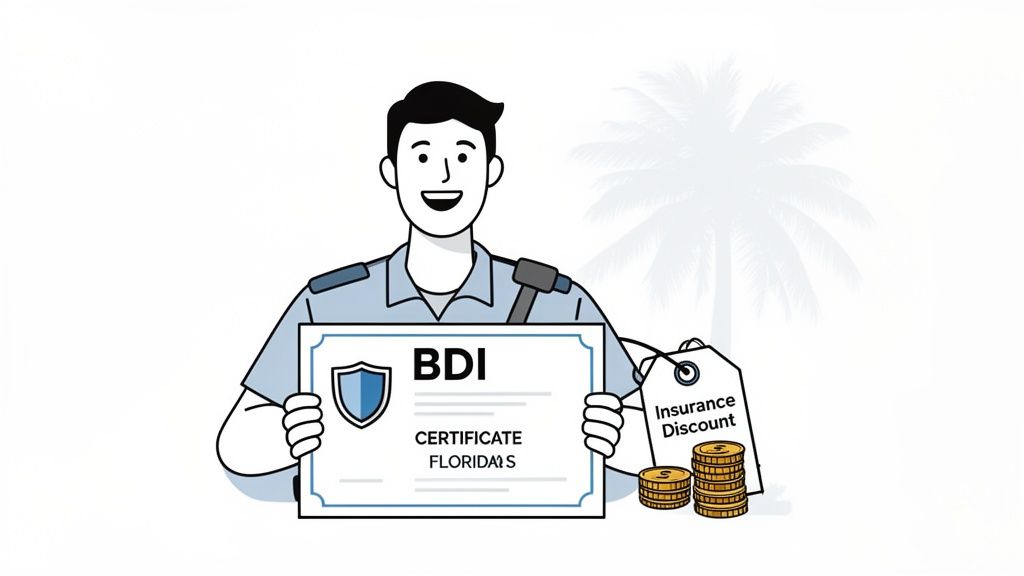
It's one thing to understand the principles of defensive driving, but it's another thing entirely to see those skills turn into real, tangible rewards. That’s exactly where a formal Basic Driver Improvement (BDI) course comes in. It’s not just about theory; it’s about unlocking clear legal and financial advantages, especially right here in Florida.
The perks go well beyond simply becoming a safer driver. They have a direct, positive impact on your driving record and your wallet. For many drivers, taking a BDI course is a smart, proactive move after getting a traffic ticket.
Protect Your Driving Record
In Florida, one of the biggest wins from completing a BDI course is keeping points off your license. When you get a non-criminal moving violation, you have the option to take a state-approved course to prevent those points from ever hitting your record.
This is a huge deal. Letting points pile up can lead to a suspended license and sky-high insurance premiums that follow you for years. A BDI course basically gives you a clean slate for that one ticket, shielding your record from long-term damage. It’s also the perfect way to satisfy a court order if you were required to take a class for your violation.
Secure Significant Insurance Savings
Let's be honest: insurance companies are all about managing risk. The less of a risk you appear to be, the less you'll pay. Completing a defensive driving course is one of the clearest signals you can send your insurer that you’re a responsible driver who is less likely to get into an accident.
As a result, many insurance companies offer some pretty hefty discounts—often up to 10%—for drivers who voluntarily complete a BDI course. Those savings can quickly add up, often paying for the cost of the course itself and then some. It's a simple, smart financial move.
Completing a course signals to insurers that you've actively invested in improving your skills, reducing their financial risk and earning you a lower premium in return.
To give you a clearer picture, let's break down exactly how a defensive driving course can work in your favor.
How a Defensive Driving Course Benefits You
This table shows the main advantages you can expect after completing a certified program in Florida.
| Benefit Category | Specific Advantage | How It Helps You |
|---|---|---|
| Legal & Record | Point Dismissal | Prevents points from a moving violation from being added to your license. |
| Legal & Record | Satisfy Court Orders | Fulfills legal requirements mandated by a judge for a traffic offense. |
| Financial | Insurance Discount | Lowers your auto insurance premium, often by up to 10%, for years. |
| Financial | Avoid Fines/Fees | Can help reduce fines associated with a ticket or prevent future, more costly violations. |
| Personal Safety | Enhanced Skills | Teaches you advanced techniques to anticipate and react to road hazards. |
| Personal Safety | Increased Confidence | Gives you peace of mind, knowing you have the training to handle unexpected situations. |
The benefits clearly stack up, making the decision to enroll a no-brainer for most drivers.
Beyond all the numbers and legalities, there's an undeniable personal benefit. The skills you gain give you a newfound confidence behind the wheel. Knowing you’re prepared for whatever the road throws at you makes every trip feel safer and less stressful.
If you’re ready to start seeing these benefits for yourself, it's easy to get started. You can enroll in a Florida BDI course online and complete it entirely at your own pace.
How to Choose the Right Florida Driving Course
Alright, you're sold on the benefits of taking a defensive driving course. That's great! The next hurdle is figuring out which one to actually sign up for. With so many options out there, picking the right program is the key to making sure your time and money are well spent.
Don't worry, the process is pretty straightforward once you know what to look for.
The absolute first thing you need to check is state approval. In Florida, this is non-negotiable. Any legitimate traffic school has to be officially approved by the Florida Highway Safety and Motor Vehicles (FLHSMV). If it’s not, your certificate won't be worth the paper it's printed on for ticket dismissal, court orders, or that insurance discount you want.
Before you even think about enrolling, double-check the provider’s credentials on the official FLHSMV website. It's a simple step that guarantees the certificate you earn will be accepted by courts and insurance companies statewide.
Matching the Course to Your Needs
Once you’ve confirmed a school is legit and state-approved, it's time to pick the right course for you. They aren't all the same, and each one is built for a different reason.
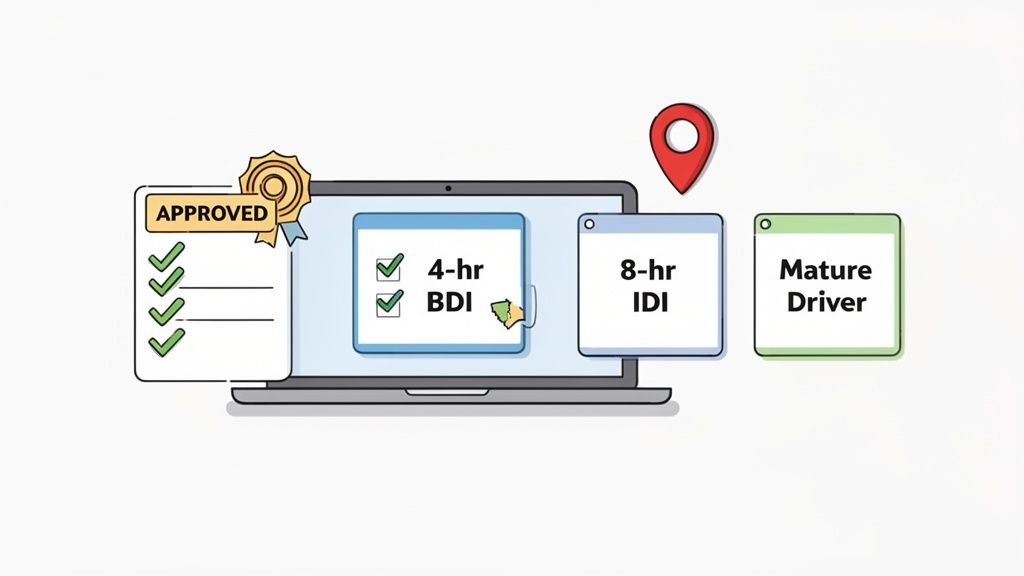
Here’s a quick rundown of the most common Florida courses:
- 4-Hour Basic Driver Improvement (BDI): This is the one most people need. If you got a standard speeding ticket or other non-criminal moving violation, this course will keep the points off your license. It's also the one you'd take voluntarily for an insurance discount.
- 8-Hour Intermediate Driver Improvement (IDI): Sometimes called "8-Hour DDS," this one is usually for more serious situations. A judge might order you to take it, or you might need it if you've already taken the BDI course within the last 12 months.
- Mature Driver Course: This course is designed specifically for drivers who are 55 and older. It’s a great refresher on traffic laws and addresses age-related driving changes, which almost always qualifies you for a mandatory insurance discount.
Getting this right from the start saves you the major headache of having to take a second course because you chose the wrong one.
The core principle is simple: match the course directly to your reason for taking it. If you have a ticket, the 4-Hour BDI is your solution. If a judge told you to take a class, the 8-Hour IDI is likely what you need.
Why Online Flexibility Matters
Let's be honest—life is busy. The last thing you want to do is waste a weekend sitting in a stuffy classroom. An online course gives you the freedom to get it done on your schedule, wherever you have an internet connection.
This is a game-changer for working professionals, parents with chaotic schedules, or students juggling classes. You can chip away at the material whenever you have a spare moment—a chapter during your lunch break, another after the kids are in bed. You can explore plenty of flexible online defensive driving courses that fit right into your life, not the other way around.
Look for a school whose course is fully mobile-friendly. That way, you can switch between your laptop, tablet, and phone without losing your place. By focusing on FLHSMV approval, matching the course to your needs, and finding one with online flexibility, you’ll be set up for success.
Ready to Become a Safer, More Confident Driver?
Let’s be honest: defensive driving is more than just a set of rules you memorize for a test. It’s a complete shift in how you think behind the wheel. It's about developing a constant state of awareness and making smart, safe choices second nature. When you adopt these skills, you’re no longer just reacting to what happens around you—you’re actively managing your space and anticipating what’s coming next.
This isn't just about protecting yourself. It's about keeping your passengers safe and doing your part to make the road safer for everyone. Driving stops being a source of stress and starts becoming an activity you feel completely in control of, even when things get unpredictable.
Driving defensively means you're not just a passenger along for the ride, hoping for the best. You're the pilot, actively creating a bubble of safety around your vehicle.
So, where do you start? The most straightforward path is taking a state-approved course, like the Florida BDI program. Think of it as an investment that pays you back in multiple ways: potential insurance discounts, a cleaner driving record, and—most importantly—the confidence that you can handle whatever the road throws at you.
It all starts with that first step. Take control of your safety and become the driver you know you can be.
Common Questions About Defensive Driving in Florida
Even after getting the hang of what defensive driving is all about, you probably still have some questions. That's normal. Let's tackle a few of the most common ones we hear from drivers here in the Sunshine State, especially when it comes to traffic school, points, and insurance.
Answering Your Top Questions
One of the biggest points of confusion is about your driving record. People often ask if a course "removes points." In Florida, a Basic Driver Improvement (BDI) course works a bit differently—and frankly, it's better. If you choose to take a course after getting a non-criminal moving ticket, it prevents the points from being added to your license in the first place.
Think of it as stopping a problem before it starts, keeping your driving record clean from that specific violation.
Another big question is about the money. How much can you really save on car insurance? The answer depends on your insurance company, but many Florida providers offer a nice discount, often up to 10%, for drivers who voluntarily take a BDI or a mature driver course. The best move is always to give your agent a quick call to see what kind of discount you qualify for.
And with so many options online, it’s smart to ask: are these courses even legit?
The answer is a definite yes, but with one huge catch: the provider must be approved by the Florida Highway Safety and Motor Vehicles (FLHSMV). If they aren't on that official list, the certificate you get won't be recognized by the courts or your insurance company.
Making that commitment to better driving habits is a great step. It's also worth looking into what it means to be recognized as a safe driver on your Florida license and the perks that come along with it.
Finally, "How long does it take?" The standard BDI course is 4 hours long. But the real advantage of doing it online is the flexibility. You don't have to block out an entire afternoon. You can break it up and work through the material whenever it fits your schedule.
Florida Defensive Driving FAQs
To make things even clearer, here are some quick answers to the most frequently asked questions we get about Florida defensive driving courses.
| Question | Answer |
|---|---|
| Will a defensive driving course remove points from my Florida license? | In Florida, if you elect to take a Basic Driver Improvement (BDI) course for a non-criminal moving violation, you can prevent points from being assessed on your license. This isn't removing existing points, but rather stopping them from being added in the first place. |
| How much can I save on car insurance with a BDI course? | Insurance discounts vary by provider, but many Florida insurers offer a reduction of up to 10% for voluntarily completing a defensive driving or mature driver course. You should always check with your specific insurance agent to confirm the discount amount and eligibility requirements. |
| Is an online defensive driving course legitimate in Florida? | Yes, as long as the provider is approved by the Florida Highway Safety and Motor Vehicles (FLHSMV). Approved online courses offer the same benefits as in-person classes but with the added flexibility to complete the material at your own pace from anywhere. |
Hopefully, this clears up some of the main questions you might have about handling a ticket or just trying to become a safer driver in Florida.
Ready to protect your driving record and lower your insurance costs? BDISchool offers fully FLHSMV-approved online courses that are flexible, engaging, and designed for Florida drivers. Enroll today and take the first step toward becoming a safer, more confident driver at https://bdischool.com.