Have you ever felt a jolt of panic when something—a deer, a stalled car, a pedestrian—suddenly appears in your headlights at night? That heart-stopping moment is often the result of a common but incredibly dangerous habit: overdriving your headlights.
So, what does that actually mean? Put simply, you're driving so fast that you can't stop your car inside the distance you can see illuminated by your headlights. You're effectively moving faster than your own vision, creating a blind zone right in front of you where surprises can hide.
The Physics Behind the Phrase
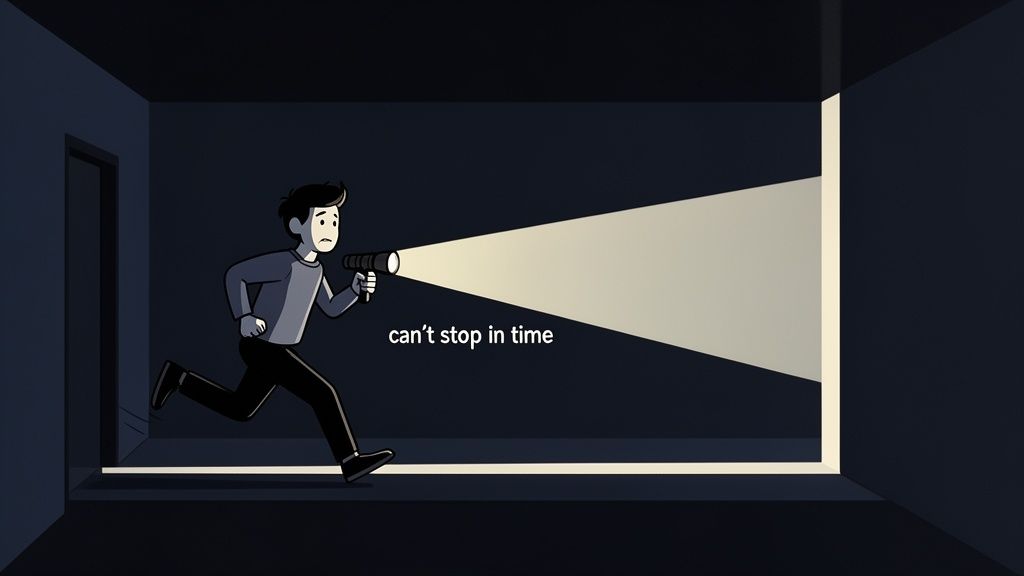
Think of it like this: you're sprinting down a dark hallway holding a small flashlight. If you're running too fast, you'll slam into the wall at the end of the hall before the light even shows it to you. That's exactly what happens in your car. Your speed is literally outrunning the beam of your headlights.
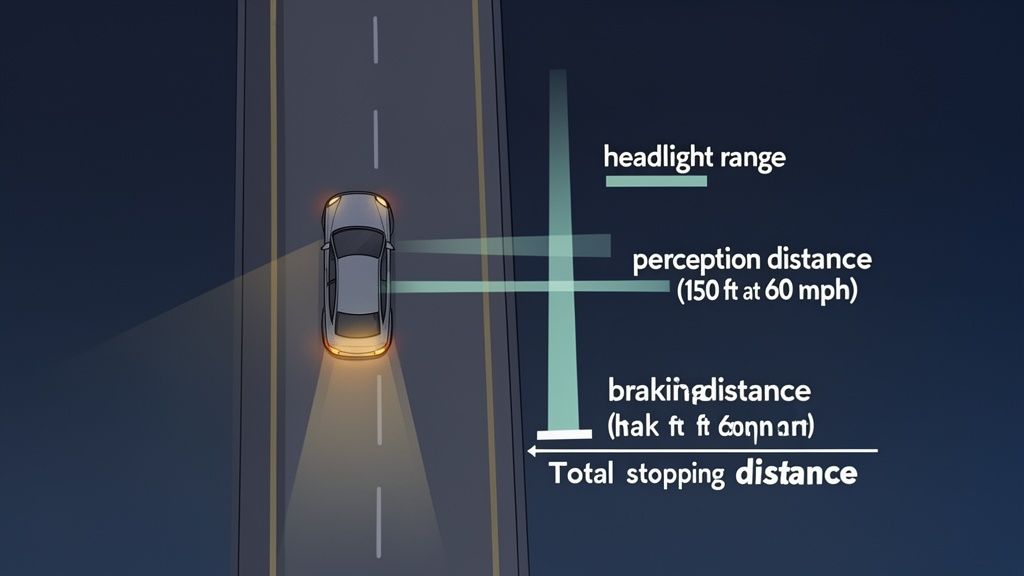
This isn't just a saying; it's a dangerous mismatch of physics and perception. To understand it, you have to look at your car's total stopping distance, which is made up of two distinct parts:
- Perception and Reaction Distance: This is how far your car travels from the instant your brain registers a hazard to the moment your foot actually presses the brake. Even for an alert driver, this takes time. At 60 mph, you can travel more than 150 feet before you even start braking.
- Braking Distance: This is the distance your car skids or rolls after the brakes are engaged until it comes to a dead stop.
When you add those two together and the total is longer than your headlight range, you are driving blind. You're committing to a stretch of road you can't see, hoping it's clear.
A Game of Feet and Inches
Here’s where the numbers get scary. Your average low-beam headlights only light up the road for about 160 to 200 feet. That sounds like a decent distance, but it gets eaten up incredibly fast as your speed climbs. At just 50 mph on a dry road, your car needs more than 200 feet to come to a complete stop.
The math is already working against you.
This chart drives the point home, showing the alarming gap between how far you can see and how far your car travels before it can actually stop.
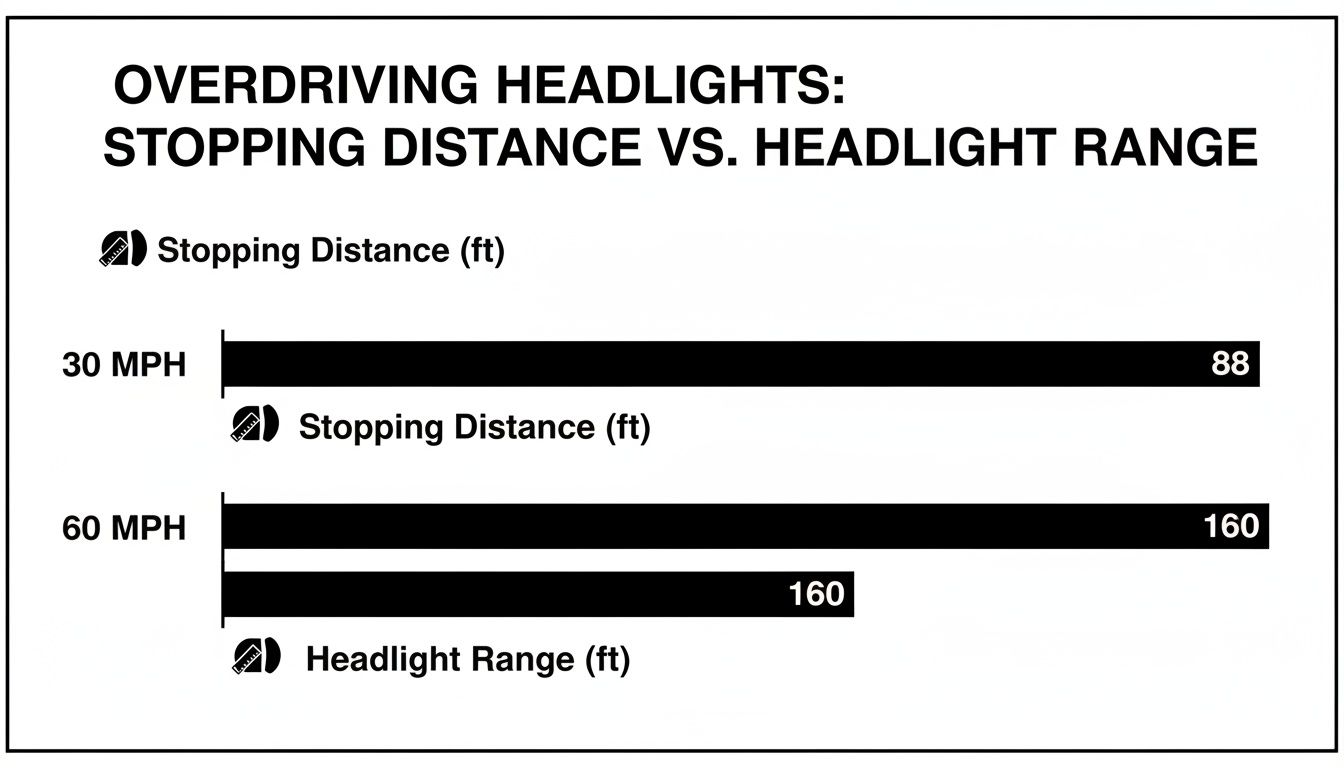
As you can see, once you hit highway speeds, your stopping distance balloons, far exceeding what your headlights can reveal. You're left with absolutely no time to react to a sudden obstacle.
When Vision and Stopping Distance Don't Match Up
This table breaks down the critical gap between how far your low beams let you see and the actual distance your car needs to stop at various speeds. The results are eye-opening.
| Speed (MPH) | Perception and Reaction Distance | Braking Distance | Total Stopping Distance | Average Low-Beam Headlight Range | Are You Driving Blind? |
|---|---|---|---|---|---|
| 40 | 117 ft | 80 ft | 197 ft | 160-200 ft | Yes, barely. |
| 50 | 147 ft | 125 ft | 272 ft | 160-200 ft | Yes. |
| 60 | 176 ft | 180 ft | 356 ft | 160-200 ft | Yes, significantly. |
| 70 | 205 ft | 245 ft | 450 ft | 160-200 ft | Yes, dangerously. |
Note: Distances are estimates for an average passenger vehicle on dry pavement and can vary based on driver alertness, tire condition, and road surface.
The data is clear: at most common driving speeds, your ability to stop falls dangerously short of what you can see. That gap is where accidents happen.
The Unforgiving Physics of Stopping at Night
To really get why overdriving your headlights is so risky, we need to look at a simple but non-negotiable bit of physics. Your total stopping distance isn't just about slamming on the brakes. It’s actually a two-part process that starts the second your brain spots a problem.
First, there's your perception-reaction distance. Think of this as the ground you cover while your brain sees a hazard, processes the information, and finally tells your foot to hit the brake. This all feels instantaneous, but your car is still moving the whole time.
Then you have the braking distance. This is the physical distance your car travels from the moment the brakes engage until it grinds to a complete stop. Add those two together, and you get a number that’s often much bigger than you’d expect, particularly at higher speeds.
Breaking Down the Math
The numbers don't lie, and at night, they paint a pretty sobering picture. Typical low-beam headlights only light up the road for about 160 to 200 feet. But if you're driving at 60 mph, your total stopping distance can easily top 200 feet. You're literally driving faster than you can see.
The core problem is that your stopping distance increases exponentially with speed, while your headlight range remains fixed. A small increase in speed creates a massive increase in the road required to stop safely.
This dangerous mismatch is the very definition of overdriving your headlights. You’re effectively creating your own blind spot right in front of you. If you’re interested in the nitty-gritty formulas, we break down exactly how to calculate stopping distance in another guide.
Of course, this all assumes your car is in top shape. Simple things like maintaining correct tire pressure are crucial for getting the best possible grip and shortest stopping distance. Every component has to work together to keep you safe on the road after dark.
Where You're Most Likely to Out-Drive Your Headlights
The risk of overdriving your headlights isn't just for deserted highways late at night. It's a danger that pops up in everyday driving, especially on Florida's varied roads. The key is learning to spot these situations before you're in them.
Some road conditions and weather naturally shrink what you can see, making it dangerously easy to go too fast. You have to anticipate these moments and slow down proactively, not after it's too late.
Common Trouble Spots on the Road
When you encounter these conditions, your first instinct should be to ease off the accelerator. You need to give yourself enough room to stop well within the bubble of light your car creates.
Cresting a Hill: As you climb, your headlights aim up into the sky, leaving the other side completely hidden. You are essentially driving blind over the peak, with no idea what's waiting for you on the downhill side.
Sharp Curves: On a tight bend, your headlights shine straight ahead into the trees or shoulder. The actual road around the curve stays dark until you're already turning into it, giving you zero time to react to a stopped car or debris.
Bad Weather: Florida is famous for its sudden downpours and thick morning fog. This kind of weather can cut visibility down to almost nothing. In heavy rain, you might be overdriving your headlights even at 35 mph.
The golden rule is this: you must be able to stop inside the distance you can see. If your headlights light up a patch of road ahead, and you can't come to a complete stop within that patch, you are going too fast.
It’s Not Just About the Road
External factors are only half the battle; your own condition is just as important. Driver fatigue is a huge factor in nighttime crashes because it slows your brain down, dramatically increasing how long it takes you to perceive and react to a threat.
A tired driver needs more time and more distance to stop. When you combine fatigue with a sharp curve or a foggy morning, you're setting yourself up for a potential disaster. A routine drive can quickly become a life-or-death situation.
How Weather and Vehicle Weight Amplify the Risk

The stopping distance math we’ve been talking about assumes perfect, dry conditions. But let's be honest—night driving is rarely that straightforward. Throw in factors like bad weather or a heavy vehicle, and the entire equation changes, making it frighteningly easy to overdrive your headlights even when you think you're going slow.
Anyone who’s driven through one of Florida's sudden downpours knows this feeling. A slick, wet road can easily double the distance you need to brake, turning a perfectly safe speed into a dangerous one in a heartbeat. The risk gets even worse when water starts to pool, creating the perfect conditions for hydroplaning. You can learn more about exactly what is hydroplaning in our other guide.
On a wet road, your tires just can't get the same grip. The friction you rely on to stop is drastically lower, meaning a speed that feels completely fine in the dry could leave you unable to stop within the bubble of light your headlights provide.
Heavier Vehicles Need More Room
Another huge factor that often gets overlooked is the weight of your vehicle. It’s simple physics: a heavier object needs more energy (and more distance) to stop. That means the fully-loaded SUV you take on family trips needs a lot more real estate to come to a halt than a small sedan.
- Family SUVs: Once you've packed in the kids and all their gear, your SUV’s braking distance is going to be much longer than it is when the car is empty.
- Work Trucks: A pickup loaded down with tools and materials can see its stopping distance jump by 25% or more.
Even with today's advanced headlights, drivers still get caught overdriving them, especially during those infamous Florida rainstorms. While 45 mph might be cutting it close on dry pavement (with typical headlights illuminating 160-200 feet), wet roads can force you to slow down to 35 mph or less to stay safe.
Proven Techniques to Stay Within Your Light
Knowing the danger is one thing; actively avoiding it is another. It all comes down to building a few smart habits behind the wheel. The good news is you don't need fancy gadgets, just solid defensive driving strategies that will eventually become second nature.
The single best method is to adopt the four-second rule for night driving. This is simply a nighttime adjustment to the standard two-second rule you might use during the day.
It's easy to do. Just find a fixed object up ahead, like a bridge or a road sign. When the car in front of you passes it, start counting slowly: "one-thousand-one, one-thousand-two, one-thousand-three, one-thousand-four." If you pass that same object before you finish counting, you're following too closely for dark conditions. That extra buffer is your safety net, giving you the time and space to stop inside the pool of light from your headlights.
Fine-Tuning Your Vehicle and Your Vision
Beyond just watching your speed, a few simple checks and habits can dramatically improve your nighttime vision. The idea is to see as much as possible while helping others see you, too.
- Master Your High Beams: Don't be shy about using your high beams on dark, empty roads. They can light up the road for up to 400 feet, which is a massive advantage. Of course, be ready to dim them the instant you see another car approaching or when you start to close in on a vehicle ahead.
- Keep Headlights Clean and Aligned: You might be surprised to learn that a layer of dirt or a misaligned headlight can slash its effective range by up to 50%. A quick wipe before a night drive and a periodic alignment check are small chores with a huge safety payoff.
- Scan the Road's Edges: It’s easy to get tunnel vision and just stare at the taillights ahead. Instead, make a conscious effort to scan from side to side. Watching the shoulders of the road helps you spot pedestrians, deer, or stalled cars long before they become an immediate hazard.
The goal is simple: create a safety bubble around your car that’s always bigger than the distance you need to stop. When you manage your speed and actively look for hazards, you’re the one in control.
Making these core defensive driving techniques part of your routine does more than just keep you safe. It builds confidence and makes you a much smarter driver long after the sun goes down.
The Legal and Financial Fallout in Florida
Outrunning your headlights isn’t just a dangerous gamble with physics; it has real-world legal and financial consequences, especially here in Florida. If you cause an accident because you were driving too fast for the conditions—whether it's pitch-black darkness or a heavy downpour—you can be found at fault.
This holds true even if you were technically driving under the posted speed limit. Law enforcement will often issue a citation for careless driving in these situations. Florida law is pretty straightforward on this: you’re required to drive in a “careful and prudent manner.” Overdriving your headlights is a clear failure to meet that standard, putting both your driving record and your bank account on the line.
Points on Your License, Hits to Your Wallet
A careless driving ticket is more than just a fine. It can add points to your license, which almost always triggers a nasty spike in your car insurance premiums that can follow you for years.
Insurers see this kind of at-fault accident as a major red flag for risky behavior, and they'll adjust your rates to match. The financial sting from one bad decision on a dark road can be surprisingly long-lasting.
In Florida, causing an accident by overdriving your headlights isn't just an honest mistake—it's a preventable violation with serious consequences for your license, your insurance, and your future on the road.
Luckily, you have options to soften the blow. For many citations, you can complete a state-approved Basic Driver Improvement (BDI) course to keep the points off your record. This simple step can save you from those painful insurance hikes and is a smart move to protect your driving privileges. Getting familiar with the Florida traffic ticket point system is the best way to understand your options after getting a ticket.
Taking a BDI course shows the state and your insurance company that you're serious about being a safer driver. It's a proactive way to turn a bad situation into a valuable lesson, all while keeping your record clean and your insurance costs down.
Common Questions About Driving at Night
Let's wrap up by tackling a few questions we hear all the time from drivers about staying safe when the sun goes down.
At What Speed Do You Start Overdriving Your Headlights?
There’s no single answer here, since it really comes down to the road conditions at that moment. But as a general rule of thumb, on a dry, flat road, most cars with standard low-beam headlights will start overdriving them right around 50 mph.
Now, throw in some rain—a regular occurrence here in Florida—and that safe speed drops dramatically. You could be overdriving your headlights at just 35 mph in wet conditions. The key is to constantly ask yourself: can I stop within the patch of road I can actually see?
Do Modern LED Headlights Fix This?
Not quite. While high-tech LED or adaptive headlights are a huge improvement and light up the road much better, they can't change physics. They might give you a longer, wider beam of light, but your car still needs the same distance to come to a complete stop.
It's easy to get a false sense of security with bright, modern headlights. You can still outrun even the best lighting system if you're going too fast for the conditions, so you have to stay just as sharp.
How Can a Defensive Driving Course Help?
A good defensive driving course is about so much more than just the basic rules of the road. It gives you practical, real-world strategies to spot and manage risks before they turn into real trouble. You'll get hands-on with techniques like:
- Using the "four-second rule" to keep a safe distance at night.
- Learning how to scan the sides of the road where hazards often appear first.
- Proactively adjusting your speed for curves, hills, and bad weather.
These are the skills that put you in control and help you avoid the trap of overdriving your headlights.
Ready to become a safer, more confident driver and keep your record clean? BDISchool offers convenient and effective Florida-approved online courses. You can enroll today and get started.