When you hear the term "impaired driving," your mind probably jumps straight to drunk driving. That's a huge part of the picture, but it's not the whole story.
Impaired driving is operating any vehicle—a car, truck, or motorcycle—when your ability to do so safely is compromised. This isn't just about alcohol. It could be due to illegal drugs, prescription medications you got from your doctor, or even just being flat-out exhausted. The bottom line is that something is interfering with your judgment, reaction time, and coordination, turning a simple drive into a life-threatening risk.
Defining What Impairment Really Means
Think of your brain as the central command center for driving. It’s constantly processing what your eyes see, making near-instant decisions, and sending signals to your hands and feet. Driving impairment is like a virus corrupting that system. It slows everything down, scrambles the signals, and leads to dangerous errors.
This "virus" can come from many sources. While a few beers are a well-known culprit, a prescribed painkiller can be just as dangerous by dulling your reflexes. Pulling an all-nighter can affect your brain in a way that's scarily similar to being drunk, leading to poor decisions and delayed reactions. For those interested in the legal specifics, resources covering Operating While Impaired Cases can offer a deeper dive.
The Four Main Types of Driving Impairment
To get a real handle on what is impaired driving, we have to look past the stereotype of just alcohol. The real danger comes from anything that weakens your ability to drive safely.
Let's break down the four most common ways a driver can be impaired. This table gives a quick overview of what they are, where they come from, and how they mess with your driving.
The Four Main Types of Driving Impairment
| Type of Impairment | Common Causes | Primary Effect on Driving |
|---|---|---|
| Alcohol Impairment | Beer, wine, liquor | Slows reaction time, impairs judgment, reduces coordination. |
| Drug Impairment | Illegal drugs (marijuana, cocaine), prescription or over-the-counter meds. | Varies widely; can cause drowsiness, dizziness, or aggression. |
| Fatigue Impairment | Lack of sleep, long work hours, driving for extended periods. | Inattention, delayed reactions, poor decision-making ("microsleeps"). |
| Medical Impairment | Seizure disorders, diabetic emergencies, vision problems, etc. | Sudden and unpredictable loss of vehicle control. |
Each of these can be just as deadly as the others. The specific cause might be different, but the result is the same: a driver who is a danger on the road.
The common thread is a diminished capacity to operate a vehicle safely. Whether it’s slowed reflexes from medication or blurred vision from alcohol, the outcome is a driver who poses a significant threat to themselves and others on the road.
Understanding these different forms of impairment is the first step toward preventing a tragedy. It's crucial to recognize that legal substances and simple exhaustion can be just as hazardous as illegal drugs. This kind of broad awareness is a cornerstone of defensive driving and ties directly into understanding all road risks, like those we cover in our distracted driving awareness guide.
The Sobering Reality of Impaired Driving Statistics
To truly grasp what impaired driving means, you have to look past the legal definitions and face the real-world consequences. The numbers paint a grim picture, showing how a single bad choice can fuel a staggering number of preventable tragedies on our roads every single year. These aren't just figures on a page; they represent families, friends, and futures torn apart by someone's decision to get behind the wheel when they shouldn't have.
On a global scale, the problem is absolutely massive. Impaired driving is one of the deadliest—and most preventable—causes of traffic fatalities. According to the World Health Organization, road traffic crashes claim around 1.19 million lives annually. Think about that. Of those deaths, an estimated 273,000 involve at least one drunk driver. These global drink driving statistics truly put the worldwide impact into perspective.
The Impact Here in the United States
Closer to home, the statistics are just as jarring. In the United States, alcohol-impaired driving plays a role in nearly 30% of all traffic crash fatalities, making it one of the top killers on American roads. The National Highway Traffic Safety Administration (NHTSA) reported that in 2023 alone, 12,429 people died in crashes that involved an alcohol-impaired driver. That works out to one death every 42 minutes—a constant, heartbreaking reminder of the human cost.
This infographic breaks down the main ways drivers become impaired, highlighting how each one contributes to the danger we all face on the road.

As you can see, impairment isn't just about one thing. Alcohol, drugs, simple exhaustion, and even medical conditions all create significant, life-threatening risks behind the wheel.
Beyond the Numbers: A Human Story
Statistics can start to feel abstract, but behind every single number is a story of devastating loss. Take the experience of Mahi, a teenager whose father was hit by a drunk driver. The crash left him with a severe traumatic brain injury, rendering him unable to walk, talk, or even eat on his own.
"I have come to realize that more than one person is impacted by a drunk driving incident, which is why people must speak up. From my story, I hope that more teens spread awareness about the dangers of consuming alcohol and drugs and driving on the road while intoxicated."
Her family's life was turned upside down in an instant, proving that the consequences of impaired driving ripple outward, impacting entire communities. These personal accounts, when paired with the hard data, make it crystal clear why Florida's laws are so strict—and why ongoing driver education isn't just a legal hoop to jump through, but a moral imperative. The ultimate goal is to stop these tragedies before they ever have a chance to happen.
Florida's DUI Laws: Understanding the Lines You Can't Cross
When it comes to impaired driving, Florida doesn't mess around. The state’s laws are strict for a reason—to keep everyone on the road safe. Getting a handle on these rules isn't just for lawyers; it’s something every single driver needs to know, because one mistake can upend your life, your finances, and your freedom.
At the heart of it all is a term you've probably heard: Blood Alcohol Concentration, or BAC. It’s not about how sober you feel. It’s a hard number, a scientific measurement of the alcohol in your bloodstream that determines, in the eyes of the law, whether you are too impaired to drive.
The Numbers That Matter: Florida's BAC Limits
Florida law is black and white on this. There are specific BAC limits for different drivers, and knowing where you fall is non-negotiable. If you're over the line, you are legally driving under the influence. It’s that simple.
To make this crystal clear, here’s a breakdown of the legal limits in Florida.
| Driver Category | Legal BAC Limit | Key Consequence for Exceeding Limit |
|---|---|---|
| Standard Drivers (21+) | 0.08% | Considered legally impaired to drive. |
| Commercial Drivers | 0.04% | A much lower threshold due to the responsibility of operating large vehicles. |
| Drivers Under 21 | 0.02% | A Zero Tolerance policy; virtually any detectable alcohol can lead to a DUI. |
As you can see, the more responsibility you carry behind the wheel, the less tolerance the law has for any level of impairment. Staying current on all traffic regulations is part of being a safe driver, which you can do by reviewing a good guide on Florida's state driving laws.
Here’s something most people get wrong: they think they’re in the clear as long as they blow below a 0.08%. But Florida law is smarter than that. You can still be convicted of a DUI with a lower BAC if an officer can prove your "normal faculties" were impaired.
The Fine Print: What "Implied Consent" Really Means
There’s another crucial piece of the puzzle: Implied Consent. The moment you receive your Florida driver's license, you’ve already given your legal consent to take a breath, urine, or blood test if a police officer has probable cause to believe you’re driving impaired.
Think you can just say no? Think again. Refusing the test isn't a get-out-of-jail-free card; it comes with its own severe and immediate penalties.
- A first-time refusal means an automatic one-year license suspension.
- A second refusal gets you an 18-month suspension and can even be charged as a separate misdemeanor.
This law gives law enforcement the authority they need to get dangerous drivers off the road. It essentially closes any loopholes, making it clear that refusing to cooperate carries its own heavy price. Understanding these rules isn’t about finding ways around them—it’s about making the right choice before you even turn the key.
Recognizing the Signs of an Impaired Driver
Your best defense against a drunk or otherwise impaired driver is knowing what to look for before they get too close. Think of it as defensive driving 101: if you can spot erratic behavior from a distance, you can give yourself the space needed to stay safe.
It's all about anticipating the threat and making a smart move.
An impaired driver almost always leaves a trail of clues. Their coordination is shot, their judgment is clouded, and it becomes nearly impossible for them to handle a multi-ton machine with the care it requires. These aren't just minor mistakes; they're giant, waving red flags that something is dangerously wrong.

Common Warning Signs of Impairment
So, what should you be on the lookout for? If you spot someone doing several of these things, it's a pretty safe bet they shouldn't be driving.
- Can't Stay in Their Lane: This is the big one. Weaving, swerving, drifting onto the shoulder, or hugging the center line are classic signs of impairment.
- Weird Speed Changes: Watch for anyone going 10 mph or more under the speed limit for no good reason. They might also speed up and slow down for no reason at all.
- Braking and Stopping Strangely: This could be anything from slamming on the brakes in the middle of the road to stopping way too early—or too late—for a stop sign.
- Bad Judgment Calls: You might see them taking turns way too wide, nearly clipping parked cars, or taking forever to react when a light turns green. Forgetting to turn on headlights at night is another telltale sign.
The moment you spot these behaviors, your goal changes. It's no longer about getting where you're going on time. Your new mission is to create a safe buffer zone between your car and theirs.
Your Action Plan for Staying Safe
Okay, so you've spotted a potentially impaired driver. Now what? Your actions in the next few moments are critical. Whatever you do, don't try to be a hero and stop them yourself.
- Create Space: Your first move is to back off. Slow down and give them plenty of room—at least a five or six-second following distance. This gives you time to react if they do something sudden.
- Don't Try to Pass: It's tempting to just get around them, but it's incredibly risky. An erratic driver could easily swerve into your lane as you're passing. Just hang back.
- Pull Over and Report: Once it's safe, pull over. Call 911. Give the dispatcher the location, which way the car is headed, the license plate number if you can get it, and a quick description of the car and what it's doing.
This is what real defensive driving looks like in action. By staying alert and making that call, you're not just protecting yourself—you're looking out for everyone else on the road, too.
The True Cost of a DUI in Florida
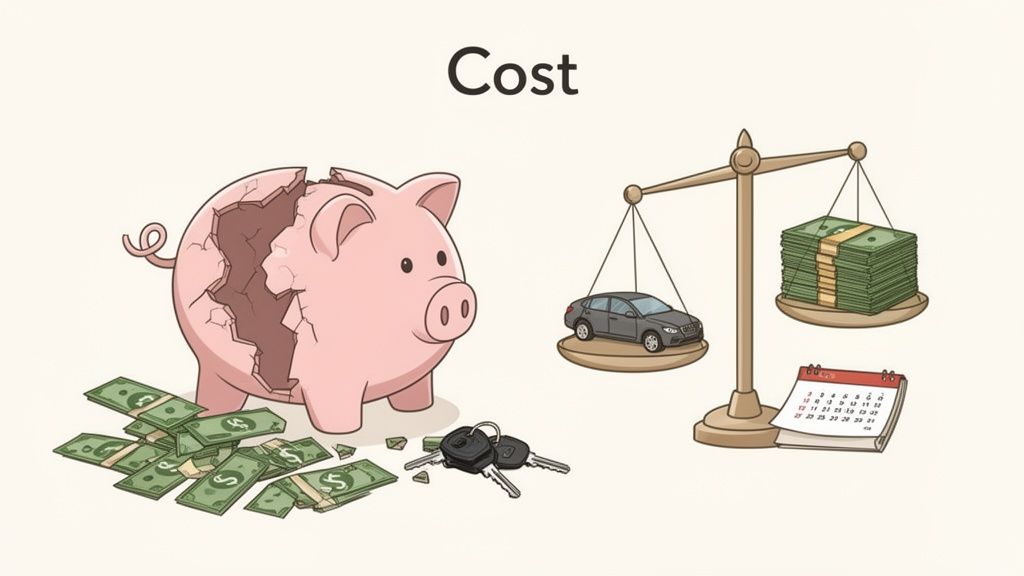
Getting a DUI in Florida isn't just a bad day in court—it's a financial and personal earthquake that can rattle your life for years. The initial sticker shock is bad enough, but the real cost of impaired driving creates aftershocks that hit your wallet, your freedom, and your future in ways you never saw coming.
The immediate penalties are designed to be swift and severe. This isn't just about a fine. A conviction means an instant driver's license suspension, forcing you to depend on friends, family, or public transit to get around. On top of that, your car might be impounded, tacking on more fees and headaches. Many drivers are also ordered to install an Ignition Interlock Device (IID) in their vehicle at their own expense—a pricey and constant reminder of one bad decision.
The Hidden Financial Drain
Think the court-ordered fines are the worst part? Think again. The real, long-term financial pain comes from all the other expenses that pile up, turning a one-time mistake into a multi-year burden.
- Skyrocketing Insurance Premiums: Once you have a DUI, insurance companies see you as a major risk. Your rates can easily double or even triple, and that financial penalty can stick with you for three to five years. We're talking about thousands of extra dollars.
- Legal Fees: You'll want a lawyer, and they aren't cheap. Attorney fees for a DUI defense can quickly climb into the thousands, even if it's your first offense.
- Court Costs and Fines: The base fine is just the start. You'll also be on the hook for court fees, administrative charges, and the cost of mandatory DUI school. Plus, right after an arrest, there are immediate expenses like bail. It's why understanding DUI bail costs is another critical piece of the financial puzzle.
Consequences That Go Beyond Money
Frankly, some of the most damaging costs of a DUI have nothing to do with money. A conviction leaves a permanent stain on your record that can torpedo your career, especially if your job involves driving or requires a professional license. It can also do serious damage to your reputation and put a major strain on your relationships with family and friends.
The loss of freedom is arguably the most jarring consequence. From the moment of arrest through probation and simply not being able to drive to the grocery store whenever you want, a DUI takes away your independence and puts someone else in control of your life.
This reality check highlights the devastating human toll of impaired driving. In the U.S., alcohol is a factor in about 30% of all traffic crash fatalities. According to the National Highway Traffic Safety Administration (NHTSA), an astonishing 12,429 people died in these preventable crashes in 2023. That’s one person every 42 minutes.
When you grasp the full weight of the consequences—from the specifics of a driver's license suspension in Florida to these heartbreaking statistics—it’s clear that prevention isn't just a good idea. It's everything.
Your Next Step Toward Safer Driving
Knowing the laws, spotting the signs, and understanding the serious consequences of impaired driving are all essential. But true safety isn't just about knowing the facts—it's about putting that knowledge into practice.
Your next move is about more than just staying out of trouble. It’s a commitment to being a smarter, more responsible driver every single time you start the car.
That's where quality driver education comes in. For any driver in Florida, a state-approved Basic Driver Improvement (BDI) course is one of the best tools you can have. And it’s not just for people who’ve gotten a ticket; it’s for anyone who wants to be safer on the road.
Why A Driving Course Is Such A Smart Move
Think of a BDI course as a tune-up for your driving skills. It’s an opportunity to sharpen your defensive driving techniques, get a clear update on current traffic laws, and really cement your understanding of the dangers of impairment.
If you have recently received a traffic ticket, the benefits are immediate.
- Avoid Points on Your License: Finishing a BDI course can keep points off your driving record, which is a huge help in maintaining a clean slate.
- Keep Your Insurance Rates Down: When you keep points off your license, you also dodge the expensive insurance premium hikes that almost always come with a moving violation.
For everyone else, the course is a practical way to reinforce your commitment to road safety. With the flexibility of online classes, you can easily fit the course into your life, making it simple to invest in your skills.
A traffic school course isn't a punishment. It’s about committing to being a better driver. It’s about mastering the skills that protect you, your loved ones, and everyone else sharing the road.
At the end of the day, taking a defensive driving course is one of the most direct ways to turn what you've learned into habits that can save a life. It gives you the strategies and awareness you need to handle whatever the road throws at you, proving that safe driving is a choice you make long before you even turn the key.
Common Questions About Impaired Driving in Florida
Let's be honest, the rules around impaired driving can feel complicated. When you're trying to do the right thing, a lot of questions can pop up. Here are some straightforward answers to the things drivers in Florida ask most often.
Can Prescription or Over-the-Counter Drugs Really Lead to a DUI?
Yes, they absolutely can. The core question is about impairment, not legality. If a substance—any substance—hinders your ability to drive safely, you can be charged with a DUI in Florida.
This is a really important point. Many perfectly legal medications for pain, anxiety, sleep, or even severe allergies come with side effects like drowsiness, blurred vision, or delayed reactions. It's crucial to read the warning labels and have an honest conversation with your doctor about whether you're safe to get behind the wheel.
Am I Good to Drive the Morning After a Night of Drinking?
That’s a risky assumption. Alcohol doesn't just disappear from your system when you go to sleep. Your body needs time to metabolize it, and that process can take many hours.
Even if you feel okay, you could easily still be over the legal 0.08% BAC limit the next morning. Your weight, how much you drank, and your personal metabolism all play a role. The only thing that truly sobers you up is time.
Many people think a strong coffee or a cold shower will sober them up. While those might make you feel more awake, they do absolutely nothing to lower your BAC. Your impairment level remains the same.
Do Florida's DUI Laws Apply If I'm Just Visiting?
They sure do. Florida's traffic laws apply to anyone driving on its roads, period. It doesn't matter if your license is from Georgia, California, or any other state.
If you get a DUI while visiting the Sunshine State, you'll go through the same legal system and face the same consequences as a local resident. Plus, thanks to interstate agreements, your home state will likely be notified, and you could face license suspension there as well. An out-of-state plate offers zero protection.
A DUI conviction can follow you for years, but knowledge is your best defense. If you want to dive deeper into traffic safety, satisfy a court order, or even lower your insurance premiums, a state-approved course from BDISchool is a great place to start. You can learn more and sign up at https://bdischool.com.