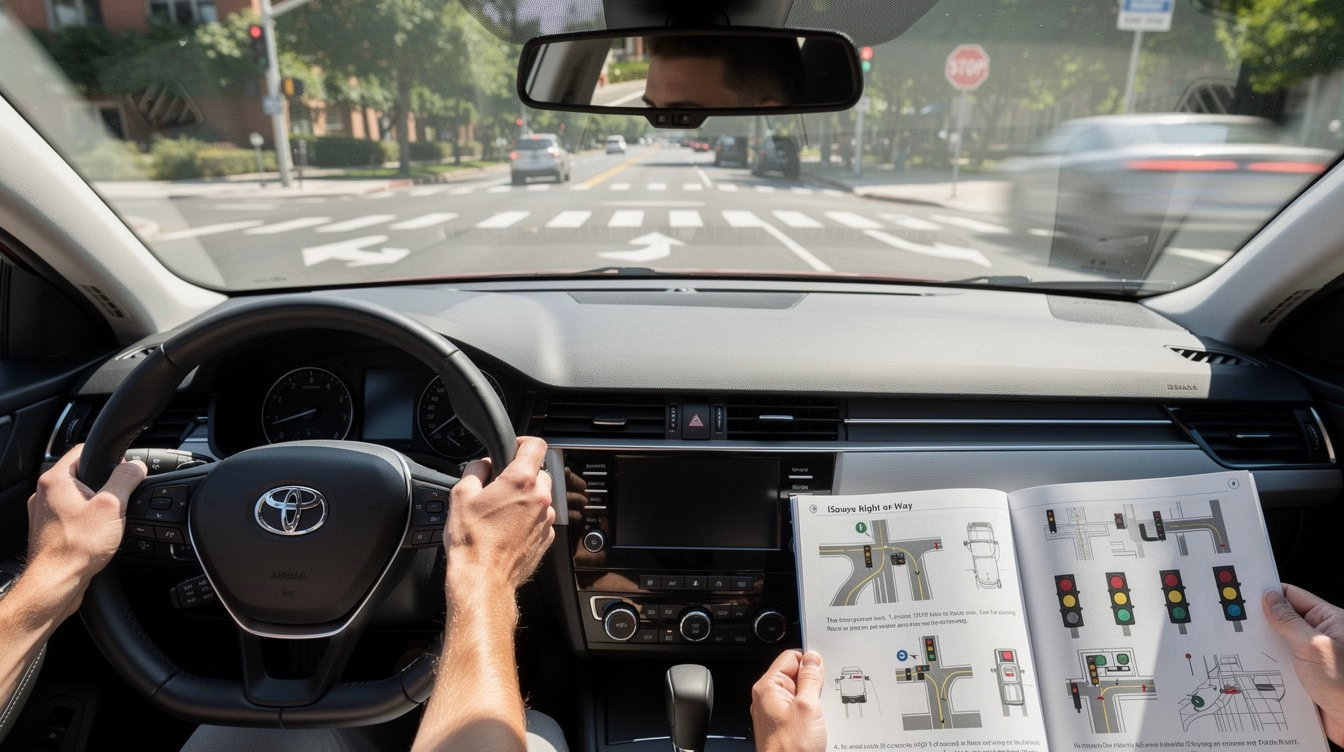
You’re holding a Florida moving violation citation, and three questions are probably competing for attention: Will points go on my record? What will I owe? Could my insurance be affected? The answer may depend on a decision you must make before you pay the ticket.
So, how does traffic school work in Florida? For an eligible moving violation, you can elect a state-approved course, usually the 4-hour Basic Driver Improvement course, instead of allowing points to be added for that offense. Traffic school doesn’t erase the violation, cancel every obligation, or give you permission to ignore the court. It’s a timed legal election connected to your citation and driving record.
The process usually has several parts. You check whether the citation and your driving history qualify, notify the clerk of court within the required period, enroll with an approved provider, complete the course, and make sure completion is reported and accepted. Missing the election deadline or using the wrong course can undermine the benefit.
This guide walks through the decision in plain language, from Florida’s points system to course selection, enrollment, online study, and certificate handling. If you’ve just received a ticket, start by checking the date on the citation. The clock matters from day one.
Introduction to How Traffic School Works in Florida
Maria has just received a Florida moving violation. She could pay the citation, but that choice may affect whether points are added to her driving record. Her first question should be whether she can legally elect traffic school for this citation and complete the process before the deadline.
For many eligible citations, traffic school is optional. A judge or court can also order it. The decision is therefore a timed legal election, not a choice to attend a class.
The usual course is the Basic Driver Improvement, or BDI, course. Florida recognizes this state-regulated 4-hour course, which must come from an approved provider. FLHSMV explains the provider requirements in its official BDI provider information.
What the course does
For an eligible moving violation, a proper election followed by successful completion can prevent points from being added for that specific offense. It can also trigger an 18% reduction in the civil penalty, as long as the election and completion requirements are met. FLHSMV’s driver improvement course guidance explains the state’s course process.
The citation still exists. You must follow the court’s instructions, pay the required citation-related amounts, and provide proof as directed. Traffic school works like a legal lane for resolving an eligible ticket. It does not erase the event from every record or cancel every duty.
A quick example
Maria checks whether her citation and driving history qualify. She then elects traffic school with the clerk of court, enrolls in an approved BDI course, finishes it, and confirms that completion is accepted.
Waiting too long can change the result. Taking a course after the election window may not preserve the same point-prevention benefit, so she reviews the citation date and contacts the listed clerk promptly.
The course matters because it connects three actions: elect on time, complete the approved BDI course, and satisfy the court’s reporting requirements.
The practical answer: Florida traffic school can prevent points for an eligible offense and reduce the civil penalty by 18%, but only after you make the proper election and complete every required step on time.
Why Florida Ties Traffic School to Points and License Suspension
Florida traffic school exists inside the state’s points-and-suspension framework. The course isn’t an isolated educational product. It connects driver education with the consequences of accumulating points on a Florida driving record.
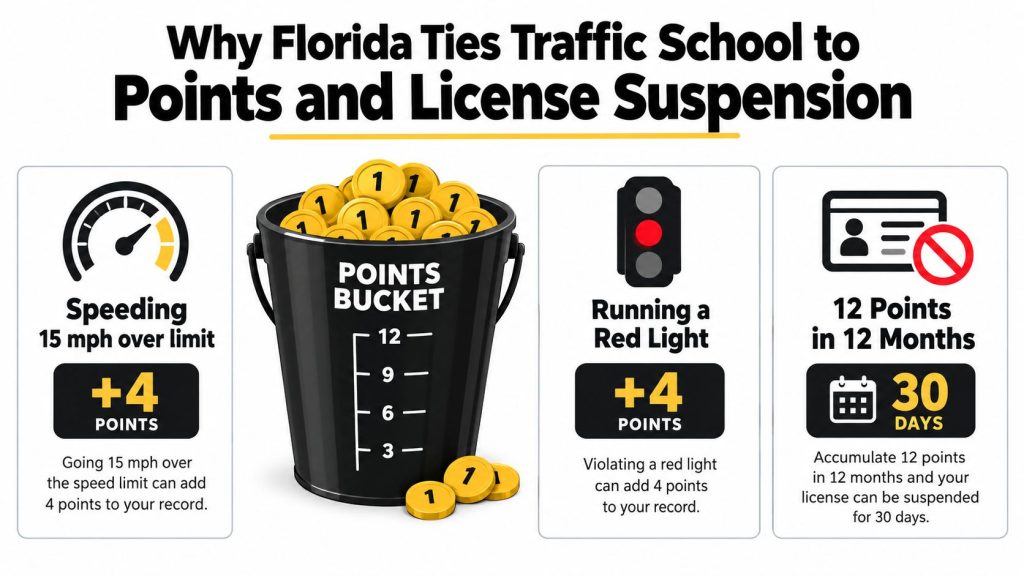
A useful analogy is a points bucket. Each qualifying offense can put more points into the bucket. Traffic school may keep points from being added for one eligible offense, which can help prevent the bucket from reaching a suspension threshold.
The suspension thresholds
According to the Florida Department of Highway Safety and Motor Vehicles, a driver can face:
- A 30-day suspension after accumulating 12 points in 12 months.
- A 90-day suspension after accumulating 18 points in 18 months.
- A one-year suspension after accumulating 24 points in 36 months.
These thresholds are measured over different time periods. That’s why a driver shouldn’t look only at the latest ticket. Earlier points may still matter when the state reviews the driving record.
Why point prevention matters
The educational course becomes valuable because Florida links it directly to licensing consequences. If the points bucket is already partly full, adding another point assessment may create a much bigger problem than the original citation.
That doesn’t mean every driver should automatically elect school. Eligibility rules apply, and the course is useful only in legally defined situations. But for a qualifying offense, point prevention can be more important than the classroom experience itself.
You can review the broader framework in this guide to Florida driver’s license points. The key is to understand your record before choosing how to handle the citation.
The available course levels
Florida recognizes different driver-improvement courses for different circumstances. The 4-hour BDI course is generally associated with eligible moving violations. The state also recognizes 8-hour and 12-hour courses for more serious or court-ordered situations.
Those courses aren’t interchangeable. Taking a longer course doesn’t automatically make it the correct choice for a regular citation. Your court instruction, license status, and violation type determine which path applies.
Choosing the Right Florida Traffic School Course for Your Situation
A first-time ticket holder may see several course names and assume the longest class offers the safest solution. The correct choice depends on the reason for enrollment, the violation, and any court instruction.
For an eligible moving violation, the 4-hour BDI course is usually the relevant option. It can prevent points for that offense and support the applicable civil-penalty reduction. In other situations, the court may require a different course.
Which Florida Traffic School Course Fits Your Need
| Course | Duration | Best For | Key Benefit |
|---|---|---|---|
| Basic Driver Improvement, BDI | 4 hours | Eligible moving violations | May prevent points for the offense and support the applicable civil-penalty reduction |
| Intermediate Driver Improvement, IDI | 8 hours | Court-ordered drivers or drivers needing more extensive instruction | Helps satisfy an applicable court or educational requirement |
| Aggressive Driver Course | 8 hours | Court-directed or behavioral situations involving aggressive driving concerns | Focuses on responsibility, decision-making, and safer driving behavior |
| Mature Driver Course | 6 hours | Drivers over 55 seeking an insurance-related benefit | Florida law ties completion to a car-insurance premium reduction, subject to applicable insurer requirements |
Course length does not decide which program applies. A court order works like a set of instructions: if it names IDI or an Aggressive Driver Course, follow that direction rather than choosing a class because it is longer or more familiar.
The BDI course is a state-regulated, FLHSMV-approved program for eligible situations. It is commonly used to handle a qualifying citation and prevent points, but it does not replace every driver-improvement requirement.
The mature driver option
The Mature Driver Course serves a separate purpose. It is a 6-hour course connected under Florida law with a car-insurance premium reduction for drivers over 55, subject to the insurer’s requirements, as described in this Mature Driver Course summary. Drivers should confirm the benefit and renewal terms with their insurer.
For a regular eligible ticket, keep the distinction clear. BDI addresses citation-related requirements, while the Mature Driver Course supports an insurance-related benefit. Taking the mature driver course does not automatically replace the BDI election for a traffic citation.
Drivers comparing approved formats can review these Florida driving courses. BDISchool offers online options in English, Spanish, and Portuguese, so students can select a course that matches their situation and language preference. The course choice still needs to match the citation or court paperwork.
Eligibility Rules and How to Elect Traffic School on Time
A traffic-school election is a legal choice tied to your citation, not a course registration. Enrolling online does not notify the clerk of court or replace the required election.
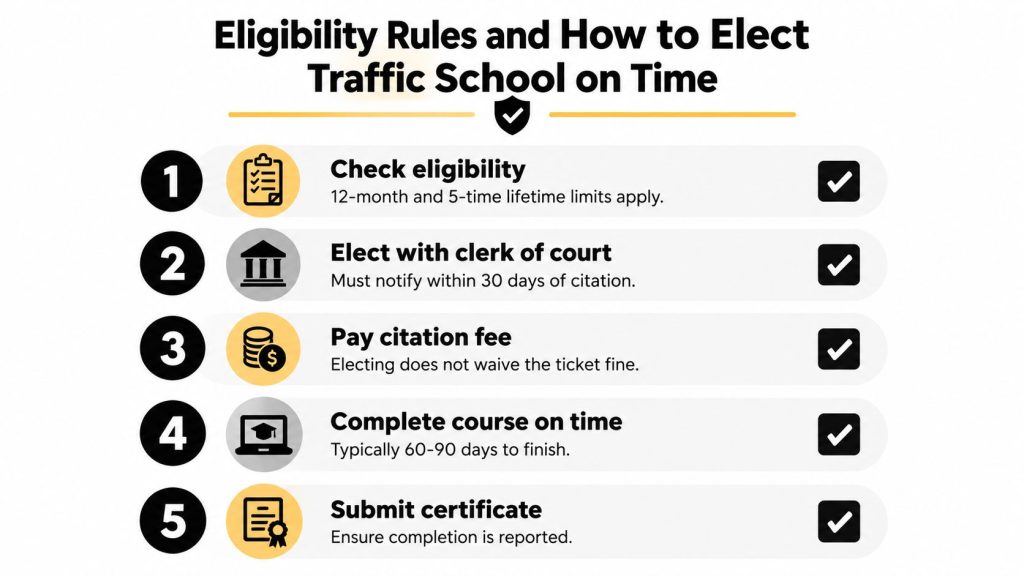
For an eligible citation, the standard BDI path uses a 4-hour course approved by FLHSMV. You must elect traffic school within 30 days of the citation. Completing the course can prevent points from being assessed and can trigger the required 18% reduction in the civil penalty, when the citation qualifies.
Follow the process in order
Read the citation carefully. Find the clerk of court, violation classification, response deadline, and election instructions. These details are your checklist.
Confirm eligibility. Prior use of traffic school, your license type, or a court order may change the answer. CDL holders and people handling criminal matters should confirm the applicable process before choosing ordinary BDI.
Elect with the clerk of court. Tell the clerk you want the traffic-school option. Follow the court’s instructions for payment, forms, and supporting documents. The clerk records the legal election.
Enroll with an approved provider. After making the election, choose a provider approved for the required course. A general defensive-driving class may not satisfy the citation.
Complete the matching course. Check that the course corresponds to the election and any court direction. A court-ordered IDI or Aggressive Driver Course follows different instructions from ordinary BDI.
Protect your proof of completion. Reporting may occur electronically, or the court may require a certificate or other documentation. Keep your confirmation and verify that the clerk received what the case requires.
The deadline to remember
Elect traffic school within 30 days of the citation. Election and course completion are separate steps, so do not wait until the course is finished to contact the clerk.
The clerk manages the citation’s case record. Even if the provider reports completion electronically, you must follow the clerk’s instructions and confirm that the case was processed correctly.
Use BDISchool’s online traffic school registration guide to review course selection and ticket information before enrolling. Starting promptly leaves time to resolve questions before the deadline closes.
What to Expect Inside the Online Self Paced Course
Once enrollment is complete, the learning experience is more straightforward than many first-time students expect. You log in, work through the approved material, answer knowledge checks, and complete the final exam.
The course is designed for self-paced online study. That means a busy driver can work through the material in sessions rather than treating the entire course like a traditional classroom appointment.

Lessons built around driving decisions
The curriculum covers Florida traffic laws and defensive-driving principles. You’ll encounter topics such as following distance, right-of-way decisions, impaired-driving prevention, distraction, aggressive driving, and crash-avoidance habits.
The strongest way to use the course is to connect each topic with a real driving moment. For example, following distance isn’t just a definition. It affects how much time you have when traffic stops suddenly on a busy Florida roadway.
Short modules, visuals, and real-life scenarios make the material easier to absorb than a dense legal document. They also help explain why a rule exists, not just what the rule says.
Progress, quizzes, and the final exam
Knowledge checks help you notice weak areas before the final exam. If a question catches you off guard, treat it as a prompt to review the related lesson rather than as a reason to rush.
The self-paced format lets you pause and resume your progress. That can suit a professional studying after work, a parent fitting lessons around family responsibilities, or a student who prefers Spanish or Portuguese instruction.
Study for understanding
The course’s legal purpose may involve your citation, but the learning itself is about safer choices. Slow down when conditions change, leave space around your vehicle, scan for conflicts, and recognize how fatigue, impairment, anger, and distraction affect judgment.
Don’t rush through the material because the course is self-paced. Use the flexibility to learn the information well, then complete the required assessment and preserve your records.
Certificate Completion and FLHSMV Reporting Explained
You finish the lessons, pass the assessment, and receive proof of completion. The legal process still has another handoff: the provider, FLHSMV, and the court each handle a different part of the record.
A certificate shows that you completed the required course. It does not by itself change the citation, so follow the clerk’s instructions and confirm that the court received the required information.
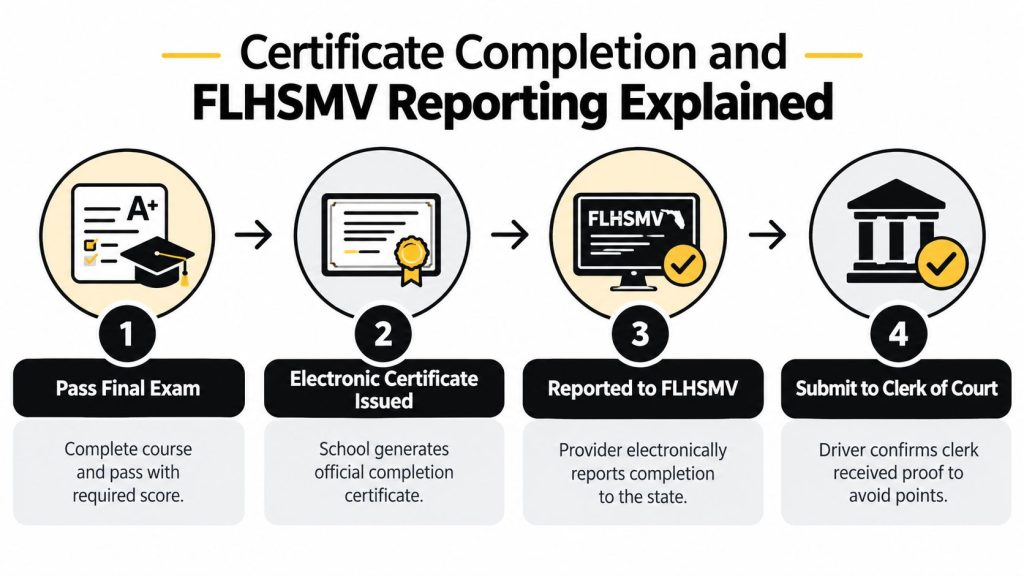
The completion chain
Pass the final exam. Complete the course requirements and pass the final assessment under the provider’s rules.
Receive the electronic certificate. The school creates official completion documentation for you.
Allow reporting to FLHSMV. An approved provider reports the completion electronically through the required state process.
Confirm the court received proof. Check the clerk’s instructions and verify that your citation record reflects the traffic-school election.
What changes on the record
The result is procedural rather than restorative. Florida traffic school does not erase an existing violation. For an eligible moving violation, however, the 4-hour BDI election can prevent points from being added and trigger an 18% civil-penalty reduction, as described in the state’s course guidance.
The election and certificate deadlines act like a legal timer. Complete the course or submit required proof late, and the point-prevention benefit may not apply.
Review BDISchool’s online driving certificate information to understand how completion documentation is handled. After finishing, keep the certificate, confirmation messages, and any court receipt together.
Your final verification list
- Certificate received: Confirm that you have completion proof.
- Provider reporting completed: Check the provider’s status or instructions.
- Clerk notified: Make sure the court received what it requested.
- Case status checked: Contact the clerk if the citation still appears unresolved.
- Record reviewed: Verify the final driving-record treatment when appropriate.
“Course complete” does not automatically mean “case closed.” The final check confirms how your election was recorded and helps you catch a missing document or reporting step.
Protect Your Record and Save With BDISchool Today
A traffic-school election is a timed legal choice, not a class to take. For an eligible moving violation, completing the approved 4-hour BDI course can prevent points from being added, trigger the applicable 18% civil-penalty reduction, and satisfy the court requirement when every step is completed correctly.
The course also needs to match your purpose. A court may direct you to an IDI or Aggressive Driver Course instead. Drivers over 55 who want an insurance-related benefit may need the 6-hour Mature Driver Course. Florida law connects that course with an insurance premium reduction, but your insurer must confirm the current terms and renewal requirements.
Use the online format to finish on time
Self-paced access can make the deadline easier to manage. Lessons cover Florida traffic laws, defensive driving, safe following distances, impaired-driving prevention, distraction, aggressive driving, and crash avoidance. Course material is available in English, Spanish, or Portuguese, and you can study from a suitable device.
The legal timer still applies. Read the citation, confirm eligibility, elect traffic school with the clerk within the required period, select the approved course, complete it, and verify that the certificate and reporting steps are finished.
Start by comparing approved options through BDISchool’s course page or DriverEducators’ course page. Select the course that fits the citation or driving goal, rather than assuming every traffic-school option has the same effect.
BDISchool offers Florida-approved online traffic school courses with self-paced access and instruction in English, Spanish, and Portuguese. Visit BDISchool to choose the appropriate course, complete the requirement, and work toward protecting your driving record.