Spain’s penalty-point system was associated with a 20% reduction in cumulative road fatalities over the five years following its introduction, according to a study summarized in the European Commission’s road-safety enforcement review. Points aren’t just an administrative score. They’re a reason to change how you drive before repeated violations cost you your license.
For a Florida driver holding a recent citation, though, the immediate issue is the order of events. Electing an approved course before points are assessed is different from completing traffic school after points have posted. Your best move is to check the court’s election deadline immediately, not after you’ve paid the ticket and assumed everything is settled.
Florida Point Values for Every Common Violation
| Violation | Points |
|---|---|
| Typical moving violation, including speeding 15 mph or less over the posted limit | 3 |
| Speeding more than 15 mph over the posted limit | 4 |
| Passing a stopped school bus | 4 |
| Non-speeding moving violation that results in a crash | 4 |
| Unlawful speed resulting in a crash | 6 |
| Leaving a crash involving property damage | 6 |
Florida’s driver-license point rules assign values according to the violation. The table shows the point categories for these common violations.
A typical moving violation falls into the lowest category shown. Check the exact allegation on your citation, especially for speeding. Our guide to speeding in Florida explains the distinction between the two speeding categories.
Read the violation and its consequences
Passing a stopped school bus has its own point value. A non-speeding moving violation that results in a crash also falls into a separate category from an ordinary moving violation.
Unlawful speed resulting in a crash carries more points than speeding alone. Leaving a crash involving property damage is treated separately, so check the exact violation listed on the citation.
Practical rule: Match the violation on your citation to the table before deciding how to resolve it.
For example, a 3-point speeding ticket followed by a 6-point crash-related citation adds up to 9 points. The point total depends on the violations recorded.
The assigned value follows the violation type. Your existing record and insurance circumstances can affect the consequences.
Find the matching violation in the table, then check your driver record. Don’t assess a new citation in isolation.
Suspension Thresholds at 12, 18 and 24 Points
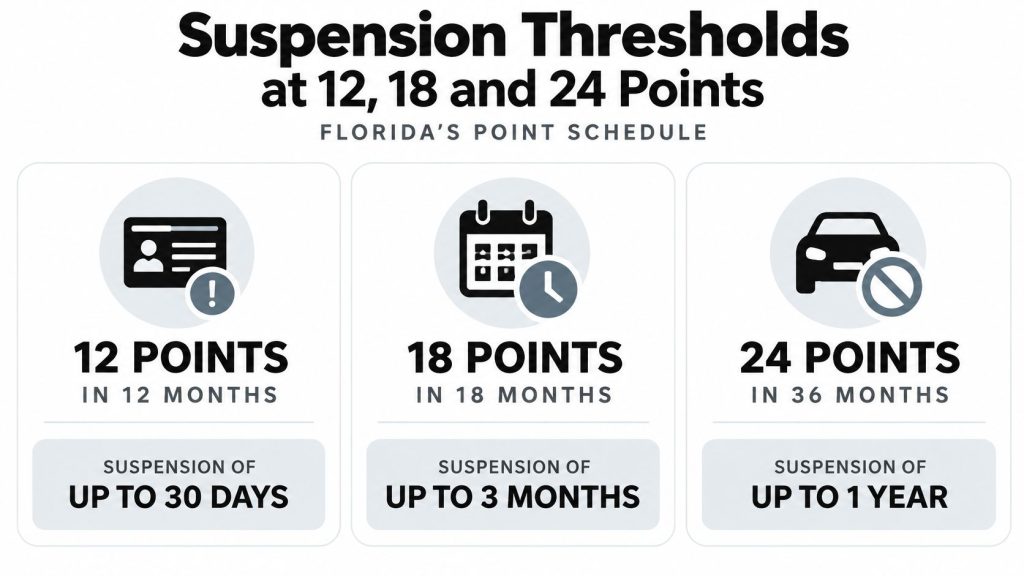
Florida uses an escalating schedule: 12 points within any 12 months can mean up to 30 days of suspension; 18 points within 18 months can mean up to 3 months; and 24 points within 36 months can mean up to 1 year, according to FLHSMV’s points and point-suspension guidance.
| Points | Time window | Maximum suspension |
|---|---|---|
| 12 points | Within any 12 months | Up to 30 days |
| 18 points | Within 18 months | Up to 3 months |
| 24 points | Within 36 months | Up to 1 year |
Read the schedule as an escalating warning
At the initial threshold, repeated violations can interrupt your ability to drive even when no individual ticket seemed especially serious. That’s why dismissing an ordinary citation as just another fine is a poor decision.
At the next stage, points involved in the earlier suspension still count toward the higher threshold. A suspension isn’t a fresh start that lets you disregard the violations that brought you there.
At the highest stage shown, a longer accumulation period exposes a persistent pattern of violations. A driver who focuses only on the most recent ticket can miss the significance of the older entries still inside that period.
The schedule is easier to recognize when you see the stages together.
Monitor dates, not just the total
A rolling window isn’t a calendar year. Changing calendars doesn’t mean the state stops counting an otherwise relevant violation.
Use a spreadsheet or a simple written log with a separate entry for each citation. Record the violation date, point value, court disposition, and any school election associated with it.
- Start with your driving record: Use the recorded entries rather than guessing from tickets you remember paying.
- Group entries by the applicable window: Add only the points that fall inside each relevant period.
- Keep unresolved citations visible: A pending ticket deserves attention before it becomes another recorded entry.
- Retain supporting documents: Save court notices and completion records alongside your log.
This habit is particularly useful when tickets arrive close together. Individually modest point values can produce a serious total when the violations fall within the same window.
Don’t wait for a suspension notice to calculate your exposure. Once you have multiple citations, check the dates after every new ticket and investigate an eligible course election before your record climbs further.
Election Limits and Insurance Exceptions by Case
| Situation | Election available | Insurance protection |
|---|---|---|
| First qualifying citation with no other in the past 12 months | Yes, within lifetime and other eligibility limits | Yes, subject to the listed exceptions |
| Second infraction within 18 months | Only if the 12-month limit allows it | No, exception applies |
| Third infraction within 36 months | Only within the 12-month and lifetime limits | No, exception applies |
| Speeding more than 15 mph over the limit | Yes, if otherwise eligible | No, exception applies |
| Commercial driver license holder | No, cannot use the election to avoid points | No protection through this election |
| Driver who has used eight elections in a lifetime | No | No protection through this election |
Under FLHSMV’s driver-improvement course FAQ, the election is generally available once in any 12-month period and no more than eight times during a lifetime; insurance exceptions include a second infraction within 18 months, a third within 36 months, and speeding more than 15 mph over the limit.
Separate the points benefit from insurance protection
For an eligible qualifying citation, completing the elected course results in adjudication being withheld and no points being added for that violation. Adjudication withheld means the case receives that specific legal disposition, not that the citation disappears from every record.
Insurers generally can’t add a premium or refuse renewal solely because of that qualifying noncriminal infraction. But the protection has exceptions, and it isn’t a promise that your total insurance bill will never change for another reason.
A repeat infraction can create an insurance exception even when the driver remains eligible to elect school. Likewise, a qualifying higher-speed citation may still allow the points benefit without providing the same insurance protection.
Don’t combine separate questions: Whether you can elect school and whether your insurer is restricted from acting on the infraction require separate checks.
Check your history before paying
The first qualifying citation is the clearest case only when the driver meets all the other requirements. A first recent ticket doesn’t override a lifetime election limit, a license-class restriction, or an applicable insurance exception.
Criminal violations don’t receive the same treatment as qualifying noncriminal infractions. Don’t assume that enrolling in traffic school resolves a criminal traffic charge.
Commercial license holders also need a different analysis. Our explanation of whether CDL holders can take traffic school in Florida distinguishes taking a course from using an election to prevent points.
Before buying a course, check your election history and the nature of the citation. If you’ve recently used the option or have several infractions, ask the issuing county’s court to confirm your eligibility rather than relying on the course registration system to decide it.
How to Elect a Course and Keep Points Off Your Record
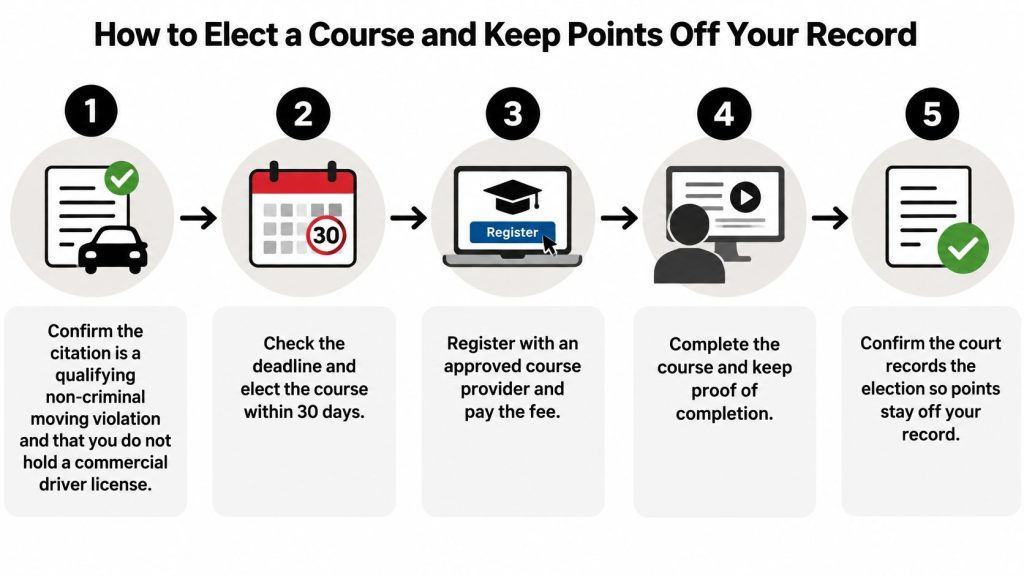
The election generally must reach the court within 30 days of the citation, and qualifying drivers must elect through the county where the ticket was issued, according to FLHSMV’s driving-record questions and answers. The option applies to eligible noncriminal moving violations for drivers who don’t hold a commercial driver license.
Follow the court process before treating enrollment as the solution
Confirm that you qualify. Read the violation description and check your license class, election history, and case status. A course is aimed at drivers with recent moving violations, but not every driver or citation qualifies for the points-avoidance election.
Elect through the issuing county’s court. Tell the clerk you want to elect an FLHSMV-approved Basic Driver Improvement course and follow that court’s procedure. Registering with a school isn’t a substitute for making the election with the court.
Confirm the deadline immediately. Check the citation and court instructions, and ask the clerk to clarify anything unclear before submitting payment or selecting a disposition. Also obtain the course-completion deadline, because electing school and finishing school are separate obligations.
Complete the approved course and retain proof. Follow the course requirements and keep your completion certificate with your citation paperwork. Submit proof wherever the court directs rather than assuming that possessing a certificate finishes the case.
Verify the result. Check that the election and course completion are reflected correctly in the relevant records. If something is missing, contact the clerk with your citation number, election confirmation, and completion certificate available.
The process works best when you treat the court election and the course as connected tasks.
Keep court questions separate from registration questions
If you’re unsure whether your matter requires a court appearance, Ticket Shield, PLLC’s resource on Broward and Miami-Dade traffic court help provides useful context. Confirm the requirements for your own case with the court rather than treating general guidance as an individualized ruling.
For the enrollment process itself, use our guide to registering for online traffic school. Have your citation and identifying information ready so you can enter details accurately.
The payoff is specific: an accepted, successfully completed election helps keep the qualifying violation’s points off your license. For cases covered by the insurance restriction, completing the course also prevents an insurance rate increase due solely to that moving violation.
Review the available options in the BDISchool course listing or the DriverEducators course listing, confirm the approved course matches your court requirement, and register after checking eligibility.
Why Timing Decides Your Points and the Mistakes That Cost Them
Say two eligible drivers each receive the same 3-point speeding citation. The first elects an approved course within the 30-day election window, completes it by the court’s deadline, and verifies the disposition; the second lets the citation post with points and then buys a course hoping to erase them.
The first driver has used the election to prevent points. The second driver needs a correction process, not just a completion certificate.
This comparison shows why the sequence matters.
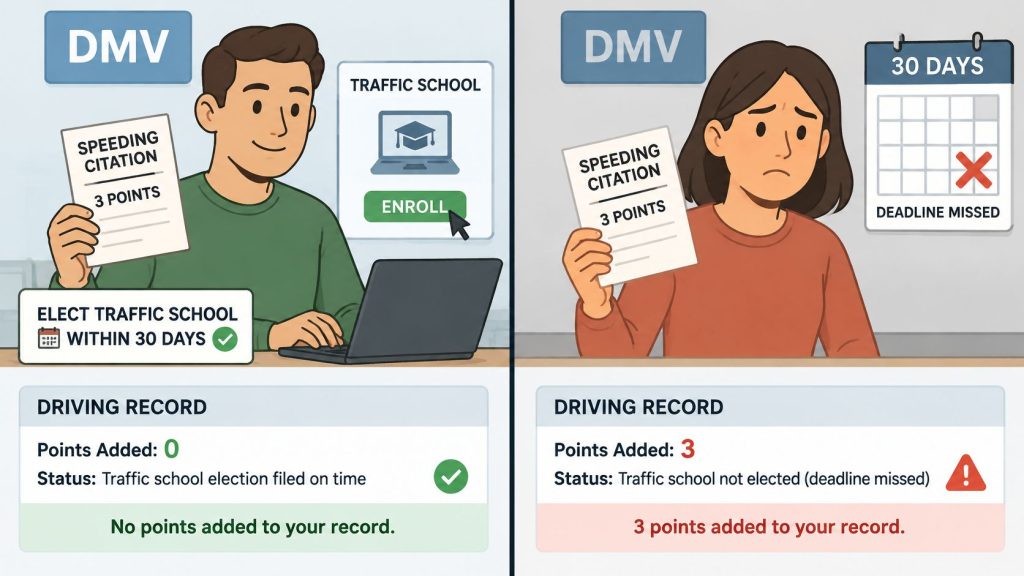
Under Florida’s guide to reading a driving record, points already added can be removed only when the court that placed them there notifies FLHSMV, and the record identifies school elections and course completions, including course type and completion date. Completing traffic school doesn’t independently authorize a driver or provider to delete an existing point entry.
Acting before points post is a decision, not an afterthought.
Avoid the mistakes that change the outcome
- Missing the election window: Act the day you receive the citation and contact the court in the issuing county instead of waiting until you have time to study.
- Waiting until suspension is close: Count your rolling windows after every ticket, because another citation could cross a suspension threshold.
- Expecting retroactive point removal: Elect through the court before assessment rather than assuming a later course automatically clears posted points.
- Choosing an unapproved course: Confirm FLHSMV approval and the correct course type before paying, because an unrelated course won’t satisfy the election.
- Overlooking a commercial license: Check your license class before proceeding, because CDL holders can’t use this election to avoid points.
The video below accompanies the traffic-school decision, but your own court’s instructions should control how you handle the citation.
Questions drivers ask about posted points
Will completing traffic school erase an existing point entry?
Not by itself. If you believe points were posted incorrectly, contact the court responsible for the entry and ask what documentation it requires to review the matter.
Does a no-points outcome mean the citation vanishes?
No. A record can show the school election and completion without adding points for the qualifying violation, so distinguish the citation history from the point total.
Should I wait for older points to disappear before handling a new ticket?
No. Handle the new citation on its own deadline, and use our explanation of how long points stay on a driving record to distinguish record retention from suspension calculations.
Keep your election receipt, certificate, court correspondence, and record check together. If an entry is wrong, those documents give the clerk something concrete to review.
If you receive a citation, check the election window immediately. Don’t wait for points to appear before deciding whether to prevent them.
Enroll in a Florida Basic Driver Improvement Course Today
Choose an approved Basic Driver Improvement course if you’re eligible and want to prevent points from your recent noncriminal moving violation. Make the decision while the court election remains available, not after the citation has already been processed in a way you didn’t intend.
The practical advantage is control over the steps you can complete now. You can confirm eligibility, obtain the court’s instructions, register accurately, and finish the required work without relying on a later correction.
Prepare your registration information
Our course is approved by the State of Florida for all courts and counties. That approval addresses the course’s acceptance, but you still need to satisfy your own court’s election and completion requirements.
Before using the course, you must complete the registration form with your name, driver license information, and email address. Those details generate your completion certificate, so enter them carefully and match your identifying documents.
- Use your legal name: Avoid a nickname or an abbreviated version that could complicate matching the certificate to your case.
- Check your driver license entry: Compare it directly with your license before submitting the form.
- Use an accessible email address: Choose an inbox you check and can continue accessing throughout the process.
- Save your case instructions: Keep the court’s deadline and proof-of-completion directions available while you study.
Make the course choice fit the citation
Don’t choose a different driver-education program just because its title sounds similar. A court-ordered course and an elective Basic Driver Improvement course can serve different purposes, so match the registration to the requirement you’re trying to satisfy.
Also keep the insurance benefit in perspective. For a protected qualifying infraction, the election prevents an increase tied solely to that violation; it doesn’t guarantee an unchanged premium for unrelated reasons.
You don’t need to wait until your point total is alarming to make a sensible choice. A recent qualifying ticket is the right time to protect your record and review the driving habits that led to it.
Confirm the election window with the court in the county where your citation was issued. Then register for the approved course and begin while you can still meet the court’s requirements.
BDISchool offers Florida’s Basic Driver Improvement Course, which eligible drivers can register for and start on our website to help keep moving-violation points off their license. Visit BDISchool, complete your registration, and begin your approved course before your court deadlines close.