Right of way rules determine who has priority on Florida roads, and misunderstanding them causes thousands of preventable accidents every year. Whether you’re navigating busy intersections, merging on highways, or encountering emergency vehicles, knowing these rules keeps you and others safe.
We at DriverEducators.com have built this guide to cover the specific right of way situations Florida drivers face most often. You’ll learn exactly what the law requires and how to apply it in real traffic.
What Right of Way Actually Means in Florida
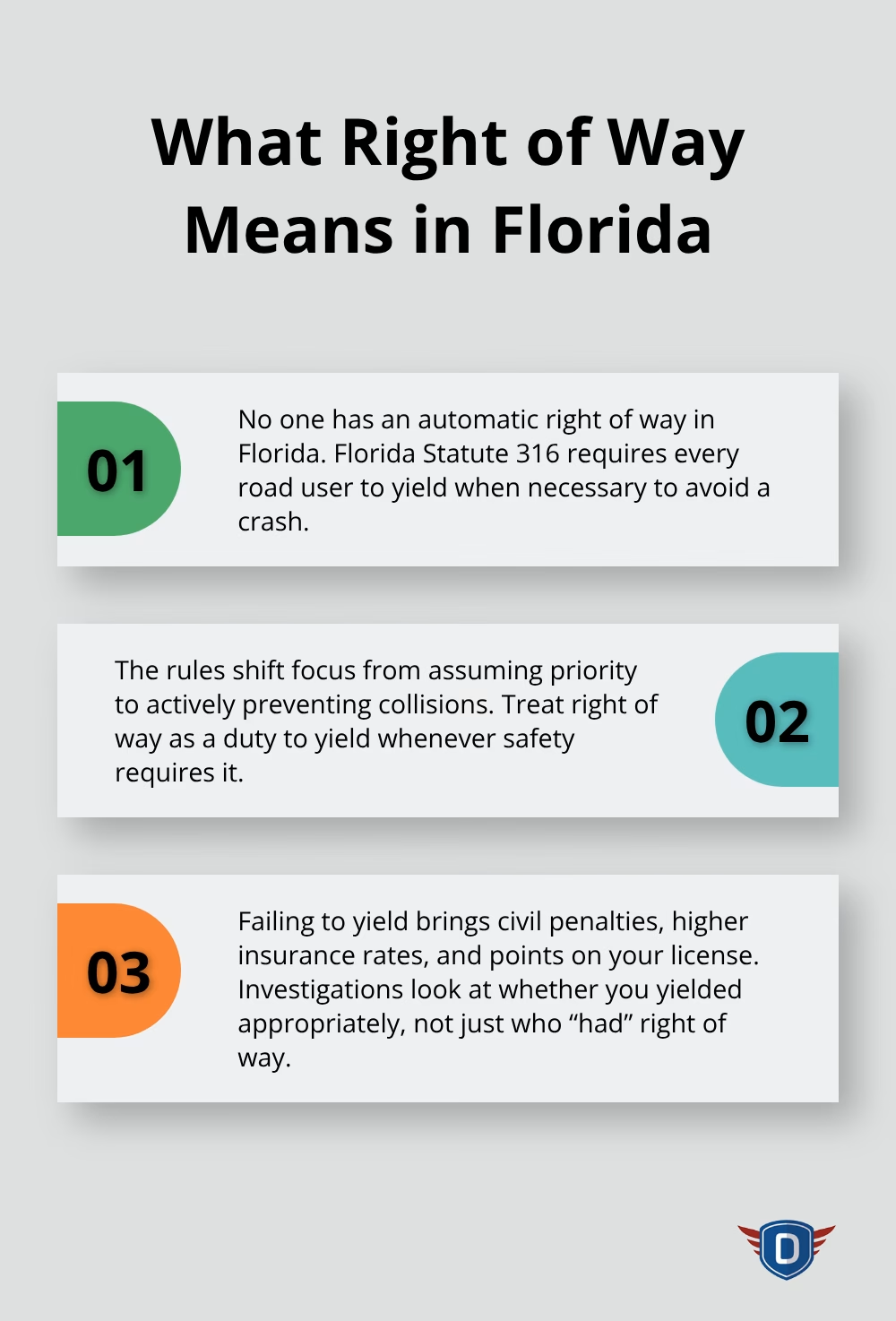
Right of way in Florida isn’t a suggestion or a courtesy-it’s a legal requirement that determines who must yield to whom on the road. Florida Statute 316 makes this clear: no driver, motorcyclist, bicyclist, or pedestrian has an automatic right of way. Instead, every road user must yield when necessary to avoid a crash, regardless of who technically has the legal advantage. This distinction matters because it shifts responsibility away from assuming you have priority and toward actively preventing collisions. If you’re involved in an accident and the other driver claims they had right of way, your insurance company and law enforcement will examine whether you yielded appropriately. A failure to yield violation can result in civil penalties, but the real cost comes from the increased insurance rates and points on your license that follow.
Why Right of Way Prevents Crashes
The connection between understanding right of way and collision prevention is direct and measurable. Drivers who know the rules don’t hesitate at intersections, don’t second-guess who should go first, and don’t create the confusion that leads to side-impact crashes. When both drivers understand that the vehicle on the right has priority at a four-way stop, or that pedestrians in crosswalks must move upon the right half of crosswalks when practicable, split-second decisions become automatic rather than improvised. Intersection crashes-where right of way violations occur most frequently-account for a significant portion of injury accidents in Florida. The FLHSMV Driver Handbook emphasizes that right of way rules establish predictability on the road. When you know the rules and follow them, other drivers can anticipate your actions. When you don’t know them, you create uncertainty that other drivers must work around, and that uncertainty breeds accidents.
The Biggest Misconception About Right of Way
Most Florida drivers believe that having the right of way means they can proceed without checking. This is dangerously wrong. Right of way is permission to go, not a guarantee of safety. You still must verify that the intersection is clear before entering it. Even if you have a green light or a stop sign advantage, a distracted driver or someone running a red light could be in your path. The Florida Driver Handbook doesn’t describe right of way as automatic protection-it describes it as a responsibility to yield when you don’t have it. This means defensive driving always comes first. Check the intersection, make eye contact with other drivers when possible, and proceed only when you’re certain the path is clear. Understanding this principle separates drivers who follow rules from drivers who actually stay safe on Florida roads.
How Right of Way Works at Intersections
Intersections present the most common right of way situations you’ll face. At a four-way stop, the first vehicle to stop has the right to proceed first (if two vehicles arrive simultaneously, the driver on the right goes first). Traffic signals give you the right of way when you have a green light, but you still must yield to pedestrians in the crosswalk and check for red-light runners. Yield signs require you to slow down and let other traffic pass before you enter the intersection. At unmarked intersections with no traffic control, yield to traffic on your right and to vehicles already in the intersection. These rules create order where confusion could otherwise cause collisions.
Preparing for Real-World Right of Way Situations
The rules you’ve just learned apply to every intersection, roundabout, and merging situation you’ll encounter. The next chapter covers how these rules work in specific real-world scenarios-from roundabouts and lane changes to emergency vehicles and school buses-so you can apply them with confidence.
Traffic Signals, Stop Signs, and Yield Signs Control Right of Way
Understanding What Traffic Signals Actually Grant You
Green lights, red lights, and stop signs create the foundation of intersection safety, yet many Florida drivers misunderstand what these signals actually grant them. A green light gives you the right to proceed, but only if the intersection is clear of pedestrians, cyclists, and vehicles already within it. According to the Florida Driver Handbook, you cannot enter an intersection on a green light if doing so means you’ll block traffic on the other side. This rule exists because intersection gridlock causes rear-end crashes and prevents emergency vehicles from passing.
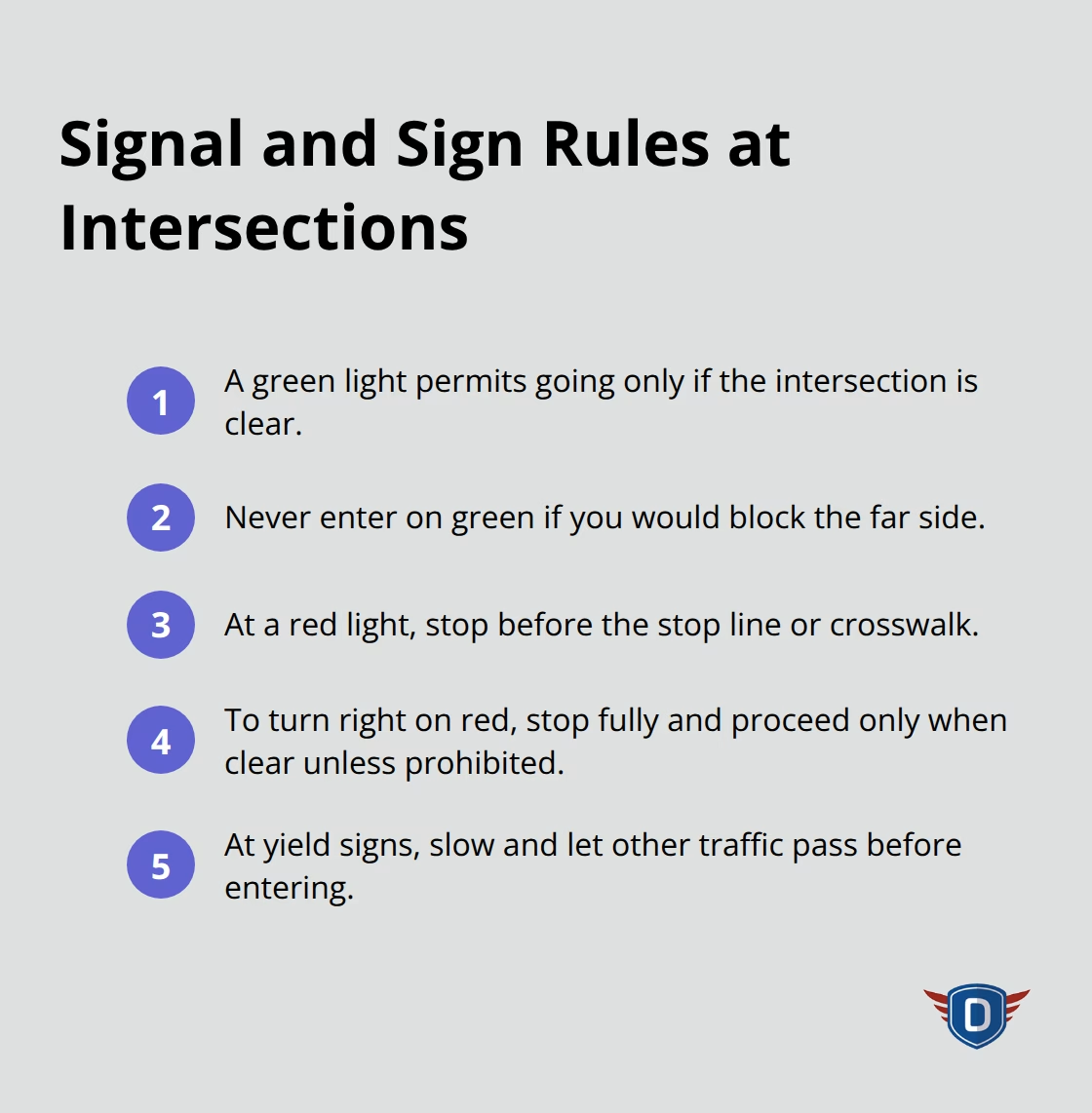
A green light is permission to go, not a guarantee that you should go. At a red light, stop completely before the stop line or crosswalk. If you need to turn right on red, come to a full stop first, check for pedestrians and cyclists in the crosswalk, and only proceed when the path is clear unless a sign prohibits it. Running a red light in Florida costs $264 in civil penalties, but the real danger lies in the T-bone collisions that result from drivers entering intersections against the signal.
Stop Signs and Four-Way Stops
Stop signs demand a complete halt before the stop line, and you must yield to all pedestrians, bicyclists, and vehicles already in the intersection or approaching from another direction. At four-way stops, the vehicle that arrived first moves first. If two vehicles arrive simultaneously, the driver on the right has the right of way. This rule prevents the uncertainty that causes drivers to hesitate, wave others through, and create dangerous confusion.
Yield signs require you to slow down and allow other traffic to pass before you enter. Unlike stop signs, you don’t have to come to a complete halt at a yield sign if the intersection is clear, but you must be prepared to stop if traffic approaches. At unmarked intersections with no traffic control devices, yield to vehicles on your right and to traffic on main roads when you’re entering from a side street. These rules transform intersections from dangerous guessing games into predictable situations where every driver knows their role.
Turning Vehicles and Pedestrian Priority
Turning vehicles and pedestrians create the most complex right-of-way situations at intersections because both move in different directions. When you turn left across oncoming traffic, you must yield to vehicles moving straight or turning right, even if you have a green light or green arrow. Oncoming traffic always has priority over left-turning vehicles.
Check for pedestrians in the crosswalk before and during your turn because they have the right of way over turning vehicles. Pedestrians in marked or unmarked crosswalks have the right to cross when they have a walk signal or when traffic control devices indicate it’s safe. If a pedestrian is in the crosswalk, you must stop and wait, regardless of the traffic light.
Drivers turning right must also yield to pedestrians in the crosswalk, even though many Florida drivers treat right turns as automatic. The FLHSMV Driver Handbook makes clear that pedestrians have priority over turning vehicles in all situations. When you’re turning right on red, perform the same check: stop completely, verify no pedestrians are crossing, and proceed only when safe.
Bicyclists and Turning Traffic
Bicyclists following traffic laws have the same rights as motor vehicles, so yield to them as you would any vehicle. If a bicyclist is in a crosswalk or traveling straight through an intersection, they have priority over turning traffic. Many Florida drivers fail to account for the extra time cyclists need to clear an intersection, leading to close calls and crashes.
Never assume pedestrians or cyclists will stay out of your path. Make eye contact when possible, wait until they’ve completely cleared the intersection, and only then proceed with your turn. This defensive approach costs you a few seconds but prevents the injury crashes that occur when drivers prioritize speed over safety. Understanding these turning rules prepares you for the more complex scenarios you’ll face on roundabouts, during merges, and when encountering emergency vehicles and school buses.
Right of Way on Roundabouts, Merges, and Emergency Situations
Navigating Roundabouts Without Unnecessary Stops
Roundabouts operate on a principle that many Florida drivers misunderstand: yield to traffic already circulating inside the circle, then enter when safe. Unlike traditional intersections where you stop and wait for a signal, roundabouts keep traffic moving continuously because vehicles yield rather than halt. The NHTSA and IIHS recommend that you enter only when you have a clear gap in circulating traffic, signal when exiting, and stay in the correct lane throughout.
Most drivers fail at the signaling part-they either don’t signal at all or signal too late, leaving other drivers guessing about their intentions. If you’re in the roundabout and another vehicle tries to enter, that entering vehicle must yield to you. This creates predictability: once you’re inside, you have priority over anyone trying to enter. Many Florida drivers treat roundabouts like four-way stops and come to unnecessary halts, creating backups and confusion. The correct approach treats the roundabout as a continuous flow where you yield only at entry, then proceed with confidence through your exit.
Merging and Lane Changes at Highway Speeds
Merging onto highways and changing lanes requires the same defensive mindset as intersections, but with higher speeds that demand earlier decisions. When you merge from an on-ramp onto a highway, you must yield to traffic on the main road and adjust your speed to match the flow. The FLHSMV Driver Handbook emphasizes that you cannot force your way into traffic; you must find a gap, match the speed of vehicles around you, and slide smoothly into position.
Check your mirrors multiple times, look over your shoulder to verify your blind spot is clear, and signal at least 100 feet before you move. Lane changes follow the same rules: signal early, check mirrors and blind spots, and only move when the path is clear. A critical mistake many Florida drivers make is signaling and changing lanes simultaneously, giving other drivers no time to react. Signal first, wait for acknowledgment or confirmation that the lane is clear, then move.
Responding to Emergency Vehicles
Emergency vehicles with sirens or flashing lights create automatic right-of-way situations that demand immediate action. Florida’s Move Over Law requires you to vacate the lane closest to the emergency vehicle or slow to a safe speed if moving over isn’t possible. On multi-lane highways, move one lane away from the emergency vehicle. On two-lane roads, slow to 20 mph below the posted speed limit if the limit is 25 mph or higher, or slow to 5 mph if the limit is 20 mph or less.
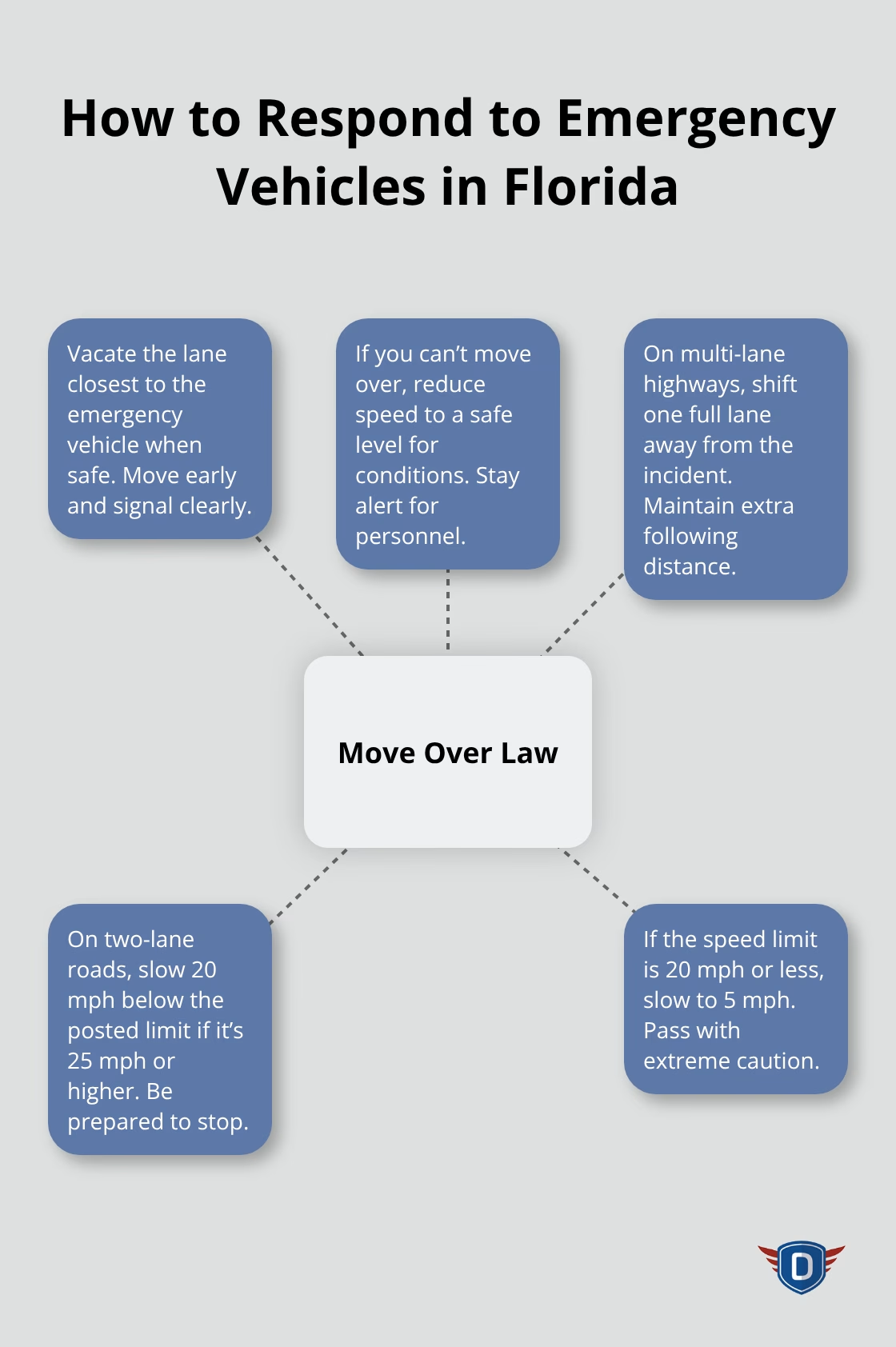
Do not block intersections while moving over-complete your lane change and continue forward. These vehicles transport people in life-threatening situations, and your quick response can mean the difference between life and death. Treat every siren and flashing light as a signal to act immediately, not a suggestion to eventually move.
School Buses and Crossing Guards
School buses present a different right-of-way situation that carries steep penalties. When a school bus displays red flashing lights and extends its stop arm, you must stop completely from all directions except on divided highways with raised barriers or medians at least five feet wide. Painted lines do not count as barriers, so most Florida roads require you to stop. Failing to stop for a school bus costs $371 in civil penalties according to Palm Beach County Clerk records, but the real consequence is the potential to strike a child.
Approach school bus zones with extreme caution, especially during morning and afternoon hours when children board and exit. Watch for crossing guards at school zones; they have authority to stop traffic, and you must obey them completely. These individuals stand between children and traffic, and your compliance with their signals protects lives.
Final Thoughts
Right of way rules form the foundation of safe driving in Florida, and mastering them transforms you from a driver who follows signals into a driver who prevents crashes. The core principle remains constant across every situation: yield when necessary to avoid a collision, verify that your path is clear before proceeding, and treat right of way as responsibility rather than permission. These rules work because they create predictability on the road, and predictability saves lives.
We at DriverEducators.com recognize that understanding right of way rules is only the first step toward safer driving. Our Florida-approved traffic school courses go deeper, covering defensive driving techniques, safe following distances, and how attitude affects decision-making behind the wheel. Whether you take our Basic Driver Improvement course to avoid points on your license or our Intermediate Driver Improvement program for court-ordered completion, you will learn how to apply these rules in real traffic situations.
The next step is straightforward: commit to applying these rules consistently on every road you travel. If you need structured guidance or court-ordered completion, DriverEducators.com offers flexible, self-paced courses that fit your schedule while meeting all Florida Department of Highway Safety and Motor Vehicles requirements. Safe driving starts with understanding the rules and ends with making them automatic.