A lot of Florida drivers start the CDL process in the same place. You’re working, paying bills, maybe thinking about a steadier career or a bigger paycheck, and you keep circling back to commercial driving. Then you look up the cdl test florida process and it feels like a pile of forms, rules, medical paperwork, and tests that all seem to speak their own language.
That feeling is normal.
The good news is that getting a Commercial Driver’s License in Florida is less like solving a mystery and more like following a route. You don’t need to do everything at once. You need to take the right step, in the right order, and understand why each step matters. That’s how professional drivers work every day. They don’t control every variable on the road. They prepare, stay calm, and handle one decision at a time.
Your Guide to Getting a Commercial Driver’s License in Florida
If you’re standing at the beginning of this process, consider it similar to learning a long delivery route. At first, the whole map looks overwhelming. Once you break it into turns, landmarks, and checkpoints, it becomes manageable.
Florida’s CDL path has three big stages.
First, you make sure you’re eligible and gather the documents Florida requires. That includes identity, residency, medical certification, and, for many applicants, required training before the road test. If your paperwork is incomplete, you can lose time before you ever answer a test question.
Second, you pass the written knowledge exam to get your Commercial Learner’s Permit. If you want a clean overview of that permit stage, this Florida CDL permit guide is a useful starting point. The permit is your bridge between study and hands-on practice.
Third, you pass the skills test. That’s the part where Florida wants to see that you can inspect the vehicle, control it at low speed, and drive it safely in real traffic.
Practical rule: Don’t treat the CDL process as one giant test. Treat it as a sequence of smaller passes.
That mindset matters. Safe commercial driving isn’t built on nerves or luck. It’s built on habits. The same habits that help regular Florida drivers stay out of trouble, paying attention, checking blind spots, reading signs early, following the law, become even more important when the vehicle is bigger, heavier, and less forgiving.
A professional driver is really a safety professional first. The license proves you’re ready to carry that responsibility.
Florida CDL Eligibility and Required Documentation
A lot of applicants hit their first delay before they ever answer a test question. They show up ready to learn about trucks, but the main problem is a missing document, the wrong license class, or training they did not realize Florida requires.
Treat this part like a pre-trip inspection for your CDL journey. A good driver does not wait until the truck is rolling to find out something was missed. You check the basics first, because the basics decide whether you can even leave the yard.
Who can apply in Florida
Florida draws a clear line between driving inside the state and driving across state lines.
You must be old enough for the kind of commercial driving you plan to do. If you will operate only within Florida, the lower age standard may apply. If the job takes you across state lines, federal rules set a higher threshold. The practical lesson is simple. Know the kind of work you want before you start the licensing process, because that choice affects eligibility from day one.
You also need a valid regular Florida driver license before you move into CDL licensing. For most applicants, that means a Class E license in good standing.
Start with the paperwork Florida will ask for
Paperwork feels boring right up until it costs you an appointment.
Before you go to the DMV or tax collector office, gather your documents in one folder and check them one by one. A DMV document checklist for Florida drivers can help you organize what to bring before you leave home.
Florida applicants are commonly asked for:
- A valid Florida driver license
- Proof of identity and lawful presence, such as a passport or birth certificate, depending on your status
- Your Social Security information
- Two documents that show Florida residency
- A completed CDL application
- Payment for the applicable fees
- A current medical certification, if your type of driving requires it
That last item causes more confusion than it should. Many students assume the medical card is just another form to file. It is better to view it as a safety clearance. Florida and federal regulators want proof that you can meet the physical demands of commercial driving before you move deeper into the process.
The medical certificate matters more than applicants expect
Commercial driving asks more of your body than ordinary driving. You sit longer, scan farther, react in a heavier vehicle, and manage more risk around you. The medical exam is meant to confirm that you can do that job safely.
A certified medical examiner reviews whether you meet the standards for commercial driving and then issues a Medical Examiner’s Certificate when you qualify. If that certificate is required for your driving type and it is missing or expired, your CDL progress can stall fast.
Keep the expiration date where you can see it.
Experienced drivers handle this the same way they handle maintenance intervals. If you wait until something lapses, the problem usually shows up on a day you were counting on working.
ELDT trips up many first-time applicants
Entry-Level Driver Training, or ELDT, is another point where people lose time. Florida applicants often hear about the permit and the road test, but they miss the training rule that sits in the middle.
ELDT is required for many drivers, including:
- First-time Class A applicants
- First-time Class B applicants
- Drivers upgrading from Class B to Class A
- Applicants adding certain endorsements, including H, P, or S
The training must come from a provider listed on the federal Training Provider Registry. It includes theory instruction and behind-the-wheel training. If ELDT applies to you and the training is not completed and properly recorded, you cannot move on to the skills test.
That is why rushing to schedule a test can backfire. Good preparation for a CDL works like building a house. You do not start with the roof. You make sure the foundation is in place first.
Choose the right CDL class before you spend time and money
A lot of confusion clears up once you match the license class to the vehicle you want to drive.
| CDL Class | Vehicle Type | Common Examples |
|---|---|---|
| Class A | Combination vehicles that meet the higher weight thresholds, including a heavier towed unit | Tractor-trailers, semi-trucks, large combination rigs |
| Class B | Single vehicles that meet the higher weight thresholds | Straight trucks, large buses, dump trucks |
| Class C | Vehicles that do not fit Class A or B but still require commercial licensing for passenger or hazardous materials operation | Smaller hazmat vehicles, passenger vehicles carrying the qualifying number of people |
If your goal is long-haul freight, Class A is usually the path. If you want to drive a bus, box truck, or dump truck, Class B may fit better. Class C is more specialized, usually tied to passengers or hazardous materials.
The safest approach is to work backward from the job, not forward from the test. Ask, “What vehicle will I operate?” Then match your class, training, and endorsements to that job. That mindset saves time and keeps the process from feeling bigger than it is.
The CDL Knowledge Test Deconstructed
You sit down at the testing station, read the first question, and your mind goes blank for a second. That reaction is common. The written exam feels different from learning turns, mirrors, and backing because the skill here is recognizing safe choices on paper before you prove them in the truck.
What the test looks like
Florida uses a multiple-choice knowledge exam based on the CDL handbook, and you must meet the state passing standard before you can move ahead in the licensing process. The exact question count, passing score, permit rules, and retest details can change, so verify current requirements with FLHSMV before you schedule.
That may sound simple, but it gives you a big advantage. You are not guessing what might appear. You are studying from the same rulebook the state uses to build the test.
A better way to see this exam is as the first checkpoint in a longer safety journey. Basic Driver Improvement courses teach the habit of spotting risk before it becomes a problem. CDL study asks you to do the same thing at a professional level. You are learning how a commercial driver thinks before the wheels start rolling.
Study the handbook like a working driver
Start with the Florida driver manual collection, then narrow your attention to the commercial sections that fit your license class and any endorsements you plan to add.
Do not chase random answers from memory drills alone. Use a shop-manual mindset. A good mechanic does not memorize one bolt size and call it done. He learns what the part does, how it connects to the next part, and what failure looks like. Your CDL studying works the same way.
Use this rhythm:
- Read one topic at a time. General knowledge first, then air brakes, combination vehicles, or endorsements as needed.
- Put each rule into plain English. If the handbook sounds formal, restate it the way you would explain it to a training partner.
- Quiz yourself after reading. Practice questions show whether you absorbed the rule or only recognized familiar wording.
- Track misses by topic. If air brakes keep showing up as wrong answers, return to that chapter instead of retaking the same quiz blindly.
- Study in short, steady sessions. Forty focused minutes over several days beats one long cram session.
One strong habit helps more than students expect. Read a rule, close the book, and say it back out loud. If you can teach it, you usually know it.
Where people get tripped up
The written test usually does not beat applicants with one impossible question. Trouble comes from several small weak spots that add up.
Air brakes are a good example. Students often memorize parts without understanding the purpose of the check. The air brake system is like a pressure-based warning and stopping network. During inspection, you are confirming that pressure builds correctly, holds correctly, and drops in the right way when safety warnings should activate. Once that logic clicks, the questions stop feeling random.
Combination vehicle questions cause another problem for Class A applicants. The trailer changes how the whole unit behaves, especially in turns, backing, and stopping. If you only study the tractor side, you miss half the picture.
Watch the wording, too. On CDL exams, words such as “must” and “should” are not decoration. They tell you whether the rule is required or whether the question is asking for the safest practice.
Vehicle inspection topics also matter more than some applicants expect. Reviewing a practical vehicle inspection checklist can help connect the written material to the actual walkaround you will perform later.
Focus on understanding, not trivia
Students pass this exam faster when they stop treating it like a pile of disconnected facts. Safe driving rules connect to each other. Mirror checks connect to space management. Air brake checks connect to mechanical safety. Inspection rules connect to decisions you will make before every trip.
That is why the knowledge test matters beyond the testing room. A driver who understands the reason behind the rule usually stays calmer, answers more accurately, and performs better later in the cab. Passing is achievable. The goal is not to memorize your way through a mystery. The goal is to build the same steady judgment Florida expects from a professional driver.
Mastering the Three-Part CDL Skills Test
Test morning often feels different from study night. You are no longer answering multiple-choice questions. You are standing beside a commercial vehicle, explaining what you see, controlling its movement in tight space, and proving you can drive it with the judgment Florida expects from a professional.
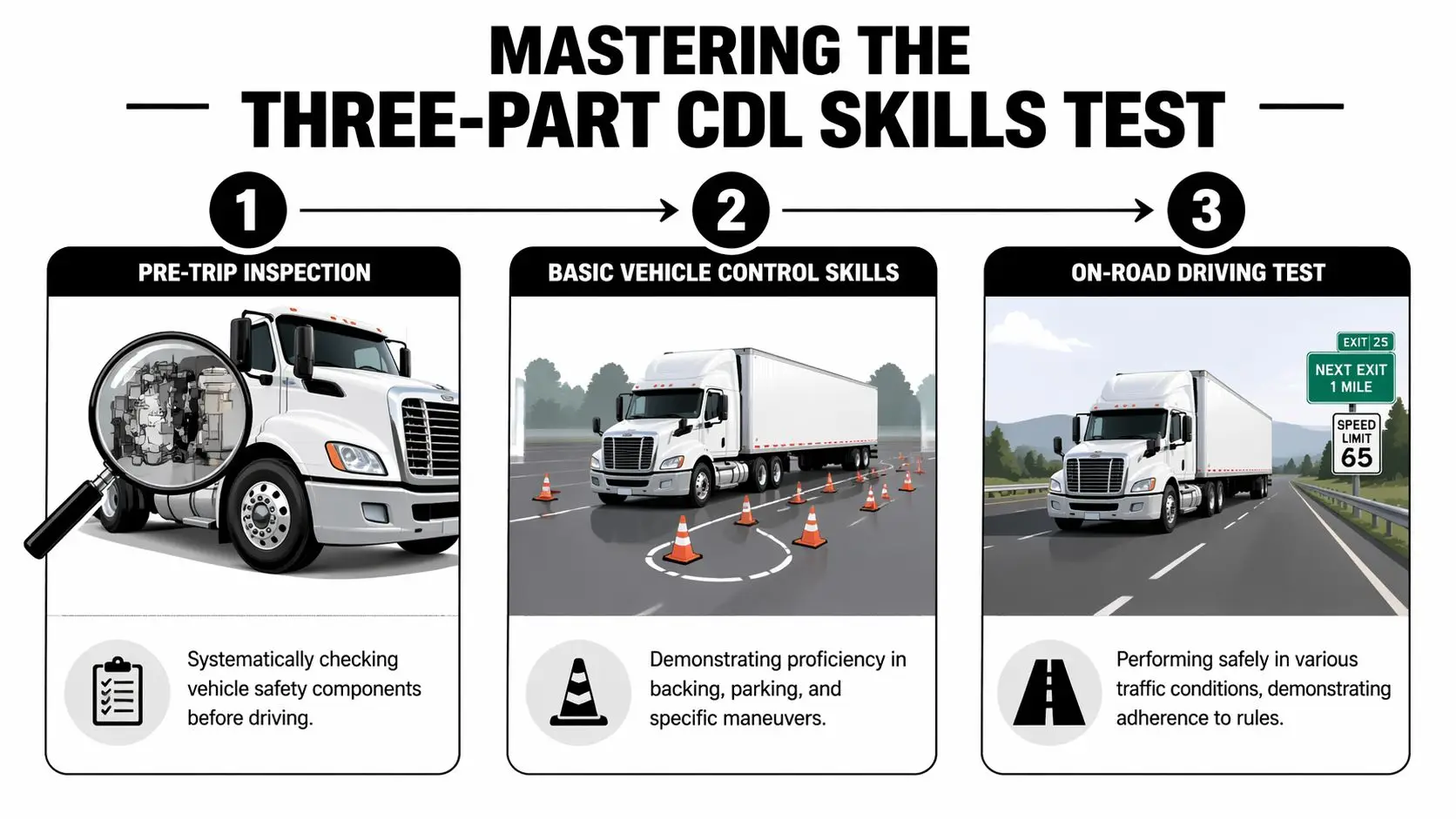
Florida breaks the skills test into three parts: pre-trip vehicle inspection, basic vehicle control, and on-road driving. You must pass each part. A serious mistake in one segment, such as missing key safety items or failing an air brake check, can end the attempt, as explained in this Florida CDL skills test guide.
That can sound intimidating at first. It also makes sense. The same safety habits taught in basic driver improvement courses carry over here. Check the vehicle before it moves. Control the vehicle before traffic adds pressure. Make calm decisions once you are on the road. The CDL test applies those same safety principles at a professional level.
Part one is your pre-trip inspection
The pre-trip works like a pilot’s pre-flight check. You are showing that you can catch a problem before it becomes a breakdown or a crash.
Examiners are looking for a method, not random pointing. They want to hear that you know what the part is, what condition it should be in, and what would make it unsafe. Students usually do better when they stop trying to memorize one giant speech and start learning a route around the vehicle.
Use a routine you can repeat under pressure:
- Start in the same place every time: front to rear, or one side all the way around
- Use the same pattern of explanation: name the part, describe proper condition, state what you are checking for
- Point with purpose: your hands should match your words
- Practice out loud: the test is verbal as well as visual
If you want a non-CDL example of how an organized walkaround works, this vehicle inspection checklist shows why a system beats memory alone.
Air brakes make more sense once you know the purpose
Air brake checks trouble many first-time applicants because they try to recite steps like a script. That usually falls apart under stress.
The better approach is to learn what each step proves. The system needs to hold pressure, warn you if pressure drops too low, and protect the vehicle if pressure falls into a dangerous range. Air brake testing works like checking a pressurized line before trusting it on the road. If the system leaks, warns too late, or fails to engage protection, the vehicle is not ready to drive.
That understanding helps you stay calm. You are not performing magic. You are verifying how the system behaves.
Part two is basic vehicle control
This section tests whether you can place the vehicle accurately at low speed. For many Class A applicants, that means backing maneuvers that feel awkward at first because the trailer reacts opposite of what your instincts expect.
That is normal, and it improves with repetition.
The biggest problem I see in practice yard sessions is overcorrection. A student gets a little off line, turns too much, waits too long to fix it, and then creates a second problem. Backing a commercial vehicle works better when your steering inputs are small, early, and deliberate. Your mirrors are your guide. The cones are reference points that tell you what the trailer is doing.
A few habits make a big difference:
- Set up carefully before you move: good positioning makes the maneuver easier
- Scan both mirrors: one-sided backing invites drift
- Make small corrections: early adjustments are easier to recover from
- Pause and reset your eyes: a short stop is better than a rushed mistake
Here’s a useful visual example before you practice your own sequence.
Part three is the on-road test
The road portion shows whether your habits stay steady once traffic, signs, and timing enter the picture. Examiners are watching for safe, lawful, professional driving. They want to see active observation, proper speed control, lane discipline, complete stops, and steady awareness.
Some mistakes carry extra weight. School zones and railroad crossings deserve careful attention because examiners expect exact procedure there. If your route includes either one, slow down mentally as well as physically and handle it by the book.
During the drive, expect close attention to:
- Mirror checks: regular scanning instead of staring straight ahead
- Lane changes: signal, check, confirm space, then move smoothly
- Stops: bring the vehicle to a full stop, with no rolling
- Turns: stay in your lane and manage space through the turn
- Hazard awareness: notice signs, traffic flow, and changing conditions early
What passing usually looks like
A strong CDL skills test does not look flashy. It looks organized.
The driver has a repeatable inspection routine, makes measured corrections in the control area, and drives on the road with patience and awareness. That is the journey Florida wants to see. Learn the why behind each step, practice the how until it feels familiar, and the test becomes much more manageable.
Florida CDL Endorsements and Restrictions Explained
A Florida CDL is your base vehicle. Endorsements are the trailers you attach to it. They determine what kind of work your license can carry.
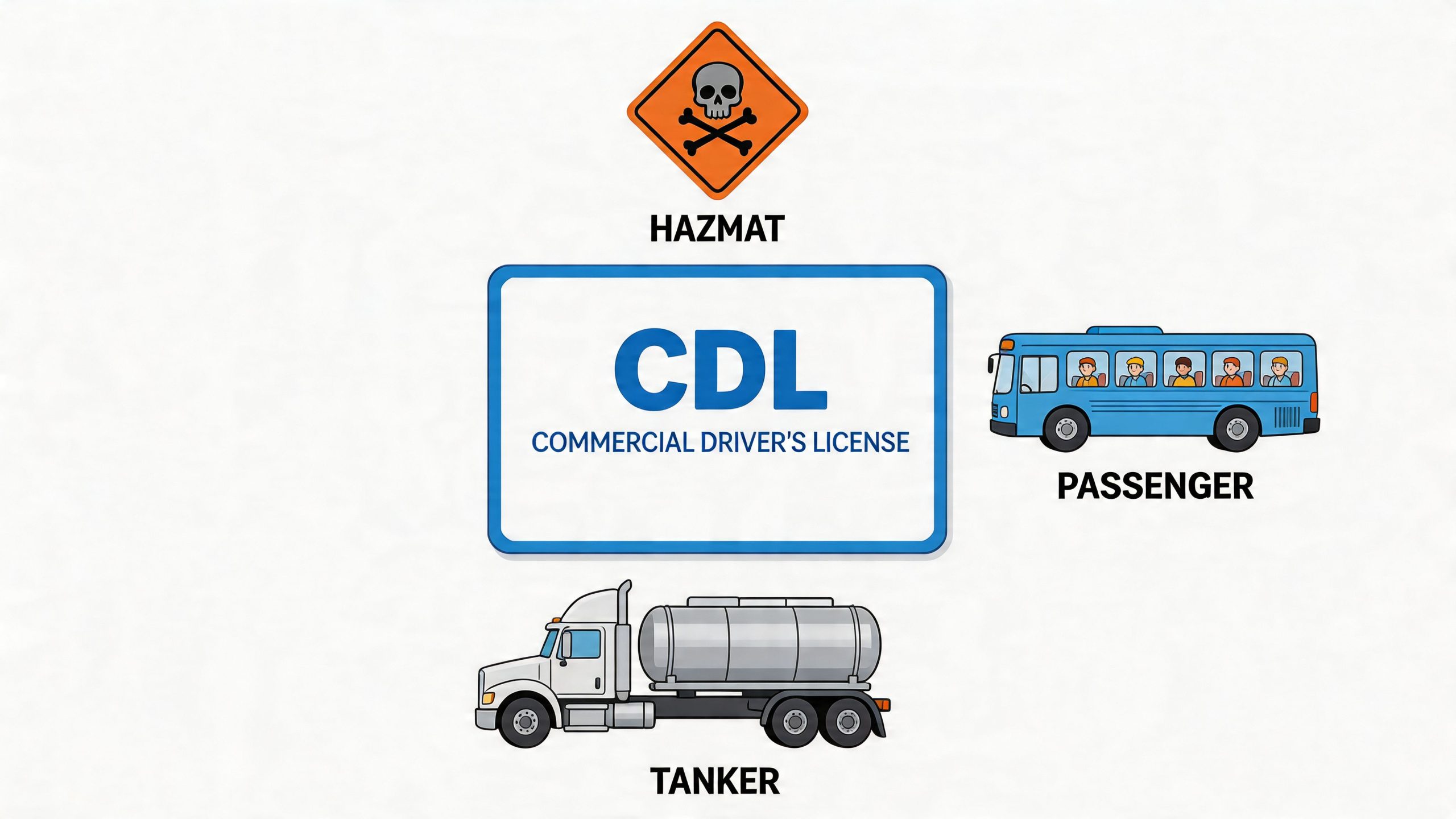
That matters more than many new drivers realize. A Class A or Class B license gets you in the gate, but endorsements often decide which jobs you can accept. If your goal is fuel delivery, school transportation, or hauling doubles, you need the right add-on before an employer can put you to work.
What each endorsement allows you to do
Endorsements are extra permissions tied to a specific kind of vehicle, cargo, or passenger duty.
Common Florida CDL endorsements include:
- H for Hazmat: Required to transport hazardous materials.
- N for Tank Vehicle: Required for certain tank vehicles.
- P for Passenger: Required for vehicles designed to carry passengers.
- S for School Bus: Required to operate a school bus. This usually goes hand in hand with passenger qualification.
- T for Doubles/Triples: Required for pulling double or triple trailers where allowed.
- X for Tank Vehicle and Hazmat: A combined endorsement for tank vehicles carrying hazardous materials.
The smartest way to choose endorsements is to work backward from the job you want. A driver planning for dump trucks may not need the same path as someone aiming for a passenger route or chemical hauling. Good training works the same way. You match preparation to the vehicle and duty, much like BDI road training matches safe driving habits to the roads you will use.
Hazmat takes extra preparation
Hazmat is the endorsement that causes the most confusion, so let’s slow it down.
This endorsement involves more than studying a manual and passing a written test. Florida drivers also have to clear federal security steps. The Transportation Security Administration explains that a hazmat endorsement requires a security threat assessment and fingerprint-based background check through the TSA hazmat endorsement process at tsa.gov/for-industry/hazmat-endorsement.
That extra screening makes sense. Carrying hazardous material is a little like carrying a box marked fragile and dangerous at the same time. The cargo may need careful routing, special placards, and stricter handling habits. The state wants proof that you understand both the safety rules and the responsibility that comes with them.
If hazmat is part of your plan, give yourself extra lead time. Delays usually come from paperwork and background processing, not from the knowledge test alone. A Florida road test scheduling guide can help you organize the timing side of the process so one missing step does not hold up the rest of your CDL path.
Restrictions narrow what your license covers
Restrictions do the opposite of endorsements. They limit what you are allowed to drive or how you qualified.
That sounds abstract until it affects a job offer. For example, if you test in a vehicle without air brakes, you can end up with an air brake restriction. If you test in the wrong type of transmission or vehicle setup, you may limit the range of trucks you can legally operate later.
A simple comparison helps:
| License Feature | What it means |
|---|---|
| Endorsement | Adds permission for a certain vehicle, cargo type, or passenger role |
| Restriction | Limits the vehicles or conditions your CDL covers |
This is why vehicle choice on test day matters. It is similar to learning on a small practice course and then being asked to work on a busy highway. The training tool shapes what you are ready and qualified to do.
Ask a direct question before you start training: “Will this truck and this test setup leave me with any restriction I do not want?” That one question can save time, money, and a frustrating redo later.
A useful CDL is more than a passing result. It fits the work you want and leaves you room to grow.
Scheduling Your Test, Fees, and Retake Rules
This is the part many applicants underestimate. They prepare mentally for the exams but not for the logistics. Scheduling and budgeting can create just as much stress as the test itself if you leave them until the last minute.
Where testing happens
Florida doesn’t handle every CDL step at every office. Testing happens at designated FLHSMV locations for the knowledge side, and the skills test is administered by FLHSMV-approved third-party testers rather than as a one-size-fits-all state process.
That means you should confirm the location, appointment process, and required documents before you show up. If you assume every office handles commercial testing, you can waste a day quickly.
If you need help understanding general Florida road test scheduling workflows, this DMV road test scheduling guide gives a useful overview of how to plan ahead and avoid preventable delays.
What costs are clear and what costs are not
Some Florida CDL fees are straightforward. Others are not.
The state-level fees described in this Florida CDL fee overview include:
- Initial CDL license fee of $75
- Endorsement fee of $7 each
That same source also explains the biggest budgeting problem applicants run into. The skills test fee is set by third-party providers and is not standardized by the state. In other words, one of the most important parts of the process can carry a local price that you have to research yourself.
That’s why people call it a hidden cost. It isn’t hidden because nobody mentions it. It’s hidden because there isn’t one universal statewide number you can plan around in advance.
How to budget without surprises
A practical CDL budget should include more than the obvious line items.
Build your plan around:
- License fee: The fixed state amount for the CDL itself.
- Endorsements: Add these based on the type of work you’re targeting.
- Written retests if needed: Small compared with other expenses, but still worth planning for.
- Skills test charge from your chosen provider: Call ahead and ask directly.
- Travel and time costs: Fuel, missed work hours, and rescheduling headaches are real costs even if they don’t appear on a receipt.
Retakes and timing
Florida’s written exam retest rules are clearer than many people expect. As covered earlier, a written retest can be taken after the next business day and carries a set charge. For the skills side, scheduling depends more on the provider’s calendar and policies.
The best mindset is simple. Plan as if you’ll pass the first time, but budget as if you might need one more attempt. That’s not pessimism. That’s adult planning.
Conclusion Your Career on the Road Starts Now
The finish line often looks biggest the night before a test. You have your permit, your notes, and a head full of checklists. Then the question hits: Am I ready for this?
That feeling is normal. Earning a Florida CDL is a process of building one layer at a time, much like learning to handle a large vehicle itself. You do not start with the tight turn into a loading dock. You start with the basics, repeat them until they become steady, and then add the next skill. The licensing path works the same way. Eligibility comes first. Then documents, training, study, practice, and finally a test day that measures habits you have already built.
Florida sets that bar high for a reason. A commercial license carries more responsibility than a standard license. In general, drivers can begin commercial driving at a younger age for work that stays inside Florida, while interstate driving and some types of operation require an older age and broader eligibility, as noted earlier in the guide. The point is not to make the process harder. The point is to make sure the person behind the wheel is prepared for the weight, size, and responsibility of the job.
The applicants who usually do best are not the ones trying to memorize everything in one sitting. They are the ones who treat CDL preparation like professional training from day one. They check mirrors before they are reminded. They slow down their thinking before they speed up the vehicle. They approach a pre-trip the way a pilot approaches a walk-around, because small misses on the ground can become big problems on the road.
That mindset connects directly to the safe-driving principles taught in Florida driver improvement courses. Hazard recognition, space management, patience, and legal compliance are not separate from commercial driving. They are the foundation under it. Air brake checks, backing maneuvers, and lane management may feel technical at first, but they rest on the same basic habit: notice what matters early and respond calmly.
Passing is achievable. Plenty of good drivers feel shaky at first, especially during the pre-trip or basic control portion. With steady practice, those tasks start to feel less like a script and more like a routine. That is when confidence becomes real.
If you are also thinking past the license and toward the kind of career you want to build, this guide to professional growth can help you map out the bigger picture.
Start where you are. Prepare one skill at a time. A CDL is not just a test result. It is the beginning of doing the job the right way.
Frequently Asked Questions About the Florida CDL Test
How many questions are on the Florida CDL knowledge test
Florida’s CDL knowledge test has 50 multiple-choice questions, and you need 40 correct answers to pass for the required 80% score, based on the earlier Florida knowledge test reference.
How long is the Commercial Learner’s Permit valid
A Florida CLP is valid for 12 months, based on the same knowledge test source discussed earlier. That gives you a substantial practice window, but it’s still smart to train with a schedule rather than letting time drift.
Can I take the CDL test at any Florida DMV office
No. Commercial testing is handled at designated locations and approved testing sites, not every office. Always confirm before traveling.
What happens if I fail one part of the skills test
The skills test is divided into three separate parts: pre-trip inspection, basic vehicle control, and on-road driving. You must pass each part, and failure in one segment can stop the testing process for that attempt.
Do I need ELDT before taking the skills test
If you’re a first-time Class A or Class B applicant, upgrading from Class B to Class A, or applying for certain new endorsements such as H, P, or S, ELDT is required through an FMCSA-registered provider before skills testing eligibility.
Do I need a medical certificate
Yes, when your application falls under the applicable commercial medical requirements. The DOT Medical Examiner’s Certificate is one of the key prerequisites in the process.
Are all CDL fees fixed statewide
No. Some fees are fixed, such as the state license fee and endorsement charges, but the skills test fee can vary because approved third-party providers set that charge locally.
Can I add endorsements later
Yes, many drivers do. That can be a smart move if you want to get your base license first and specialize once you know what type of work you want.
If you’re building safer driving habits while preparing for your next step, BDISchool offers Florida-approved online courses designed to make traffic law, defensive driving, and responsible decision-making easier to understand. That kind of safety mindset helps every driver, and it’s a strong foundation for anyone serious about a future on Florida’s roads.