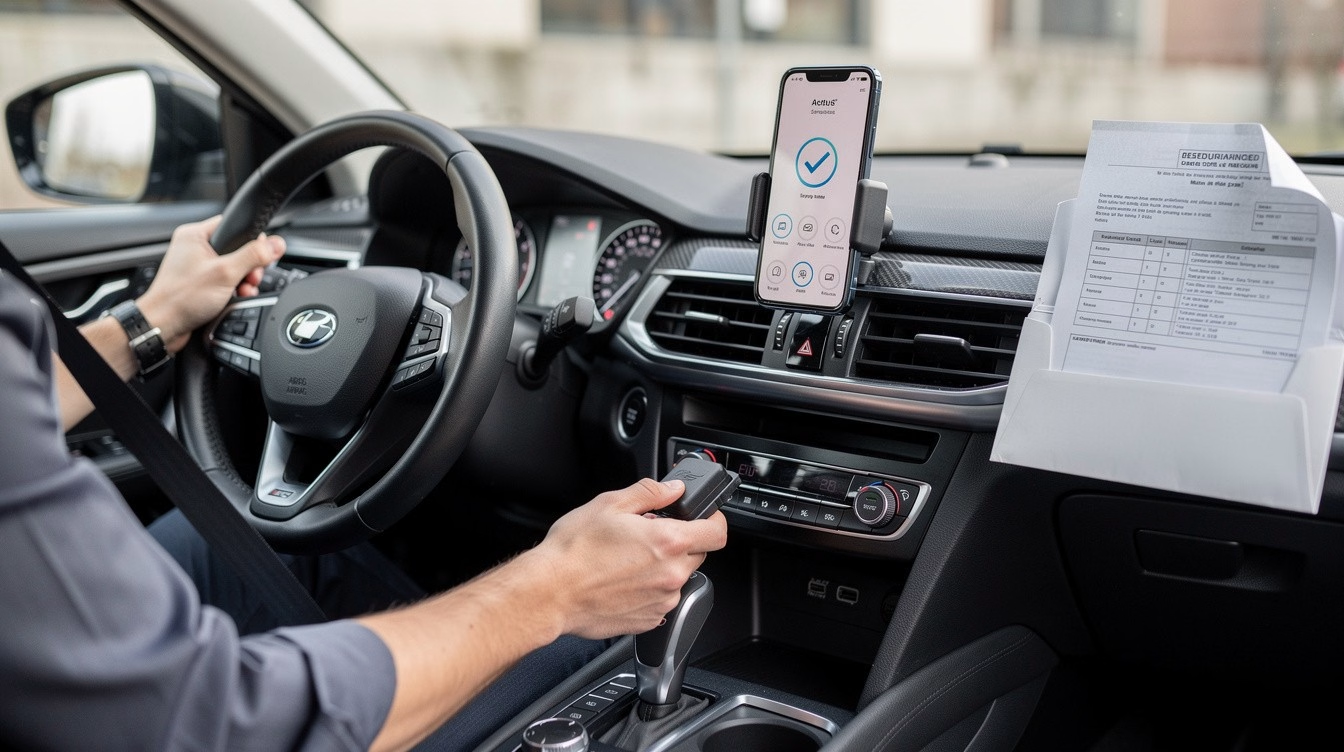
You get a ticket on I-10, open your phone that night, and see page after page of “Texas defensive driving” courses. They can look interchangeable. They are not.
For a Houston driver, the central question is not which course looks fastest. It is which course the court will accept and whether the school meets Texas approval rules. A wrong pick can cost you the course fee, leave you scrambling near the deadline, and still do nothing for your citation.
That is why this article uses a Texas checklist instead of generic shopping advice. You will work through the same screening process the smart way: confirm court permission, check the rules tied to Texas DPS and TDLR, verify that a school is approved, match the course type to your goal, compare total cost, and make sure the certificate and driving record reach the court on time.
A defensive driving course works a lot like using the right form at the DMV. The class itself may be fine, but if it is not the right one for your case, it does not solve the problem you are trying to fix.
You may also be taking the course for more than ticket dismissal. Some drivers use it to refresh habits after a citation. Others want an insurer-approved option for a discount. If your case involves a court requirement, this court ordered driving school overview shows the kind of process details you should confirm before enrolling.
The goal is simple: help Houston drivers check approval, timing, fees, and paperwork in the right order so they can choose a valid course with confidence.
1. Step 1: Confirm Your Eligibility with the Court

Before you compare schools, contact the court listed on your citation. That comes first.
You usually can't decide on your own that you're taking a defensive driving course for dismissal. The court has to allow it. If you skip that step and sign up anyway, you could finish the course and still have the ticket remain on your record.
A common Houston example is a driver who gets a routine moving violation, sees an online ad the same night, and registers immediately. Then they learn the court required a request, a plea, or other paperwork first. That's a preventable mistake.
Ask the clerk direct questions
Keep the call simple. Ask whether your violation is eligible, what paperwork the court needs, and the exact due date for completion and submission.
You can also ask whether the court wants proof of insurance, a copy of your license, or anything else before approval. If your case is court-ordered, this court ordered driving school page gives a useful example of how schools describe that process.
Practical rule: Don't spend money on a course until the court tells you that defensive driving is allowed for your citation.
Write the deadline down immediately. Put it in your phone calendar, not on a sticky note.
What to keep in front of you
When you contact the court, have these details ready:
- Citation number: The clerk will usually need it to find your case quickly.
- Driver's license information: This helps confirm identity and eligibility.
- Mailing or email address: Some courts send instructions electronically.
- Questions about submission: Ask how they want your certificate and driving record delivered.
This step sounds basic, but it saves the most trouble. A valid course only helps if the court has already said yes.
2. Step 2: Understand Texas DPS and TDLR Rules

Texas uses more than one agency in this process, and that's where many drivers get confused.
The Department of Public Safety, or DPS, deals with driving records. The Texas Department of Licensing and Regulation, or TDLR, handles school and course approval. If you need a course for ticket dismissal, the approval that matters most at enrollment is TDLR approval.
That means a course can look polished, have customer reviews, and still be the wrong choice for your case if it isn't approved in Texas.
Know which approval matters
Think of DPS as the record keeper and TDLR as the course gatekeeper. Houston courts generally expect a Texas-approved Driving Safety Course, not just any online traffic class.
Broad marketing often trips people up. A provider may offer courses in another state, such as the Florida traffic safety programs listed by BDISchool, but that doesn't automatically make every course acceptable for a Texas ticket.
Never rely on the word “approved” by itself. Check whether the course is approved for Texas and for your exact purpose.
A fast way to think about it
Use this filter before you enroll:
- Court accepted in Texas: The course must satisfy Texas ticket dismissal requirements.
- TDLR approved: The school and the course should appear as valid under Texas rules.
- Correct course type: You want a Driving Safety Course, not driver education for a first license.
- Record support: You'll still need to deal with your driving record separately through DPS.
Incorrect enrollment creates a double cost. You pay the course fee, then still need to fix the citation.
Defensive driving education can improve habits, but Texas courts care about compliance first. Even strong safety concepts such as the five defensive driving principles popularized by the Smith System only help your legal situation if the school itself meets the state's approval rules. Safeway Driving notes that the Smith System was created in 1952 and includes habits like scanning ahead and keeping your eyes moving in this overview of the five keys of defensive driving.
3. Step 3: Find and Vet TDLR-Approved Schools

Once the court says you're eligible, use the TDLR search tool before you buy anything. Treat that database as your source of truth.
If a school says it's approved, verify it. If a coupon site says the course works for Houston tickets, verify it. If a friend sends you a link they used years ago, verify it.
What to check in the listing
Look for an active license status. Then confirm the school offers the correct Driving Safety Course, not a different training product.
A Houston driver shopping on a lunch break might narrow options by convenience first. That's fine, but legitimacy comes before price, mobile design, or same-day certificate claims.
If you want to see how an online provider presents this category, review an example such as approved online traffic school options from BDISchool. Then go back and confirm the school's current standing through the Texas regulator.
If the school isn't clearly verifiable, move on. You don't need to investigate a maybe.
Vet the school, not just the website
A real vetting pass is short but specific:
- Check active status: Don't assume an older approval is still current.
- Match the course name: “Driving Safety Course” matters more than broad phrases like “traffic class.”
- Review contact details: A legitimate provider should make support easy to find.
- Read the checkout terms: You want to know how certificates are issued and how long delivery takes.
Market demand for defensive driving training is large, and one market report projects the global category at $2.4 billion in 2024 in this defensive driving training market report. For drivers, that growth has one practical takeaway. There are plenty of providers, so you don't need to settle for one that feels vague or hard to verify.
4. Step 4: Differentiate Course Types for Your Goal

Not every driving class solves the same problem. That sounds obvious, but many enrollment mistakes happen right here.
Some drivers need ticket dismissal. Some want an insurance discount. Others need first-time licensing instruction. A school may sell all three, and the names can look similar if you're rushing.
Match the course to the outcome
For a Houston ticket, you want the state-approved Driving Safety Course tied to dismissal. If your goal is lower insurance, check with your insurer first and confirm what they'll accept.
If you're shopping on a phone after work, slow down at the product page. “Driver education,” “traffic school,” and “defensive driving course” aren't always interchangeable in practice.
A provider may also explain broader reasons drivers take these classes. For example, BDISchool's explanation of defensive driving course benefits reflects the fact that people often enroll for legal, financial, and safety reasons at the same time.
Why the distinction matters
A wrong course can be perfectly legitimate and still useless for your ticket. That's the frustrating part.
Use this quick filter:
- Ticket dismissal: Choose the Texas-approved Driving Safety Course.
- Insurance discount: Confirm acceptance with your carrier before enrolling.
- New license training: Choose driver education, not a dismissal course.
- Skill refresh: Pick a course designed for improvement, not necessarily court filing.
There's also an important expectation to keep realistic. A defensive driving course can reduce violations, but not every course has strong evidence for lowering real-world crash rates. A PubMed review found a reliable reduction in traffic violations, while crash reduction results were not consistent in the studies reviewed in this PubMed literature review. That makes course selection even more important. Choose the course that fits your legal need first, then look at quality and learning format.
5. Step 5: Compare Pricing, Format, and Hidden Fees

You find a course advertised at a low price, click enroll, and the total climbs at checkout. Certificate delivery costs extra. Processing costs extra. A rushed shipping option appears because your court deadline is close.
That is the mistake this step is designed to prevent.
After you confirm the school is TDLR-approved and the course fits your goal, compare it the way you would compare a plane ticket. The first number gets your attention. The final total is what counts.
Price is only useful if it is the real price
A low headline rate is not automatically a red flag. Some schools separate tuition from certificate mailing or expedited delivery. The problem starts when those charges are hard to spot until the last screen.
Before you pay, check three things in plain language: the course price, any certificate fee, and any optional rush charge. If the site makes that hard to find, treat that as part of your comparison.
Format affects whether you finish on time
Houston drivers often squeeze this course into lunch breaks, evenings, or weekends. A course that fits your schedule can save more stress than a small price difference.
Ask practical questions:
- Can you stop and resume without losing progress?
- Does the course work well on your phone, tablet, or laptop?
- Is the text easy to read, or is it packed into long screens that are hard to follow?
- Can you reach support if you have login trouble close to your deadline?
A cheaper course can cost you more if it is hard to use or slows down certificate delivery.
Compare these items side by side
Use a simple checklist while you review options:
- Total checkout cost: Look for the full amount before you enter payment details.
- Certificate delivery fees: Confirm whether standard delivery is included or billed separately.
- Rush options: Check the price only if your court date makes faster delivery necessary.
- Device compatibility: Make sure the course works on the device you will use.
- Progress saving: Confirm you can log out and return later without restarting.
- Course style: Choose a format you can stay focused on, whether that is text, video, or a more interactive layout.
- Customer support hours: Late-night or weekend access can matter if you study outside business hours.
Content quality matters too. Texas defensive driving is not just a box to check. The course should explain real driving situations clearly, especially the ones Houston drivers face often, such as rain, traffic density, distractions, and following distance. If the material feels rushed or confusing on the sample pages, the low price may not be worth it.
Your goal in this step is simple: find the lowest-friction, fully approved option with a clear total cost. That approach helps you avoid two expensive errors at once. Paying more than you expected, or choosing a course that creates problems later.
6. Step 6: Plan for Certificate and Driving Record Submission

A Houston driver finishes the course the night before the deadline, feels relieved, and then learns the court still needs a certified Texas driving record and a specific submission method. The course is done, but the case is not.
That is why this step deserves its own plan. For Texas ticket dismissal, the court usually wants two separate items by a fixed date: your completion certificate and a certified copy of your driving record. If either one arrives late, or in the wrong form, you can lose the benefit of taking the course at all.
Paperwork works like the last leg of a relay race. A Texas-approved school can get you through the course, but you still have to carry the baton across the final line.
Build your submission plan before you start the course
Do not wait until the final quiz to figure out delivery details. Check the court's instructions early, then work backward from the deadline.
Ask these questions in order:
- What exact documents does the court require? Confirm whether it wants the course certificate, a certified driving record, and anything else tied to your case.
- How will you get the certificate? Check whether the school emails it, mails it, or offers a download, and how long each option takes.
- When will you order your Texas driving record? Order the correct certified record early enough to avoid a last-minute scramble.
- How does the court accept documents? Some courts allow online upload. Others require mail or in-person delivery.
- What proof will you keep? Save confirmation emails, upload receipts, tracking numbers, or stamped copies.
Each question removes one point of failure. That is the actual objective here.
Focus on timing, not just completion
Drivers often treat the end of the course as the end of the process. In Texas, completion is only one checkpoint. Submission is the checkpoint that closes the loop with the court.
A better approach is to set your own earlier deadline. If the court deadline is Friday, aim to have everything submitted before then. That buffer gives you room for delivery delays, rejected uploads, or simple mistakes like ordering the wrong record type.
This is also part of vetting the school you chose. A TDLR-approved provider can still differ on certificate speed and delivery options. Approval tells you the course counts. It does not guarantee the logistics fit your deadline.
Use this step to protect the time and money you already invested.
7. Step 7: Follow the Final Enrollment and Completion Checklist

You are one click away from paying for a course, and the page looks fine. The problem is that a polished checkout page does not tell you whether the class fits your Texas ticket, your court deadline, or the documents you still need afterward.
Treat this last review like a pilot's preflight check. The plane may be ready, but you still confirm the fuel, the route, and the weather before takeoff. A Texas defensive driving course works the same way. The course itself is only one part of a process that has to match court rules, TDLR approval, and your timeline.
Final enrollment checklist
Run through these items before you enter payment information:
- Court approval is confirmed: You already verified that your court allows dismissal through a driving safety course.
- TDLR approval is verified: You checked the school against Texas requirements instead of relying on ads or reviews.
- The course type matches your goal: You selected a Driving Safety Course for ticket dismissal, not an insurance-only or unrelated class.
- The total price makes sense: You reviewed the full charge, including any fee for the certificate.
- Your completion plan is clear: You know when you will take the course and how long the provider gives you to finish it.
- Your document timeline works: You can complete the class, receive the certificate, and submit everything by the court's deadline.
One missing item can turn a valid plan into a rejected one.
Use this step to catch expensive mistakes
Houston drivers often enroll while multitasking, irritated about the ticket, and trying to get it over with fast. That is when small errors slip in. A school can be legitimate but still be the wrong fit for your deadline. A low advertised price can still cost more once certificate fees appear. A correct course can still fail to help if you do not finish it in time.
That is why this step matters. It is your final filter before you spend money.
If every box is checked, enroll with confidence. If one answer is unclear, stop and fix that issue first. A short pause here can save you from paying for a course the court will not accept.
7-Step Defensive Driving Course Comparison
| Item | 🔄 Implementation Complexity | 💡 Resource Requirements | ⭐ Expected Outcomes | 📊 Ideal Use Cases | ⚡ Key Advantages |
|---|---|---|---|---|---|
| Step 1: Confirm Your Eligibility with the Court | Low, phone/email to court; verify eligibility and deadline | Case number, driver ID, court contact | Clarifies if course option is available; prevents forfeiture | Any ticket holder determining dismissal options | Fast confirmation; avoids wasted enrollment |
| Step 2: Understand Texas DPS and TDLR Rules | Moderate, review agency rules and approved lists | Internet access, TDLR/DPS websites | Ensures chosen course is legally valid for dismissal | Selecting courses for Texas (Houston) ticket dismissal | Prevents invalid purchases; ensures compliance |
| Step 3: Find and Vet TDLR-Approved Schools | Moderate, search license database and verify status | TDLR license search tool, provider info | Selects legitimate, active provider; reduces fraud risk | Enrolling in online Driving Safety Course for dismissal | Reliable approval verification; reduces rejection risk |
| Step 4: Differentiate Course Types for Your Goal | Low, identify course purpose (dismissal, insurance, ed) | Course catalogs, insurer or court requirements | Enroll in correct course to meet legal/financial goals | Those needing ticket dismissal, insurance discount, or licensure | Aligns training to objective; avoids wrong certification |
| Step 5: Compare Pricing, Format, and Hidden Fees | Moderate, compare total cost and platform compatibility | Provider pricing pages, reviews, device testing | Accurate cost estimate and better learner experience | Budget-sensitive users and mobile learners | Avoids surprise fees; ensures mobile-friendly delivery |
| Step 6: Plan for Certificate and Driving Record Submission | Moderate–High, coordinate certificate and Type 3A record | School certificate, DPS driving record (fee/time), court deadline | Timely paperwork submission leading to ticket dismissal | Users approaching court deadlines | Reduces missed-deadline risk; ensures complete filing |
| Step 7: Follow the Final Enrollment and Completion Checklist | Low, confirm all prerequisites and logistics | Court approval, TDLR verification, payment plan, record order | Higher chance of successful dismissal; fewer errors | Ready-to-enroll individuals seeking smooth completion | Comprehensive readiness; minimizes last-minute problems |
Drive Smarter and Protect Your Record
A Houston driver gets a ticket on Monday, rushes to sign up for a course on Tuesday, and finds out later the court will not accept it. That mistake costs time, money, and sometimes the chance to keep the ticket off the record. The safer approach is slower by a few minutes and smarter by a mile. Check the court requirement first, match it to Texas rules, then enroll only after the school clears each approval step.
That is the true value of this checklist. It is not a roundup of course providers. It is a Texas-specific way to screen a school before you pay, so you do not end up with the wrong class, the wrong certificate, or a missed deadline.
The course itself matters, too. Good defensive driving training sharpens habits drivers use every day on Houston roads, such as spotting problems early, leaving enough space, and reacting calmly when another driver makes a bad move. Those skills are helpful, but only if the course you choose is approved for your exact goal.
Use a final review before you enroll. Confirm the provider is TDLR-approved for the course type you need. Check that the total price is clear, including certificate delivery or processing charges. Make sure the format fits your schedule and device. Then look at the finish line: how long the course takes, when your certificate will arrive, and what you still need to send to the court.
Small checks prevent expensive errors.
One option many Texas drivers consider is BDISchool, which provides online traffic school information and course pages for different needs. Treat it the same way you should treat any provider. Verify that the exact course matches your court or insurance requirement before you enroll.
FAQs About Texas Defensive Driving Courses
How long is a Texas defensive driving course?
A state-approved defensive driving course for ticket dismissal is required to be 6 hours long, including breaks.
Can I complete the course all at once?
Yes, many online courses are self-paced. You can finish it in one sitting or sign in and out as your schedule allows.
How much does a defensive driving course cost in Texas?
The state minimum price is $25, but schools may charge more. Check for extra fees for certificate processing or state assessments before you pay.
How do I get my completion certificate to the court?
You are responsible for submitting the certificate, along with a certified copy of your driving record, to the court before your deadline. The school does not do this for you.
If you want a starting point for comparing online traffic school options, visit BDISchool and verify that the exact course fits your Texas court requirement before enrolling.