Yes, driver’s ed and traffic school certificates can expire. In Florida, certain pre-licensing certificates are usable for only one year from the course completion date, so finishing the course today doesn’t guarantee it will satisfy a licensing requirement later. You may be looking at a PDF on your phone, preparing for a road test, or trying to close out a citation before a court deadline. The dangerous assumption is that possession equals compliance. In Florida, the course type, completion date, receiving agency, and electronic reporting record all matter.
The Short Answer on Certificate Expiration
The answer to “do drivers ed certificates expire?” is yes, but there isn’t one universal expiration period. The controlling rule depends on the state, the exact course, and whether the certificate is being used for licensing, a court requirement, or an insurance request. New York provides a clear example. Its DMV says a Student Certificate of Completion of Driver Education is valid for two years, and it must still be valid on the day the student schedules the road test. New York’s Pre-licensing Course Certificate follows a different rule, remaining valid for one year from issuance. You can review those distinctions in the New York DMV’s driver pre-licensing course guidance. Florida has its own rules, and Florida drivers shouldn’t borrow assumptions from another state. A certificate may stop satisfying the requirement even though the course was completed correctly and the document still exists in an email inbox.
Practical rule: Check the issuing date, the course name, the valid-through date, and the deadline given by the DMV, court, insurer, or licensing office.
Missing a deadline can force you to repeat training rather than just request another copy. That’s why checking your status should come before scheduling a test, submitting court paperwork, or assuming a ticket has been handled. Review the certificate validity period guidance and then confirm the rule with the agency receiving your completion record.
Florida FLHSMV Timelines for New Drivers
Florida’s transition from the older TLSAE requirement to the newer Driver Education and Traffic Safety, or DETS, course has created a specific timing issue for younger first-time applicants. The Florida Department of Highway Safety and Motor Vehicles states that, beginning August 1, 2025, people under 18 who have never held a license from another state, country, or jurisdiction must complete the six-hour DETS course before applying for a Florida license. The Florida FLHSMV DETS frequently asked questions explains the transition. Students who completed the earlier TLSAE course before that date may continue using the completion certificate for one year after course completion. If they don’t obtain a Florida license during that period, the older certificate no longer fulfills the applicable requirement, and they must complete the newer DETS course before licensing.
The completion date controls
The course completion date is not a minor detail. It determines whether an older TLSAE certificate remains usable, so students and parents should record it immediately and avoid treating the certificate as permanent proof. Florida also separates pre-licensing education from other programs. TLSAE, DETS, Basic Driver Improvement, and other driver-improvement courses may have different reporting rules and different uses. A certificate accepted for one purpose may not satisfy another. Adults and teens should identify the exact course before relying on an old completion record. Don’t assume a school’s general statement, a saved PDF, or a prior driving experience overrides the current FLHSMV requirement. Road-test preparation also includes practical readiness. If your license renewal or testing appointment requires updated vision documentation, you can book your renewal eye exam early rather than discovering a separate problem at the last minute.
Traffic School Deadlines for Citations and Insurance
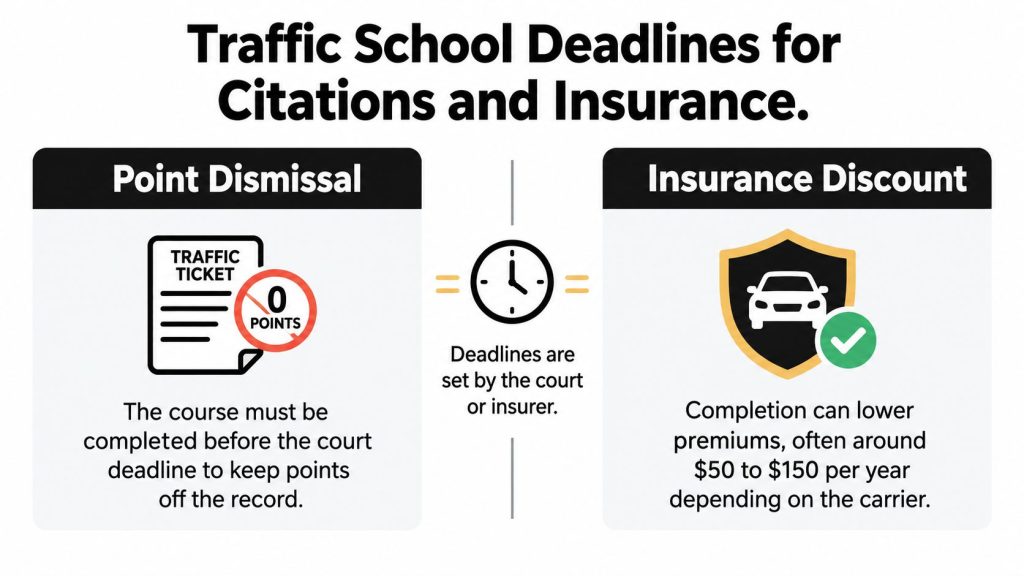
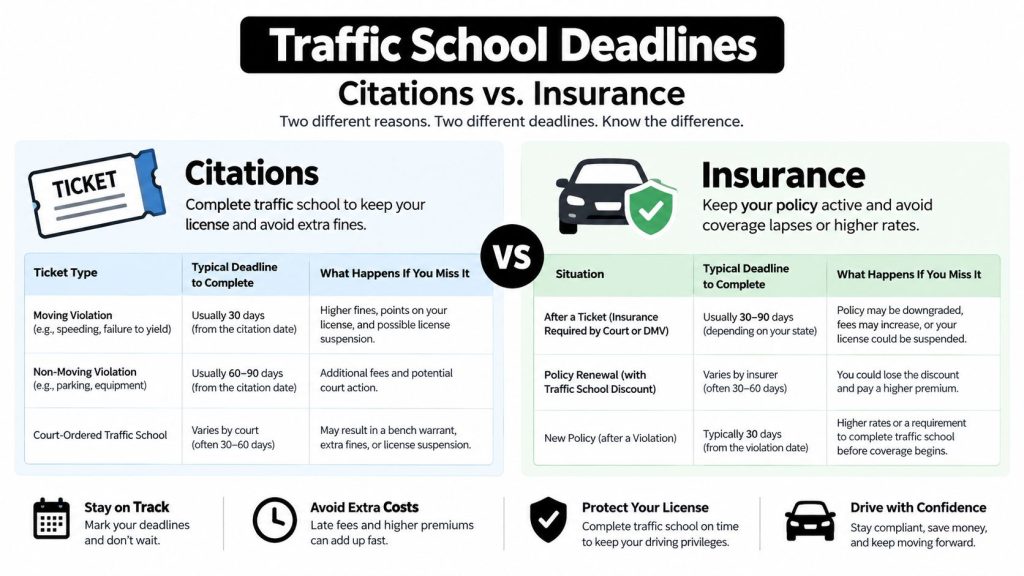
Traffic school for a citation is not the same as pre-licensing education. A driver who takes a Florida Basic Driver Improvement, or BDI, course after a moving violation is dealing with a court or citation process. A student completing pre-licensing education is trying to meet a licensing requirement. The deadline for a citation comes from the court or the applicable citation instructions. The provider’s course-completion record doesn’t replace that deadline. If the court requires completion before a specified date, finishing the course afterward may not protect the driving record, even if the course itself was completed successfully.
Match the course to the purpose
BDI is designed for drivers handling a moving violation and seeking the applicable point-related benefit. Intermediate Driver Improvement, or IDI, is a more extensive option used for certain court requirements or deeper remedial education. An Aggressive Driver Course addresses court-directed behavioral concerns, while a Mature Driver Course is intended for older drivers seeking an insurance-related benefit. Those courses aren’t interchangeable. Before enrolling, read the citation, court order, or insurer’s instructions and confirm the exact course category they require.
Court deadline: The date imposed by the court controls whether a citation course satisfies the order.
Insurance request: An insurer decides whether it will apply a discount and what proof it wants. Course completion alone doesn’t promise a premium change.
Florida’s traffic-school system also depends on accurate state reporting, not merely a document saved by the student. The Florida traffic-ticket limitation guidance can help you understand why waiting to address a citation is a poor strategy. Keep your court paperwork and insurer instructions beside your course confirmation. If the requirement is unclear, contact the court or insurer before registering, because the wrong course can consume time without resolving the actual obligation.
Why Your Paper Certificate Might Not Be Enough
A printed certificate or downloaded PDF can look official and still fail to prove compliance in Florida. The critical distinction is between having a document and having a completion record that FLHSMV can verify. The Florida FLHSMV does not accept paper certificates for licensing purposes and provides an online completion-check service to verify that a driver school course was taken and reported correctly. The department explains this through its driver-improvement school completion-check information.
What students should verify
After completing a course, confirm that the provider transmitted the completion correctly. Don’t wait until a licensing appointment or court deadline to discover that the state record is missing, incomplete, or associated with the wrong information. A paper copy can still be useful for your personal files, but it isn’t the final compliance step for Florida licensing purposes. Treat it as a backup record, not as a substitute for electronic verification.
Three dates deserve attention
Track the course-completion date, the certificate-valid-through date, and the deadline imposed by the receiving agency. They may not be identical, and the earliest controlling deadline is the one that matters. If your completion doesn’t appear in the state system, contact the course provider promptly. Ask them to confirm the submission details and give you clear instructions for resolving a reporting issue. Waiting can turn a simple administrative correction into a missed court or DMV deadline.
Choosing a Reliable State-Approved Provider
A provider matters because Florida’s process depends on accurate reporting. Choose a school that clearly identifies the course type, explains where completion is reported, and gives you access to support when a deadline is approaching. BDISchool offers online Florida courses for drivers handling moving violations, court-directed education, defensive-driving refreshers, and insurance-related requests. Its course catalog includes BDI, IDI, Aggressive Driver, and Mature Driver options, with self-paced access in English, Spanish, and Portuguese.
What to look for before enrolling
Correct course category: Select the program named by your court, licensing agency, or insurer.
Electronic reporting: Confirm that the provider reports completion to FLHSMV instead of leaving you responsible for mailing a paper certificate.
Flexible access: Self-paced online study helps drivers complete required education around work, school, and family obligations.
Language options: English, Spanish, and Portuguese access can make the material easier to understand and complete accurately.
Relevant instruction: Look for defensive driving, Florida traffic laws, right-of-way rules, impaired-driving prevention, distracted-driving awareness, and crash-avoidance techniques.
The school or instructor’s own license is also separate from the student’s certificate. Florida regulations address recurring renewal requirements for commercial driver schools and instructors, but an expiring provider credential doesn’t automatically prove that a previously completed student course certificate has expired. Check the specific course rule and the receiving agency’s record instead, using the Florida highway safety and motor vehicles information as a starting point.
Steps to Verify Your Status or Enroll Today
Start with the purpose of the course. Licensing, court compliance, point-related relief, and insurance requests can require different programs.
Read the requirement carefully. Identify the course name and the deadline from the DMV, court, citation, or insurer.
Find the completion date. Use the provider record, not memory.
Check electronic reporting. Use Florida’s completion-check service where applicable and confirm that your record was transmitted.
Call the provider if the record is missing. Ask for confirmation of the reported information and the next correction step.
Retake expired training when required. Don’t submit an old certificate and hope an agency accepts it.
A PDF in your inbox isn’t enough if Florida’s system can’t verify the completion. Check the record today, then act on the exact requirement instead of gambling your license, court outcome, or insurance request on an outdated document. BDISchool provides Florida-approved online traffic-school courses with self-paced access, multiple language options, and electronic completion reporting. Visit BDISchool to choose the course that matches your DMV, court, or insurance requirement and start before your deadline expires.
Use this traffic safety curriculum review to compare course approval, lesson quality, mobile access, reporting, and value before you enroll online today.
Equip your teen with essential driving safety skills using our parent teen driving guide. Learn proven strategies to build confidence behind the wheel.
License Points Florida. Understand license points in Florida, how they accumulate, suspension thresholds, and how to reduce them through approved courses.
See an older driver discount example, learn who may qualify, and find out how an approved mature driver course can help lower insurance costs if eligible.