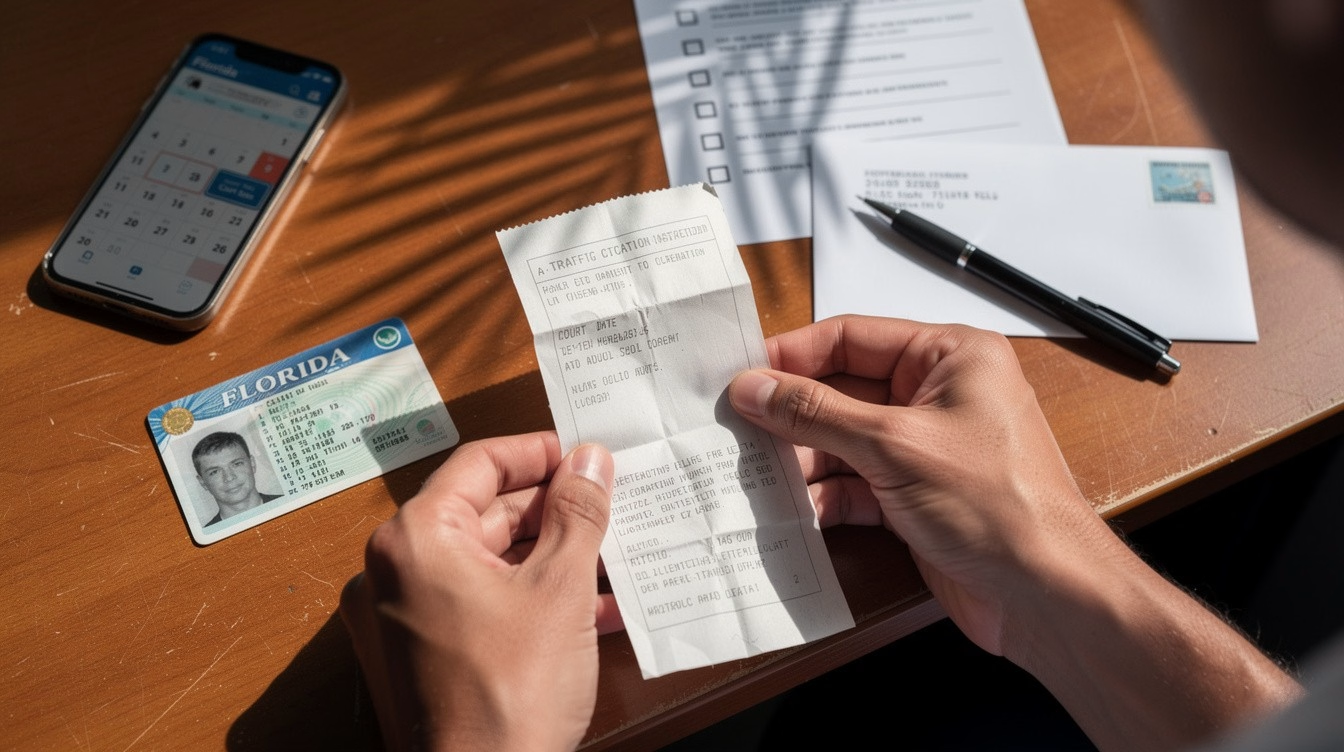
Generally, no, a red light camera ticket in Florida does not affect your insurance. A Florida camera ticket is a $158 Notice of Violation with 0 points, and that means no direct impact on your auto insurance if you handle it correctly.
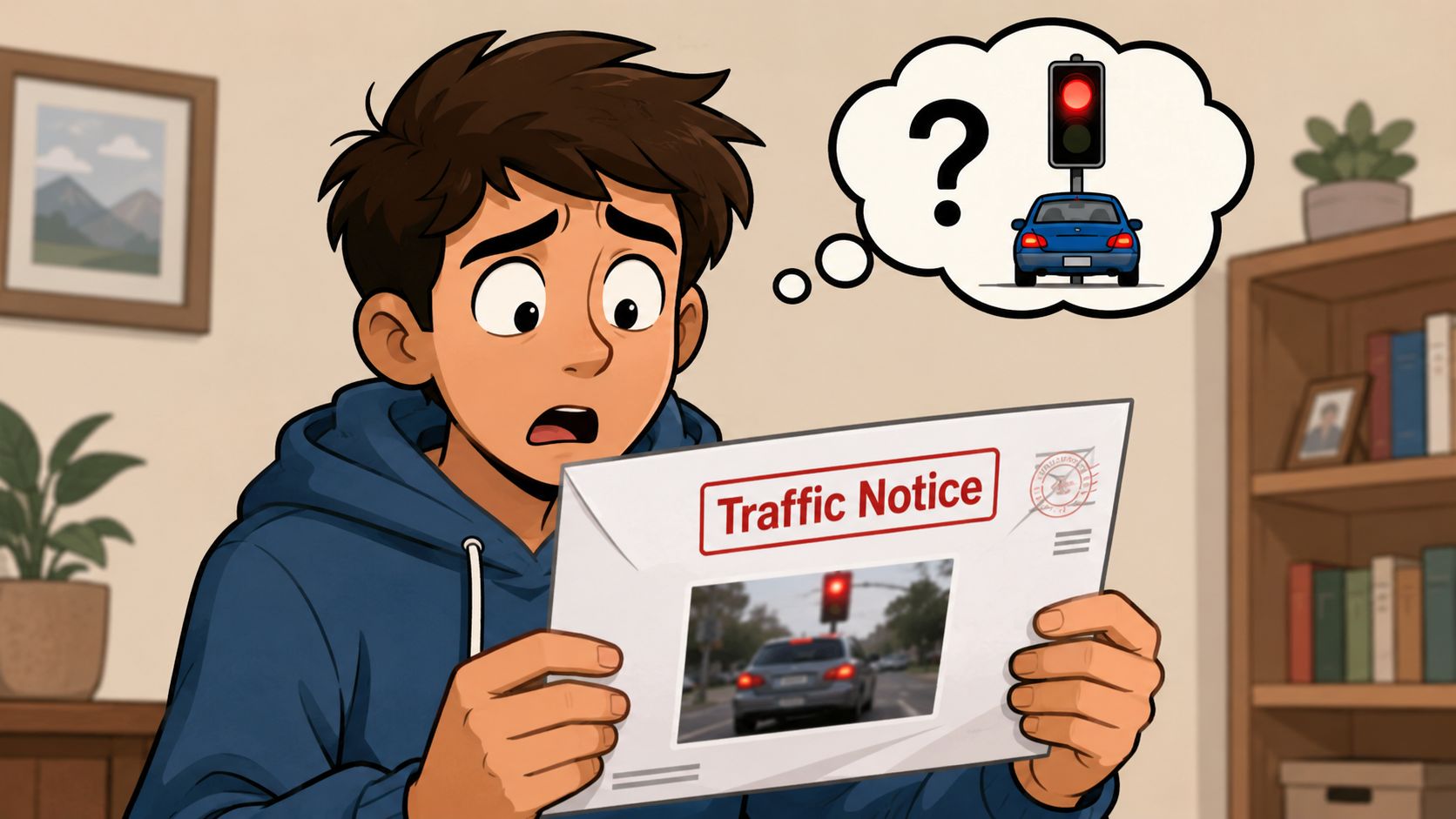
That’s the part most drivers want to hear after opening the mailbox and seeing a traffic notice with their car in the photo. The panic is real. People immediately think points, rate hike, and another expensive surprise at renewal.
For most Florida drivers, that fear is misplaced. A camera ticket is usually a civil matter, not the kind of violation that goes on your driving record the way an officer-issued moving violation does.
But “usually” only helps if you deal with it the right way. Ignore it, miss deadlines, or assume all states treat these tickets the same, and a minor hassle can turn into a much bigger problem.
Your Red Light Ticket and Your Insurance A Direct Answer
You open the envelope. There’s the intersection, the timestamp, and your car crossing on red. Your first thought is simple: “Is my insurance about to go up?”
In Florida, the answer is no, not directly. A red light camera ticket is issued as a civil notice, and that distinction matters more than is commonly understood.
What most Florida drivers need to know first
If you’re asking whether does a red light camera ticket affect insurance, you’re really asking whether this ticket shows up in the places insurers use to price you. In Florida, a camera-issued notice doesn’t work like a regular moving violation.
That’s why drivers often confuse two completely different problems. One is a mailed civil notice. The other is a real moving violation tied to your license and record.
Practical rule: Treat a camera ticket like a problem to close out quickly, not a crisis. The insurance danger usually comes from what happens after you ignore it.
A lot of drivers also mix up camera tickets with officer stops because both involve running a red light. Insurance companies care about what gets reported as a driving offense, not just the fact that a red light was involved.
If you want a better handle on how insurers view violations generally, this guide on how points affect insurance in Florida helps connect the dots.
Relief is fine. Complacency is not
You should feel some relief if the notice is a standard Florida camera citation. But don’t get lazy with it.
Here’s the clean version of the rule:
- Camera notice in Florida: Usually no direct insurance hit.
- Officer-issued red light ticket: Different animal. That can affect your record.
- Unpaid or mishandled ticket: That’s where people create damage for themselves.
This is why smart drivers don’t just ask whether a red light camera ticket affects insurance. They ask what kind of ticket it is, what state issued it, and what happens if they sit on it.
Camera Tickets vs Officer Tickets Understanding The Difference
The root of much poor advice lies in people hearing “red light ticket” and assuming every ticket works the same way. It doesn’t.
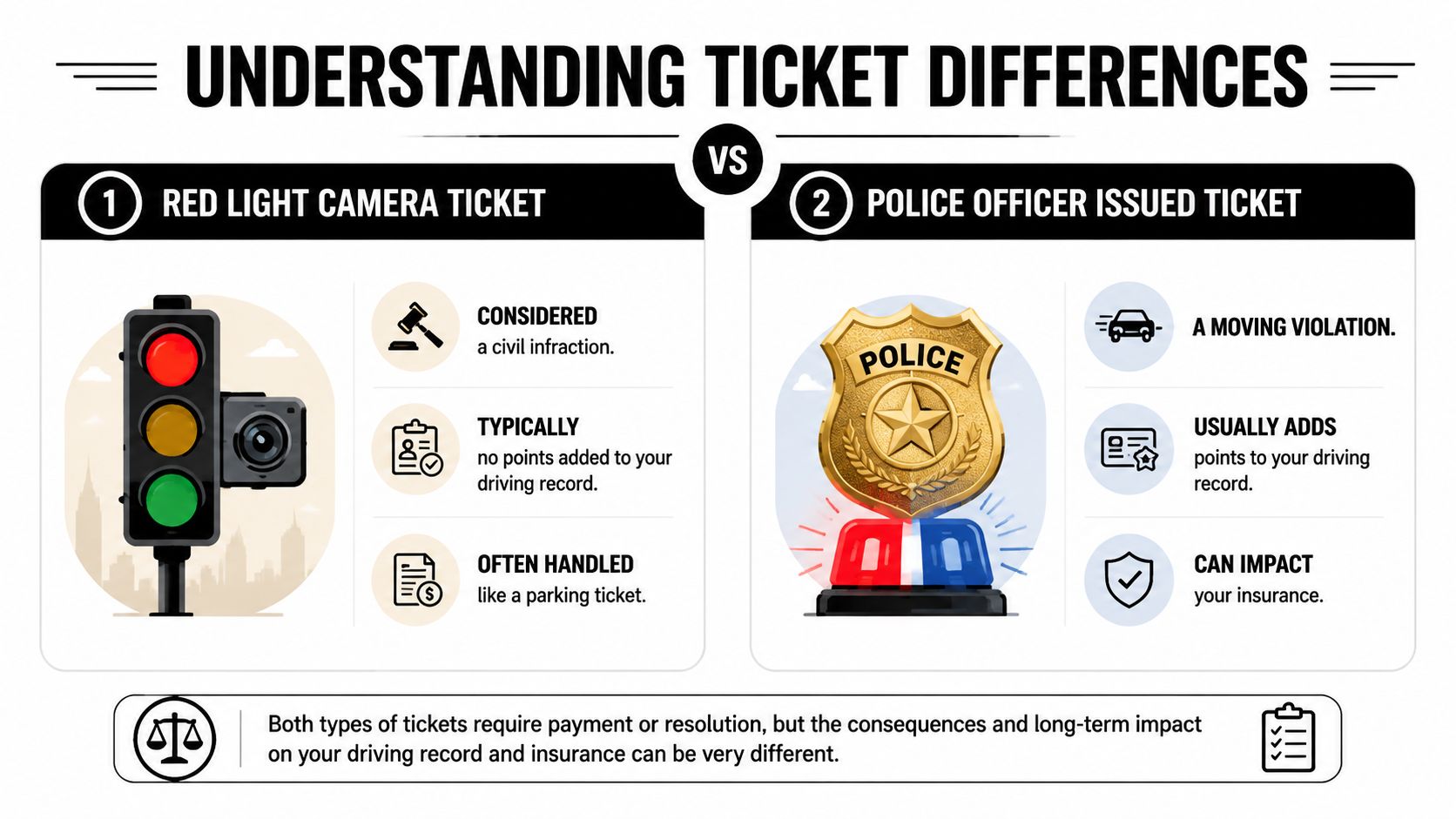
A camera ticket is usually closer to a parking ticket. An officer-issued ticket is closer to a speeding ticket. That single difference explains almost everything that follows.
Why insurers treat them differently
A camera system captures a vehicle. It usually doesn’t create the same kind of driver-specific moving violation record that an officer does when writing a citation face to face.
An officer-issued ticket is tied directly to the licensed driver. That’s why insurers take it more seriously. It lands where driving history gets reviewed.
Here’s the clean comparison:
| Ticket type | Typical classification | Points | Insurance impact |
|---|---|---|---|
| Red light camera ticket | Civil infraction | Usually 0 | Often no direct impact |
| Officer-issued red light ticket | Moving violation | Can add points | Can raise rates |
The difference isn’t just technical. It’s financial.
According to Ticket Clinic’s explanation of camera tickets versus officer-issued violations, officer-issued red light tickets add 3 points and trigger rate hikes in states like Georgia, while camera tickets are civil infractions with zero points and no insurance impact in places like Illinois and Washington. That same analysis also points out the trap many drivers miss: unpaid camera tickets can escalate into citations that do carry points and affect insurance.
The simplest way to think about it
Use this mental model and you won’t get lost:
- Camera ticket: The system says your vehicle was involved.
- Officer ticket: The officer says you, the driver, committed a moving violation.
That distinction is why camera tickets are often handled outside the normal insurance-rating pipeline. Not always, but often.
A mailed camera notice is usually a vehicle-based civil penalty. A roadside ticket is a driver-based moving violation.
If you want the Florida-specific version of how those systems work, this breakdown of Florida traffic light camera rules is useful.
Where drivers get burned
Drivers usually make one of two mistakes.
First, they overreact and assume the camera notice is automatically going to wreck their premium. Second, they underreact and toss it in a drawer because they heard camera tickets “don’t matter.”
Both are wrong.
The ticket itself may be minor. Your response to it is what determines whether it stays minor.
The Florida Rule for Red Light Camera Tickets
Florida keeps this fairly straightforward if you understand the label on the notice. If it says Notice of Violation, you are dealing with a civil infraction, not a standard moving violation.
That means the normal panic about points and insurance usually doesn’t apply.
The rule in plain English
In Florida, a red light camera ticket issued as a Notice of Violation carries a flat $158 fine with 0 points on your license and has no direct impact on auto insurance because it is classified as a civil infraction.
That’s the fact pattern that matters. Not rumor. Not what your cousin said happened in another state.
Here’s what that means for a Florida driver:
- It’s civil: It isn’t treated like a regular moving violation.
- It carries 0 points: Your license doesn’t take a point hit from the notice itself.
- It doesn’t directly raise insurance: Insurers don’t use it the same way they use a moving violation.
What you should do when the notice arrives
Keep it simple.
- Read the notice fully. Confirm it’s a camera-issued Notice of Violation.
- Check the deadline. Don’t guess.
- Handle it promptly. Delay is where clean cases turn messy.
- Keep proof. Save confirmation of payment or resolution.
The safest Florida strategy is boring. Read it, respond on time, keep records, move on.
That’s it. No drama needed.
If you want a state-specific overview of how these notices work, review Florida red light camera basics.
What Florida drivers misunderstand
The mistake isn’t usually the law. The mistake is thinking “no points” means “I can ignore this.”
No. It means the ticket starts as a civil issue with no direct insurance effect. It does not mean the state forgets about it if you refuse to deal with it.
Florida is one of the easier states on this issue when the ticket stays in its original form. The smart move is to keep it there by handling it fast.
When a Camera Ticket Can Raise Your Insurance Rates
A lot of articles stop too early and tell people camera tickets never matter. That’s sloppy advice.
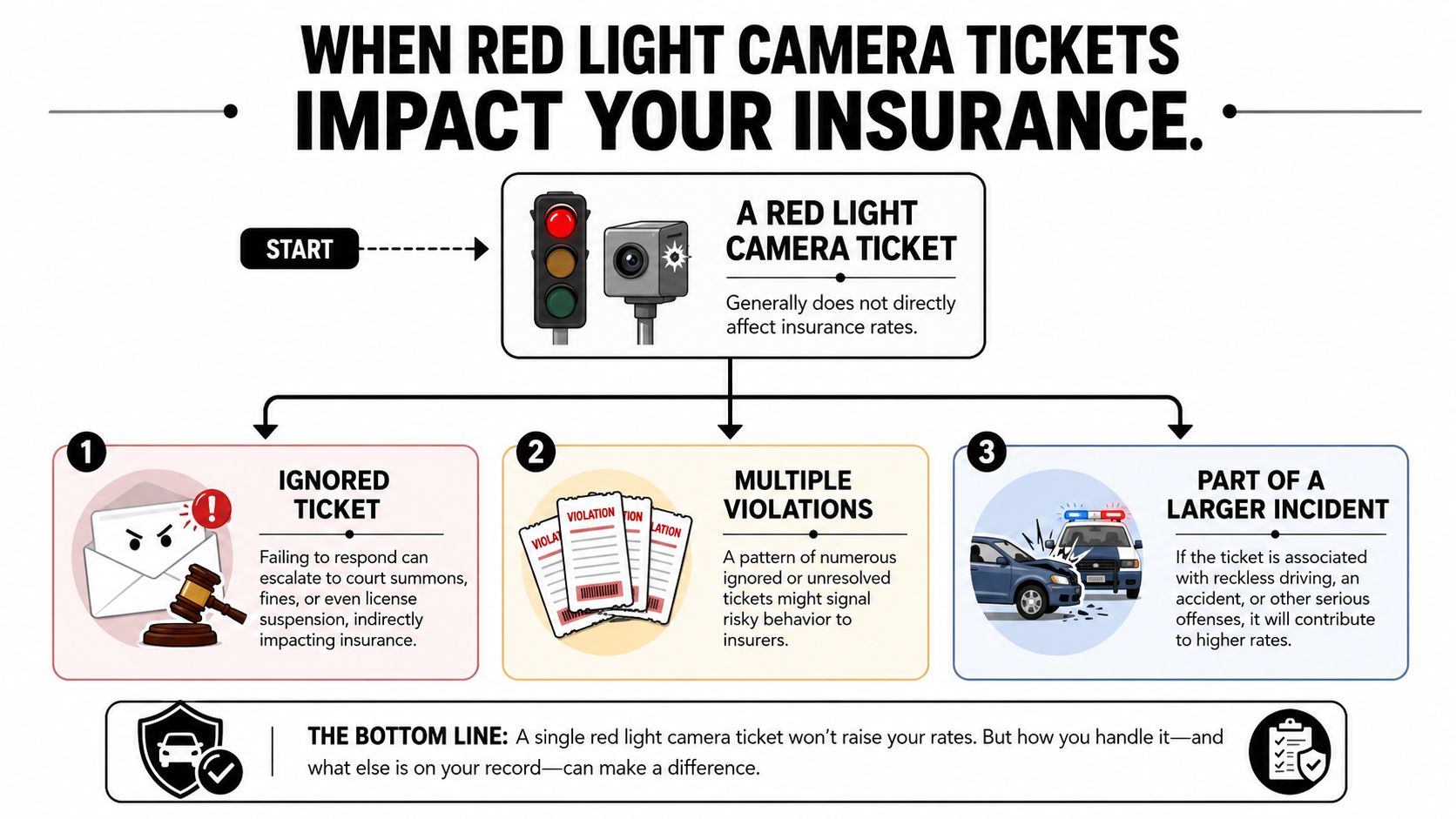
They usually don’t affect insurance directly. But they absolutely can create insurance trouble under the wrong conditions.
State law decides the starting point
Illinois is a good example of the low-risk model. There, red light camera tickets are civil infractions, usually around a $100 fine, with no license points, no reporting to the Secretary of State, and no direct insurance effect.
California and North Carolina are where drivers need to slow down and read the fine print. In those states, camera tickets can affect insurance under certain conditions, especially when nonpayment causes the citation to show up on the driving record. The same reporting also notes that in states where red light tickets are treated as moving violations, average insurance increases can range from $150 to $300 per year, ticket costs average $100 to $165, moving violations may stay on a record for 1 to 5 years, and insurers may raise rates by 20% to 30% after 1 to 2 such tickets. It also cites Liberty Mutual data showing speeding tickets can raise insurance by about 25%, with points remaining on the motor vehicle record for 2 to 3 years, according to this Sacramento Bee report.
Payment compliance is the real trigger
This is the rule drivers should remember: the initial ticket often isn’t the insurance problem. Ignoring it is.
The impact of a red-light camera ticket on insurance depends on state classification and whether you pay it. Unpaid fines can trigger license suspension or collection actions that indirectly raise premiums, while paid fines result in no insurance impact, according to Western Financial Group’s explanation of camera ticket consequences.
Watch this if you want a visual walkthrough of how these cases can snowball when drivers do nothing.
Three ways people turn a minor ticket into a costly one
- Ignoring the notice: Deadlines pass, fees stack up, and the matter can escalate.
- Assuming every state follows Florida: It doesn’t. Classification changes everything.
- Letting it connect to bigger problems: Suspensions, collections, and visible record issues are what insurers care about.
Pay the civil ticket on time and it usually stays a civil ticket. Ignore it and you may create the very insurance problem you thought you were avoiding.
Protect Your Record and Lower Costs with Traffic School
Even when a red light camera notice doesn’t directly raise your insurance, the bigger goal is the same. Keep your record clean and keep your costs down.
That’s why good drivers don’t think about traffic school only after a problem explodes. They use it as prevention.
Why traffic school still matters here
A camera ticket in Florida won’t usually give you points. Fine. That doesn’t mean your driving education has no value.
Traffic school matters because most drivers don’t live in a bubble with one single citation forever. They get an officer-issued ticket later. They want to preserve an insurance discount. They need a smarter approach before the next mistake costs more.
The verified guidance here is clear. Defensive driving courses such as BDI or IDI can help offset potential points from actual moving violations and help drivers maintain insurance discounts, as noted in the earlier source on payment compliance and mitigation.
The practical value of taking a course
Here’s where a lot of people think too small. They ask, “Can I use traffic school for this exact camera notice?” That’s not always the right question.
The better questions are:
- Do you want to protect yourself from point-carrying violations later?
- Do you want a cleaner overall insurance picture?
- Do you want a flexible online option instead of scrambling after a court deadline?
For Florida drivers, a Basic Driver Improvement course is the kind of tool that makes sense before your record gets expensive.
What a smart driver does differently
Smart drivers build margin.
They don’t wait until a moving violation lands and rates are already under pressure. They get educated, stay current on Florida rules, and use approved courses when they can help preserve discounts or avoid point-related fallout from other citations.
Traffic school isn’t just damage control. It’s one of the few legal, practical tools drivers can use to protect both their record and their wallet.
If you’ve had a close call with a camera ticket, use that as your warning shot. Not because the camera notice itself is devastating, but because the next violation might not be a no-point civil notice.
FAQ About Red Light Tickets and Insurance
Can insurance companies find out about a Florida red light camera ticket
Not in the same way they find a standard moving violation when the ticket remains a civil Notice of Violation. The major risk starts when a driver ignores the notice and lets it escalate into something that creates record or licensing consequences.
What happens if I ignore a camera ticket in Florida
Ignoring it is the dumbest move available. The direct insurance protection comes from keeping the matter as a paid civil notice, not from pretending the notice doesn’t exist.
Can a red light camera ticket add points to my Florida license
If it’s the standard Florida camera-issued Notice of Violation, it carries 0 points. That’s the main reason it does not directly affect insurance.
Can I take traffic school to erase a camera ticket
Not in the sense of using traffic school to turn that no-point camera notice into something even smaller. The better use is broader. A course can help with other moving violations and may support insurance discount goals.
Does a red light camera ticket affect insurance in every state the same way
No. State classification rules control the answer. Some states treat these tickets as civil penalties with no direct insurance impact, while others create insurance risk if the ticket becomes part of the driving record or is treated as a moving violation.
If you want a practical way to protect your record before a real moving violation costs you points or higher premiums, start with a Florida-approved course from BDISchool. You can review the full lineup at BDISchool courses or explore additional options through DriverEducators.com courses. The best time to protect your wallet is before your next ticket makes the decision for you.