A tire blowout or sudden skid can happen in seconds, and your immediate physical response, plus knowing when to call for help, determines whether it’s just a scare or a disaster. Grip the wheel, control the vehicle before braking aggressively, and call emergency services whenever injuries, fire, dangerous roadway conditions, or an unsafe scene make self-help unreasonable.
Florida roads give drivers plenty of chances to face that test. Heat, heavy rain, standing water, crowded highways, construction zones, wildlife, disabled vehicles, and unpredictable traffic can turn an ordinary trip into an emergency without warning. The right response isn’t dramatic. It’s a short sequence of practiced actions that protects control, creates space, and brings the right help to the scene.
Preparedness matters beyond the vehicle itself. The World Risk Poll 2024 report found that 30% of people worldwide who experienced a disaster in the previous five years received no warning, while the share of people saying they could do nothing to protect themselves and their families rose from 36% in 2021 to 43% in 2023. Those figures concern disasters broadly, but the lesson applies to driving: a plan works best before panic starts.
Staying Calm When the Road Turns Unpredictable
You’re moving through Florida traffic when the steering wheel suddenly shakes. A vehicle ahead stops hard. Rain is filling the tire tracks, the cars behind you are close, and your first instinct is to jerk the wheel or stomp the brake. That instinct is understandable, but it can make a manageable problem worse.
The safest driver in that moment isn’t the person who never feels fear. It’s the person who has a short mental script. Look where you want the vehicle to go, keep both hands engaged, reduce the actions competing for your attention, and make one controlled decision at a time.
Panic narrows your options
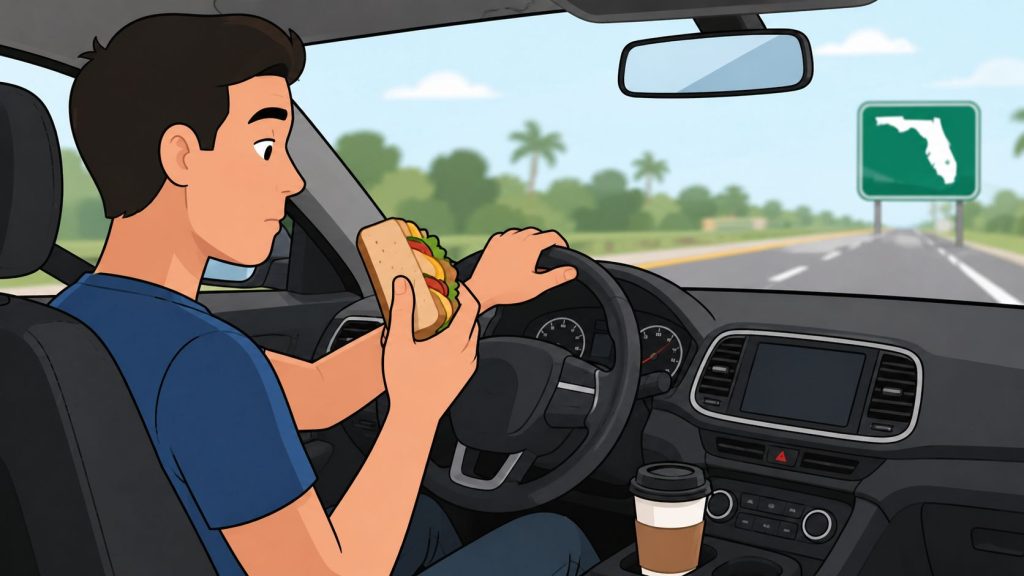
Panic encourages tunnel vision. Drivers fixate on the hazard itself, stare at the vehicle they’re trying to avoid, and react with abrupt steering or braking. That response can remove the traction and space needed to escape.
A composed response starts with three questions:
- What is the immediate threat? A disabled vehicle, a loss of traction, smoke, a medical problem, or a blocked lane requires a different next action.
- Do I still have control? If the car responds to steering and braking, preserve that control instead of making a sudden correction.
- Who else is exposed? Passengers, pedestrians, motorcyclists, and approaching traffic may need protection before you focus on paperwork or vehicle damage.
Practical rule: Slow the situation down mentally before you slow the vehicle down physically.
Training turns a frightening event into a recognition task. You learn to identify a skid before it becomes a spin, spot a stopped vehicle early, and maintain an escape path instead of driving beside a hazard with no room to move. The guide to staying calm while driving reinforces that calm isn’t passive. It’s an active driving skill built through attention, breathing, and deliberate choices.
Florida conditions reward restraint
Heavy rain can hide lane markings and create standing water. Bright sun can reduce contrast around a stopped vehicle. A crowded interstate gives you less room to correct an error, while a rural road can leave you farther from immediate assistance.
Don’t try to solve every problem with speed. Ease off the accelerator, scan beyond the first hazard, and leave yourself a route toward a clear shoulder or open lane when conditions allow. The driver who avoids the second mistake often prevents the first mistake from becoming a collision.
Mastering Immediate Responses to Critical Car Failures
Mechanical failures demand physical control before diagnosis. You may not know exactly what broke, but you can still stabilize the vehicle, reduce speed, and move away from active traffic when it’s safe.
A tire blowout
A blowout often produces a loud report, vibration, and a sudden pull. Your first job is to keep the vehicle tracking as straight as possible.
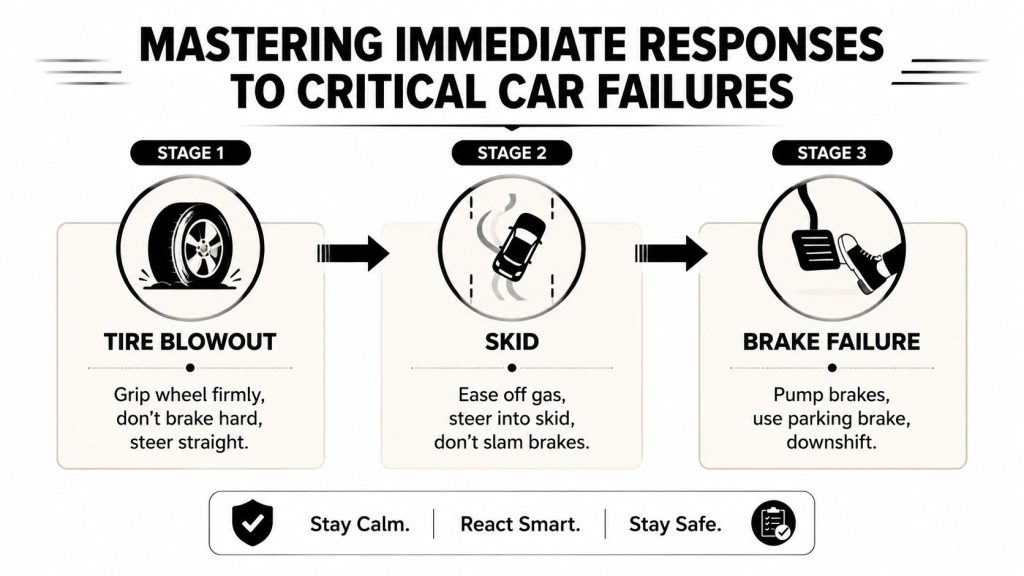
- Grip the steering wheel firmly. Keep the front wheels pointed along the roadway and resist the urge to make a sharp correction.
- Ease off the accelerator. Let the vehicle lose speed gradually rather than transferring weight abruptly.
- Avoid hard braking. Slamming the brakes can worsen the imbalance and make the vehicle harder to control.
- Signal and move toward a safe location. Once speed has dropped and the vehicle responds predictably, guide it to the shoulder or another protected area.
- Stop as far from moving traffic as practical. Turn on hazard lights and stay alert for passing vehicles.
Don’t stand beside the traffic-side door to inspect the tire. If the shoulder is narrow or exposed, remain secured in the vehicle when possible and request assistance.
A skid on wet pavement
Florida rain can overwhelm traction quickly, especially when water collects in ruts or near poorly drained areas. If the rear of the vehicle slides, ease off the gas and steer into the direction of the skid. That means guiding the wheel toward where the rear of the vehicle is moving, then straightening the wheel as the tires regain traction.
Don’t slam the brakes or fight the steering wheel with a rapid counter-movement. The goal is to help the tires recover, not to force the vehicle into a new direction before traction returns.
Brake or steering failure
A brake problem requires immediate warning and controlled deceleration. Pump the brake pedal if it has gone soft, shift to a lower gear, use the parking brake gradually, and look for a safe escape path. Avoid locking the parking brake suddenly, because abrupt rear-wheel braking can create another loss of control.
If steering becomes difficult, reduce acceleration, keep both hands on the wheel, activate hazard lights when possible, and guide the vehicle toward a safe stopping area. Don’t switch off the ignition while moving unless a qualified emergency procedure requires it, because doing so can affect steering and braking assistance.
For additional instruction on the sequence and risks, use what to do when brakes fail.
For vehicles equipped with anti-lock brakes, Georgia driver guidance says to press and hold the brake pedal instead of pumping it, because ABS pulses braking automatically and helps preserve steering control during hard braking. The state’s ABS guidance explains the mechanism, and the same principle applies when a Florida driver needs to stop while maintaining directional control.
Navigating the Scene After a Collision
After the impact, don’t rush into the roadway. Take a breath, check whether you can move safely, and identify hazards such as fire, leaking fuel, unstable vehicles, live wires, or approaching traffic.
If anyone is injured, trapped, unconscious, or in immediate danger, call emergency services and give the clearest location you can. Tell the dispatcher the roadway, direction of travel, nearby intersection or landmark, number of vehicles, and visible hazards.
Protect people before paperwork
Turn on hazard lights if the vehicle still has electrical power. If you can move the vehicle without creating another danger, Florida law and practical safety both favor clearing active travel lanes. Don’t attempt to move an injured person unless remaining in place presents a greater immediate threat, such as fire or an unstable vehicle.
Once everyone is safe, exchange identifying and insurance information with the other driver. Record names, contact details, license information, vehicle details, insurance information, roadway conditions, and visible damage. Take photographs from a safe position, but don’t step into traffic to obtain them.
Avoid arguing about fault at the roadside. A simple, factual account is safer than speculation, accusations, or an apology that could be misunderstood. Don’t post about the crash publicly while the facts and claims are still developing.
Know Florida’s roadside rule
Florida drivers must yield to an authorized emergency vehicle approaching with sirens or visible red or blue lights. Drivers must move to a position parallel to and as close as reasonable to the curb, clear intersections, and stop until the emergency vehicle has passed, unless a law enforcement officer directs otherwise. The Florida statute governing emergency vehicles sets out both the trigger and the required stopping response.
If the collision occurred near a lane closure, disabled vehicle, or responder, give emergency personnel room to work. A stopped car can become a second emergency when approaching drivers don’t see it early enough.
For a practical checklist covering the first steps after a crash, review what to do after a car accident. Drivers who need broader guidance about documentation, communication, and Florida-specific concerns can also consult Florida accident advice from Ticket Shield, especially when the crash may lead to a citation or insurance dispute.
Knowing When and How to Call for Help
Call 911 for injuries, suspected impaired or dangerous drivers, fire, smoke, a vehicle blocking a dangerous location, an active threat, a person trapped inside a vehicle, or a crash that creates an immediate risk to other road users. Give the dispatcher facts, not a long theory about what happened.
A disabled vehicle with no injury may not require 911 if it’s safely off the roadway. In that situation, hazard lights, roadside assistance, an insurer’s claims line, or local non-emergency services may be more appropriate. The decision changes immediately if the vehicle is exposed to traffic, visibility is poor, passengers are vulnerable, or the weather makes waiting dangerous.
Delays change the decision
Emergency systems can become strained. The World Health Organization reported 36 graded emergencies across more than 30 countries and territories worldwide in 2025, while its preparedness reporting found a global average SPAR score of 64 between 2021 and 2023 across a framework that measures 15 preparedness capacities. The same reporting said 83% of high-risk countries had interagency preparedness plans, which shows both the importance of coordination and the fact that readiness isn’t uniform. WHO’s emergency workforce and preparedness discussion describes workforce, coordination, and mobilization pressures that can affect response.
For cardiac emergencies, don’t wait and watch. The American Heart Association states that immediate CPR can double or triple survival, while survival drops by about 10% for every minute CPR and AED use are delayed. U.S. adult out-of-hospital cardiac arrest survival to hospital discharge is roughly 9.1% to 10.5% overall, and average EMS arrival is about 7 minutes, exceeding 14 minutes in rural areas in some situations. The AHA CPR statistics explain why a bystander should call, begin high-quality chest compressions, and use an AED as soon as possible.
Build a usable contact plan
Don’t assume you’ll remember every number under stress. Save household, medical, roadside assistance, insurer, and emergency contacts in your phone, and make sure passengers know where to find them.
A practical way to share emergency contacts effectively is to keep the information accessible to the people who may need it, not only on one locked phone. Include allergies, essential medications, and a trusted contact when appropriate, while protecting sensitive information from unnecessary exposure.
Building Confidence Through Professional Driver Education
Emergency handling starts before the emergency. A driver who scans well, maintains space, understands right of way, and recognizes changing road conditions has more time to respond and fewer forced choices.
That preparation matters because disaster exposure and preparedness gaps remain real. The IFRC recorded 332 disasters in 2020 and 378 in 2021, both above the 20-year average, and noted that the annual number of natural-hazard disasters has increased since 1970. The IFRC World Disasters Report 2022 supports a straightforward driving lesson: repeatable procedures and coordinated responses outperform improvisation.
Practice beats instinct
People often believe they’re prepared because they own a first-aid kit, flashlight, or roadside triangle. Those tools help, but supplies don’t tell you how to respond to a skid, a blocked lane, a collision, or a slow response.
The emergency maneuver training guidance focuses on actions such as firm, steady braking, steering toward an escape path, and regaining control. Those skills connect directly to Florida driving, where wet pavement, sudden congestion, and roadside hazards can demand a decision before you have time to search for instructions.
Formal education also reduces uncertainty around traffic laws. A driver who understands move-over obligations, emergency-vehicle yielding, safe following distance, and defensive scanning is less likely to freeze or make a legally risky move when responders arrive.
Choose training that fits the problem
BDISchool offers Florida-approved online programs for different driving needs. Basic Driver Improvement is a 4-hour course for drivers with a moving violation who may need to avoid points and insurance increases. Intermediate Driver Improvement is an 8-hour program for court-ordered drivers or people seeking deeper instruction in safe driving habits.
The catalog also includes an 8-hour Aggressive Driver Course focused on responsibility and behavioral change, plus a 6-hour Mature Driver Course for drivers aged 55 and older who want a refresher in safety awareness and may seek insurance discounts. Course availability, eligibility, and insurer requirements should be confirmed for your situation.
The programs are self-paced and available online in English, Spanish, and Portuguese. Certificates are issued electronically and reported directly to the FLHSMV, supporting the administrative side while the lessons build practical judgment.
Taking the Next Step Toward Safer Driving
Knowing how to handle emergency situations means more than memorizing a blowout response. You need to keep control, protect the scene, follow Florida’s emergency-vehicle rules, document a collision carefully, and recognize when a medical or roadside threat requires immediate help.
Preparedness also has a personal side. Australian Red Cross found that 90% of Australians had experienced an emergency or disaster in their lifetime, yet only 35% were prepared, with “it won’t happen to me” and “it’s not on my radar” identified as leading barriers. The Australian Red Cross preparedness research points to a familiar driving problem: many people wait for an incident to prove that preparation matters.
A course can’t prevent every road hazard, but structured education can improve recognition and decision-making before the crisis arrives. Compare your needs with Florida-approved options, and if insurance savings are part of your goal, review your insurer’s rules alongside resources about discounts for safe drivers from Florida All Risk Insurance.
Don’t wait until the next near miss becomes a crash. Visit BDISchool to choose a Florida-approved online driver education course, study at your own pace in English, Spanish, or Portuguese, and strengthen the defensive habits that help you respond under pressure. Register today so your next emergency decision starts with training instead of panic.