A lot of families hit the same moment at the same time.
The teen is ready yesterday. The parent is already thinking about traffic, paperwork, scheduling, and whether one missing document is going to ruin the whole DMV trip. Both reactions are normal.
A learner’s permit feels like freedom. It is. But it’s also a controlled entry point into driving, and families who treat it that way usually have a smoother experience. The ones who wing it usually end up wasting time, missing a requirement, or showing up with the wrong paperwork.
The First Step on the Road to Freedom
A learner’s permit is not a casual milestone. It’s the first formal stage in a safety system.
The rules exist for a reason. Graduated Driver Licensing, or GDL, is built to slow the process down so new drivers build judgment before they get more freedom. The CDC identifies core GDL components that commonly include a minimum permit age of 16, a holding period of at least six months, and 50 to 100 hours of supervised driving before the next stage of licensing in many U.S. systems (CDC overview of graduated driver licensing).
That should change how you think about learner’s permit requirements. This isn’t just about passing a test. It’s about entering a staged process that expects maturity, consistency, and supervision.
What parents and teens usually get wrong
Teens often see the permit as the finish line. Parents often see the DMV appointment as the hard part.
Neither is right.
The permit is permission to start practicing under rules. The DMV appointment is just the checkpoint that confirms a new driver is ready to begin that practice legally. If you treat the permit as “just paperwork,” you’ll miss the bigger job, which is building safe habits from day one.
Practical rule: Don’t ask, “How fast can we get the permit?” Ask, “Are we ready to start the permit stage the right way?”
Why structure helps
Families do better when they stop improvising.
A clear plan lowers stress. The teen knows what to study, the parent knows what documents to collect, and nobody gets blindsided by a requirement they assumed would be “basically the same everywhere.”
That’s the mindset you want from the start. Calm, organized, and strict about the details.
The Universal Permit Checklist
Most learner’s permit requirements change by state, but the backbone is familiar almost everywhere. Before anyone gets behind the wheel for supervised practice, the state wants proof that the applicant is old enough, identifiable, living where they claim to live, and able to understand basic traffic rules.
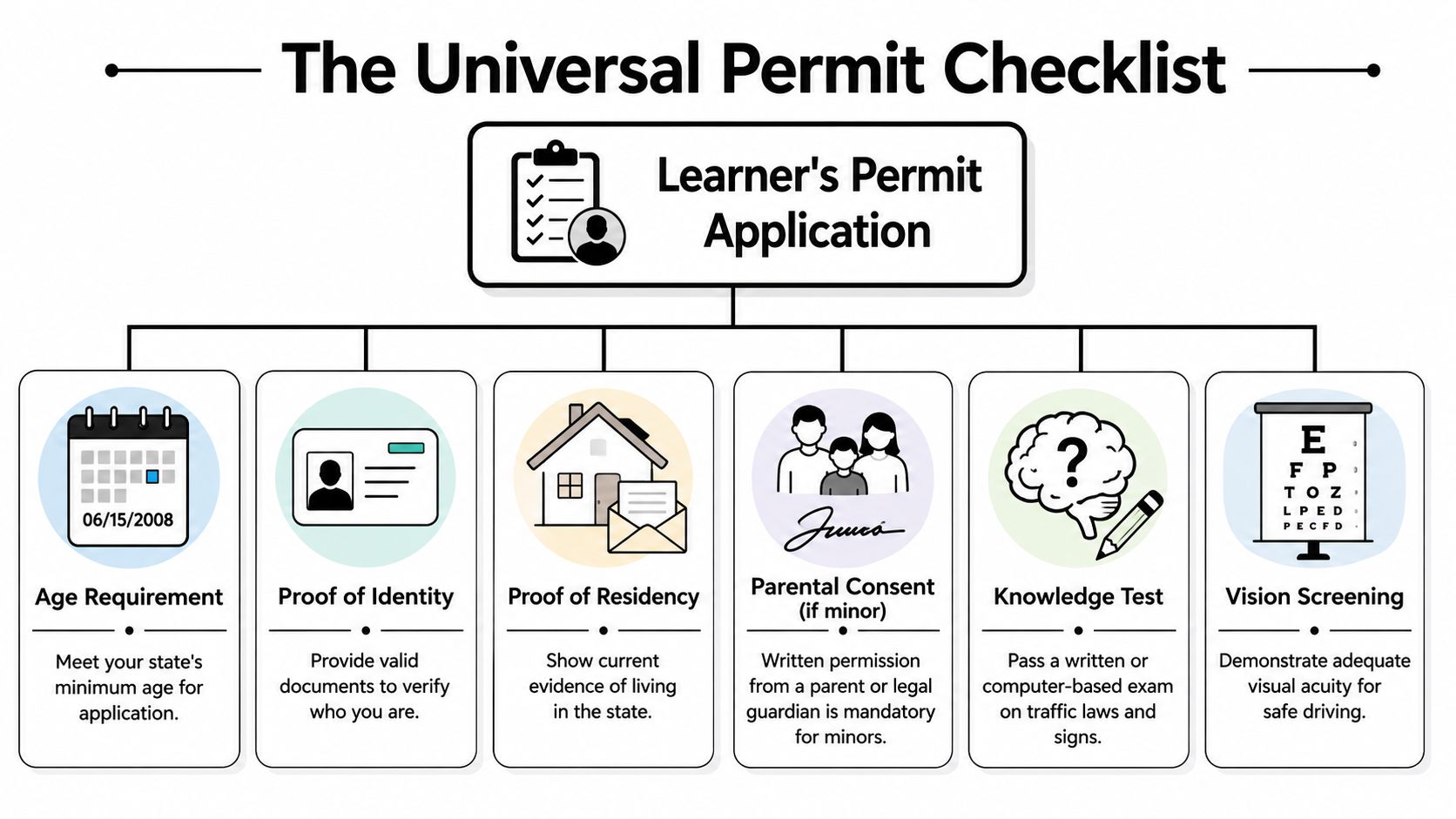
The six items that matter most
Here’s the checklist I tell families to build before they ever book an appointment:
- Age eligibility: You must meet your state’s minimum age. That number isn’t universal, so never rely on what a cousin in another state did.
- Proof of identity: The DMV needs to know exactly who you are.
- Proof of residency: The state needs evidence that you live in that state.
- Parental or guardian consent: If the applicant is a minor, this is often mandatory.
- Knowledge test readiness: You need to know traffic laws, signs, and basic safe-driving rules.
- Vision screening readiness: You need to meet the state’s visual standards for driving.
This is why the process feels strict. It is strict.
Virginia and California show how permit systems work as a staged safety instrument. They require document verification, a vision screening, and a standardized knowledge test before any supervised road practice begins, which means the state is filtering for identity compliance and baseline rule comprehension first (Virginia learner’s permit application requirements).
Why the DMV checks so much
Families sometimes complain that the DMV is making a simple thing complicated. I disagree.
The DMV is trying to prevent two bad starts. First, they don’t want someone driving under a false identity or without lawful documentation. Second, they don’t want a beginner’s first road experience to happen before that person has shown basic understanding of signs, right-of-way, and core rules.
That’s reasonable. You should want that filter.
If your documents are disorganized, your application is weak before you even sit for the test.
How to prepare without wasting a trip
Start with a document folder. Physical or digital doesn’t matter. Sloppy doesn’t work.
Use a state-specific prep list, not generic advice from social media. If you want a practical pre-appointment checklist, review this guide on what to bring to the DMV.
And if you’re comparing permit systems beyond the U.S., this breakdown of what’s needed for the G1 test is useful because it shows the same core pattern: identity, eligibility, and rule knowledge come first.
How Requirements Change Across State Lines
The fastest way to mess up a permit application is to assume all states work the same way.
They don’t. Not even close.
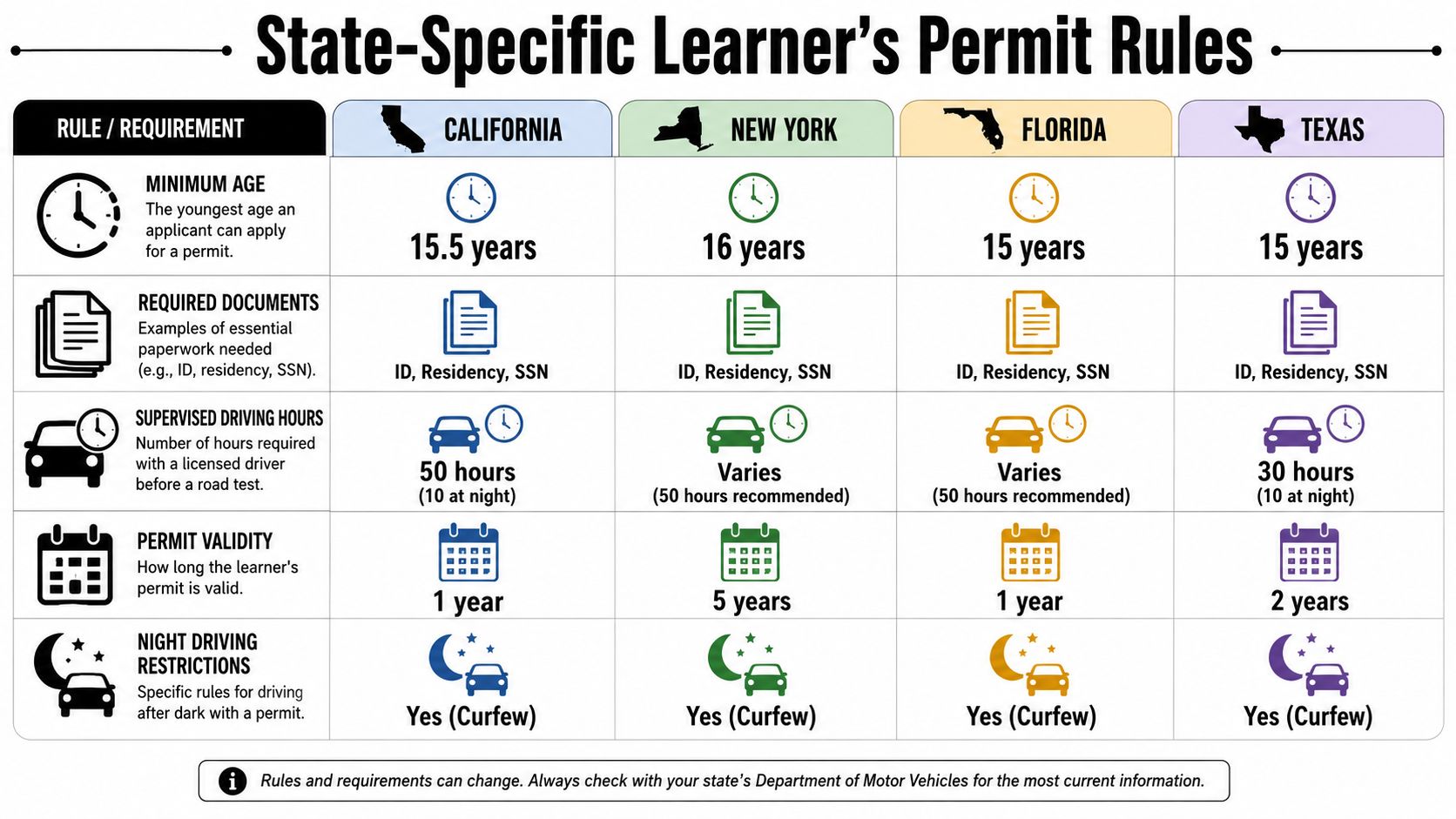
Side-by-side differences that matter
Some of the biggest differences show up in age, education, and supervised-driving expectations.
California requires applicants to be 15½ to under 18, complete or enroll in driver education, pass a vision exam and knowledge test, and hold the permit long enough to complete 50 hours of practice before the drive test. Georgia sets the minimum learner’s permit age at 15 and requires under-18 applicants to show school enrollment. The District of Columbia requires 40 hours of supervised driving in the learner stage and sets the minimum age at 16 years and 6 months. California also uses an 80% passing score on its knowledge test (California instruction permit requirements).
That is a major spread. Same goal, different gatekeeping.
Why out-of-state advice causes problems
A friend in Georgia may be correct about Georgia and completely wrong for Florida. A relative in California may remember the process accurately and still give advice that gets you turned away elsewhere.
Use this simple rule:
| Situation | Smart move | Bad move |
|---|---|---|
| You moved recently | Check your current state’s DMV rules | Using your old state’s checklist |
| Your teen is homeschooled | Confirm accepted education documents | Assuming a report card is required everywhere |
| A family member gives advice | Verify it against your state agency | Trusting memory over current rules |
That’s also why age questions need state-specific answers. If you’re trying to sort out the basics before anything else, this page on what age you can get a permit is a useful starting point.
Florida families need Florida guidance
This matters even more in Florida, where families often hear conflicting advice from newcomers, snowbirds, relatives in other states, and classmates who “already did it.”
Ignore the noise. Learner’s permit requirements are local. The right path is the one your state recognizes, using the documents your state accepts, under the rules your state enforces.
Mastering the Vision and Knowledge Tests
Most new drivers focus on the written test and barely think about the vision screening. That’s a mistake.
Both matter. One checks whether you can physically see what’s happening on the road. The other checks whether you understand what you’re looking at.
The vision test is basic but not optional
The vision screening is usually straightforward. If the applicant already wears corrective lenses, they should bring them and wear them.
Families get tripped up here because they treat the screening like a formality. It’s not. If a teen struggles to read signs clearly, judge distance, or spot hazards quickly, that affects every minute of practice driving. Handle the eyesight issue before the appointment, not after a failed screening.
The knowledge test measures judgment, not trivia
The written or computer-based exam is supposed to confirm baseline understanding. It should cover road signs, traffic laws, right-of-way, and safety rules serious enough to keep a beginner from becoming a danger in the first week of driving.
California gives a good example of how seriously states take this. Permit applicants complete a vision exam and knowledge test, and the state uses an 80% passing score based on multiple-choice questions from the driver handbook, as noted earlier in the article.
That tells you exactly how to prepare. Don’t memorize random facts. Learn the handbook well enough to apply it.
What actually helps someone pass
I’ve seen students fail because they studied passively. Reading the handbook once and hoping for the best is weak preparation.
A stronger approach looks like this:
- Read the handbook actively. Stop on signs, lane rules, right-of-way situations, and impairment topics.
- Quiz in short sessions. Short, repeated review sticks better than one long cram session.
- Fix misunderstandings early. If a rule doesn’t make sense, clarify it before test day.
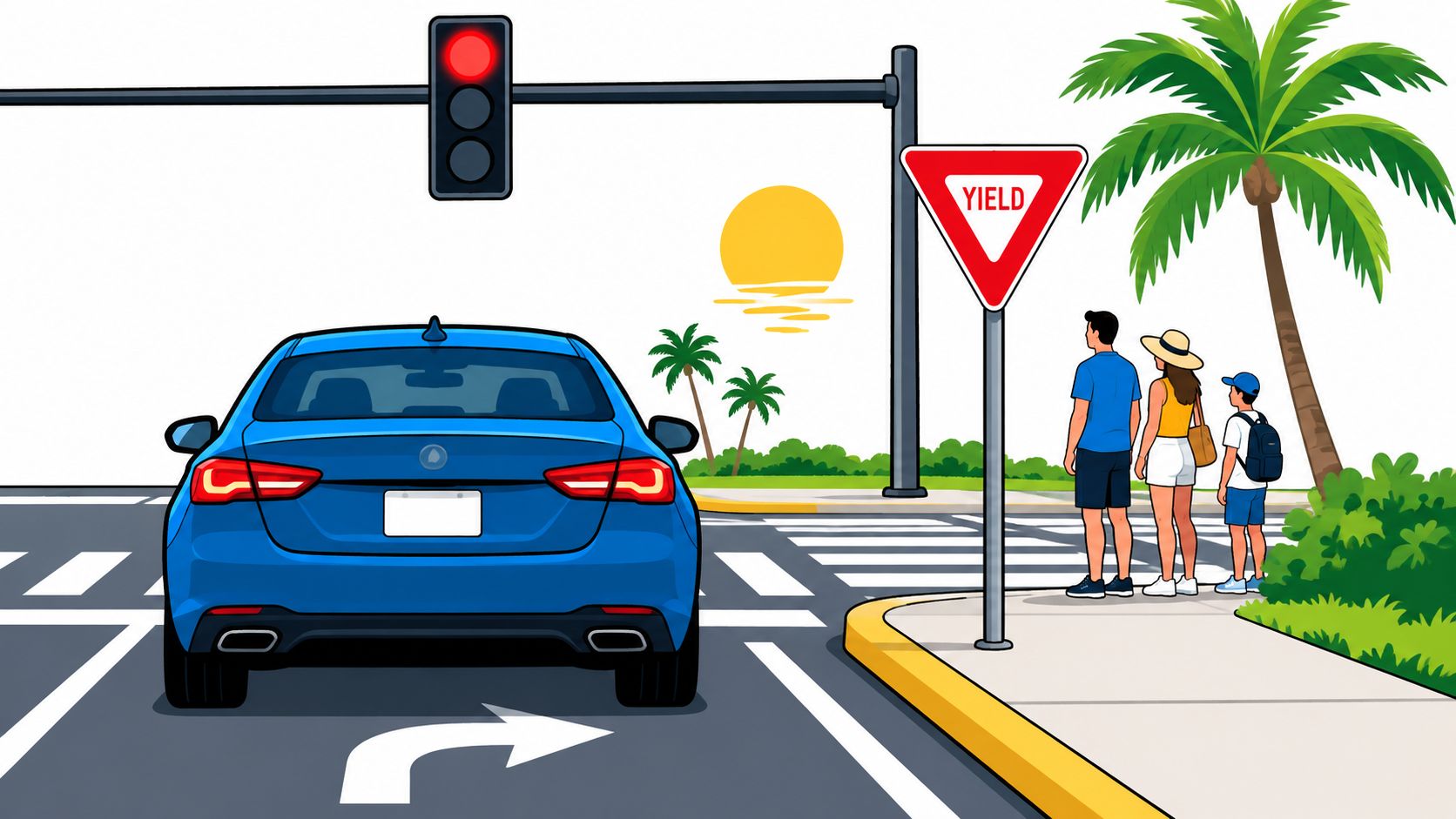
- Match the test to real driving. Ask what the rule would look like at an actual intersection, crosswalk, or parking lot.
The permit test isn’t asking whether a teen can repeat words. It’s asking whether that teen can make safer decisions once the car starts moving.
For Florida students, use the required course correctly
Florida families should treat the required education step as the foundation, not a box to click through.
That’s where an approved course helps because it organizes the material in the same order a beginner needs it. If you’re preparing for Florida permit testing, review these permit test requirements. For students who need a Florida-approved online course path, BDISchool offers state-approved programs designed around clear instruction and self-paced study.
That’s the right use of a course. Not as a shortcut. As a cleaner way to learn the rules before a beginner carries them into traffic.
Logging Your Supervised Driving Hours
A learner’s permit gives a teen the right to practice. Nothing more.
That distinction matters because too many families think the hard part is over once the permit is issued. It isn’t. The supervised driving period is where habits get built, corrected, or ignored.
Why states require real practice time
States don’t set supervised-hour rules just to create extra chores. They want new drivers to face different traffic conditions while an experienced adult is sitting there correcting mistakes in real time.
Pennsylvania requires under-18 permit holders to complete at least 65 hours of behind-the-wheel practice, including 10 hours at night and 5 hours in bad weather, before the road test. Virginia requires 45 logged hours for minors, with 15 after sunset (Pennsylvania learner’s permit practice-hour requirements). That structure forces practice in conditions that demand better scanning, speed control, and judgment.
How to make those hours count
Don’t just drive in the same neighborhood loop.
Use categories. Rotate conditions. Keep notes on what went well and what still needs work.
- Start with low-pressure routes: Empty parking lots and quiet streets are good for steering, braking, and smooth turns.
- Add decision-heavy driving next: Controlled intersections, lane changes, school zones, and moderate traffic build awareness.
- Practice difficult conditions on purpose: Night driving, rain, and unfamiliar roads should be supervised carefully, not avoided.
- Repeat weak skills: If merges, parking, or left turns are messy, go back and drill them again.
A parent’s role matters more than families think
The supervising adult sets the tone.
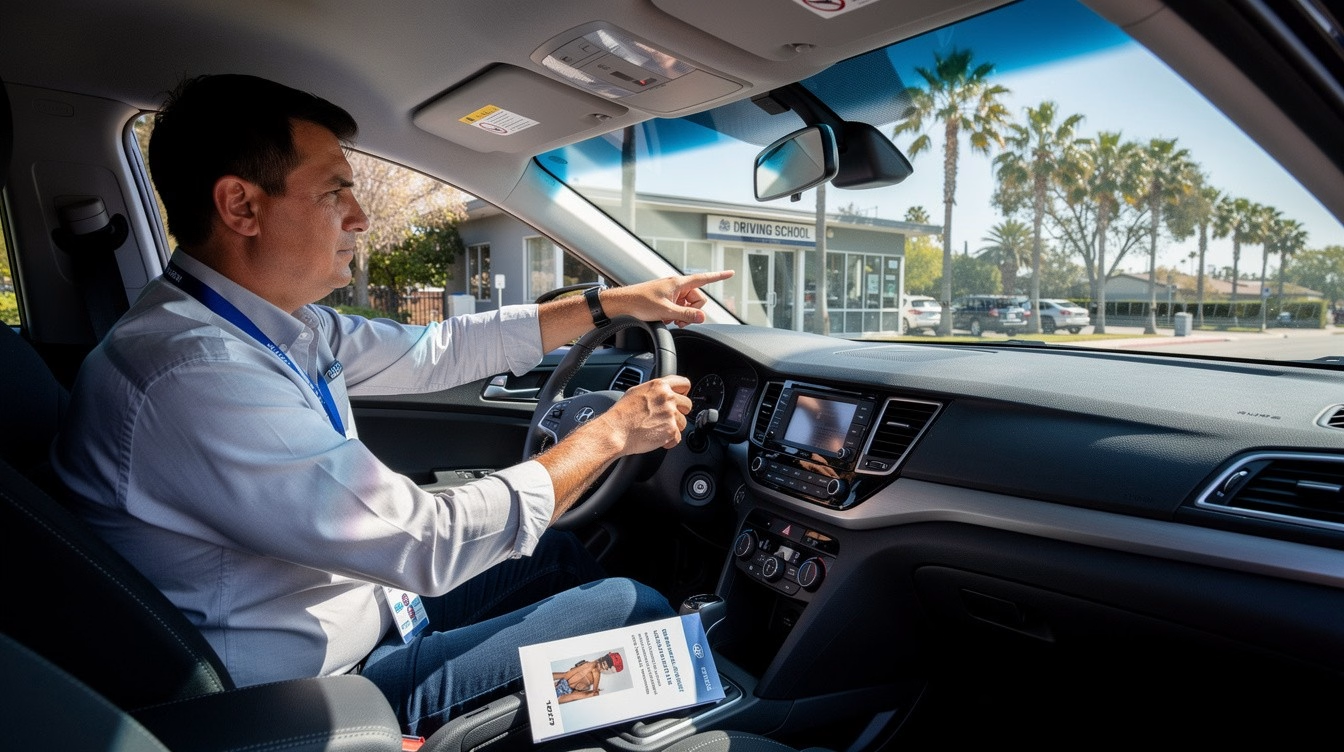
If the parent gives late instructions, grabs the wheel emotionally, checks their phone, or turns every mistake into a lecture, the student learns anxiety instead of judgment. Calm correction works better. Short directions work better. Consistent expectations work better.
For families comparing how supervised practice is tracked in other countries, this overview of Melbourne logbook hours driving is a useful reference point because it shows how formalized practice logs can shape better routines.
If night-driving rules are part of your planning, check the specifics on driving at night with a permit.
Avoiding Common Document Pitfalls
At this point, many permit applications fall apart.
Not because the student is unprepared for the test. Not because the family forgot the appointment. Because somebody assumed their paperwork was “normal” and the DMV disagreed.
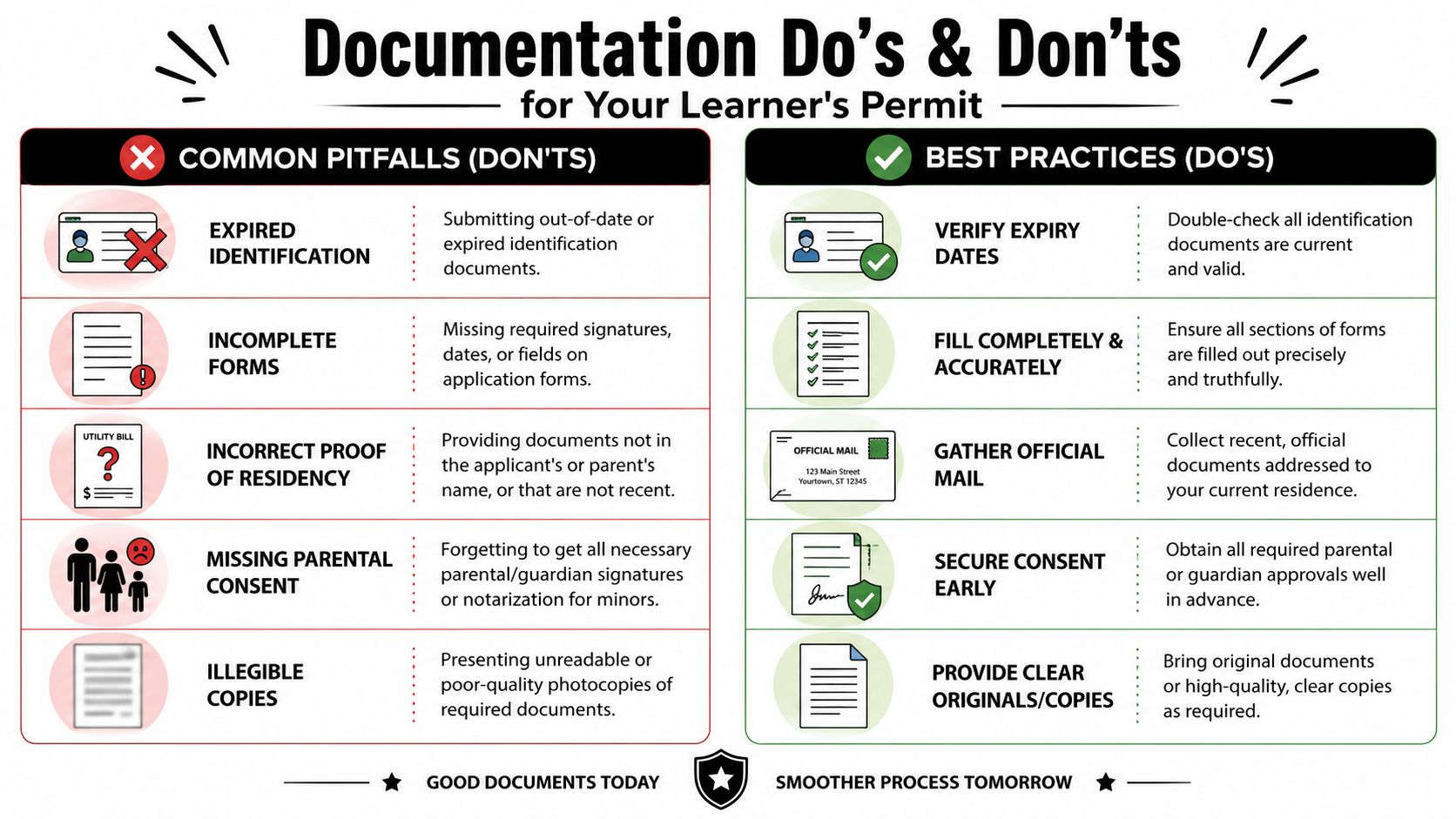
The standard checklist isn’t enough for many families
A lot of permit guides are written for one type of applicant. Traditional school enrollment. Stable address. Two obvious proofs of residency. Easy parent signature situation.
That doesn’t describe every family.
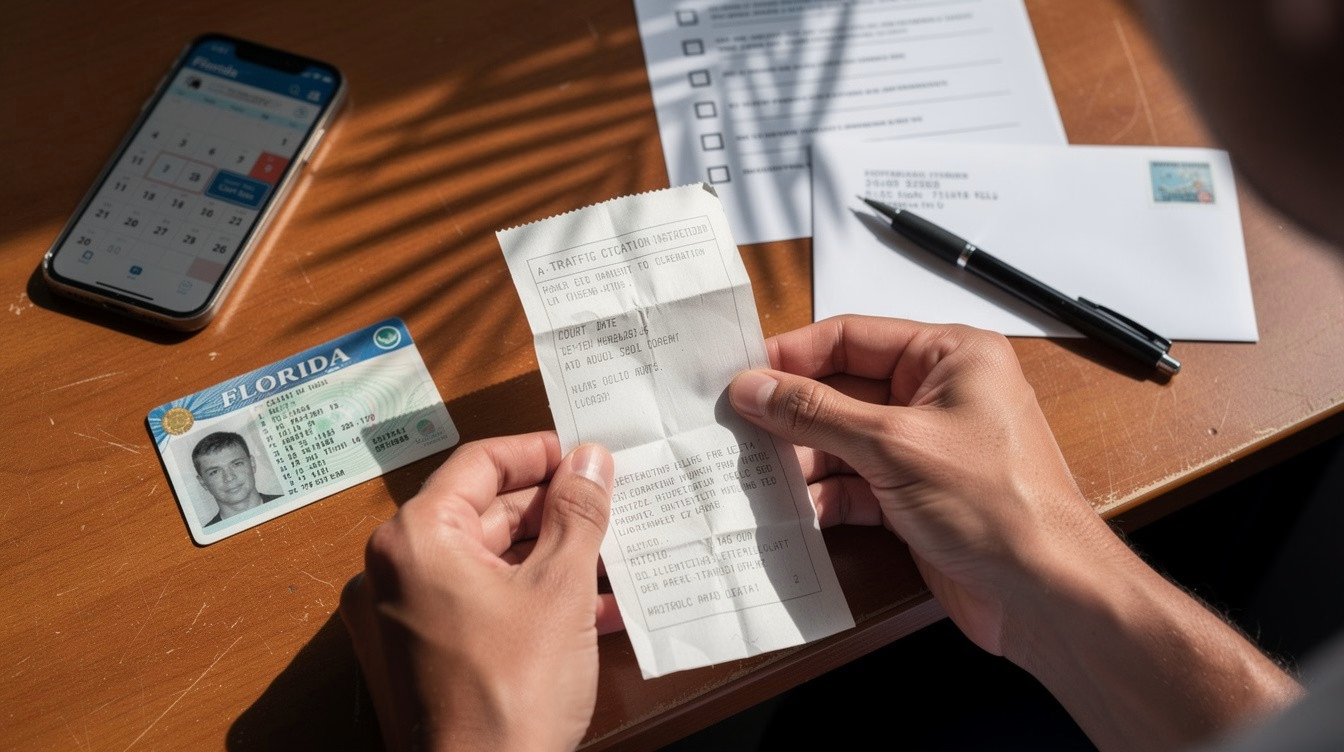
Georgia’s DMV guidance is especially useful here because it highlights the issue: nonstandard documentation. States may accept specific alternatives for proof of residency or school enrollment for homeschooled teens or recent movers, but applicants often miss those options and end up treating the process like simple age-and-test compliance when it is a document-verification problem (Georgia learner’s permit documentation guidance).
The situations that cause the most trouble
These are the ones I’d check first:
- Homeschooled students: School-related proof may work differently, and assumptions based on public-school enrollment can fail.
- Recent movers: You may not have the usual utility-bill pattern yet.
- Divorced or separated parents: Address mismatches and signature issues can create delays.
- Applicants using alternative residency proof: Some states allow alternatives, but only in specific formats.
- Adults applying later than expected: Requirements may differ from what they remember from years ago.
Bring more documentation than you think you need, but make sure it’s relevant, current, and readable.
What to do before the DMV visit
Don’t guess. Verify.
Use this pre-appointment review:
| Check | What to confirm |
|---|---|
| Identity | Name matches across documents |
| Residency | Address is current and accepted by the state |
| School or education proof | Correct format for your student status |
| Consent | Every required signature is complete |
| Document quality | Originals or acceptable copies are clear and valid |
Then do one more thing. Put every document in the order the DMV will likely request it. That alone can save a lot of stress at the counter.
My blunt advice on paperwork
Families underestimate paperwork because it feels unrelated to driving skill.
It isn’t unrelated. It’s the gatekeeper. If the documents don’t work, the permit doesn’t happen that day. That’s why smart families prepare for edge cases first, not last.
Your Action Plan from Application to Permit
You don’t need a complicated system. You need a disciplined one.
Start early. Build a checklist. Verify every document before anyone leaves the house.
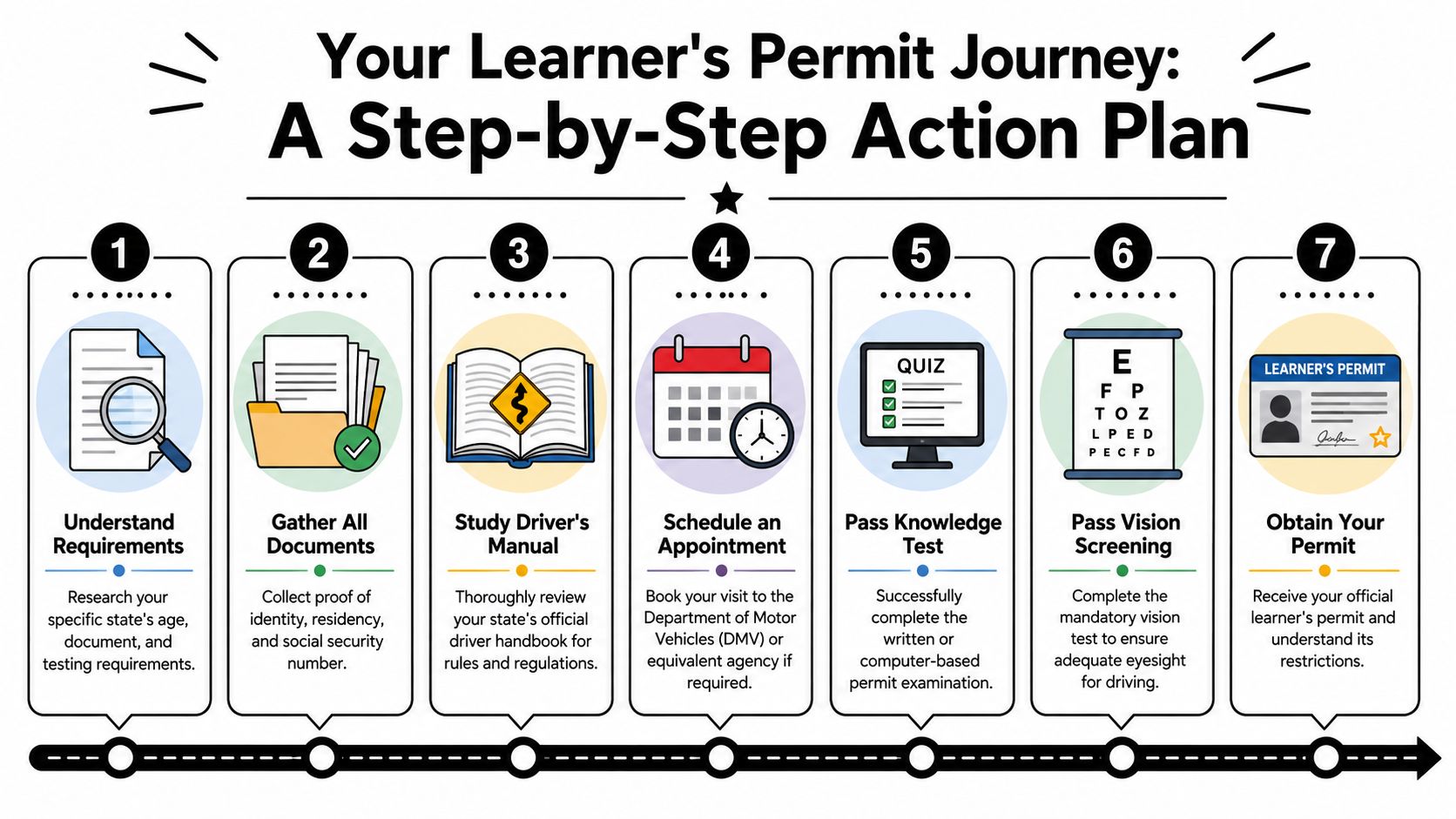
The cleanest order to follow
- Confirm your state’s learner’s permit requirements. Don’t borrow another state’s process.
- Handle the required education step. For Florida families, this should happen early so test prep and paperwork move together.
- Collect identity, residency, and consent documents. Put them in one folder.
- Study the handbook with intent. Focus on signs, right-of-way, and safety rules.
- Schedule the appointment once the folder is complete. Booking too early creates avoidable pressure.
- Take the vision and knowledge tests prepared, not hopeful.
- Start supervised driving with a written practice plan. Don’t “just drive around.”
This video gives a useful overview before test day:
What families should do this week
If you’re serious, take action today.
- Pick your permit timeline: Don’t leave the date vague.
- Build the document folder: Missing paperwork causes more delays than weak studying.
- Choose the course path: If Florida rules apply to your situation, use an approved option and finish it before the rush starts.
- Assign responsibilities: The student studies. The parent verifies documents and appointment details. Both review restrictions together.
That approach works because it replaces stress with sequence.
Frequently Asked Questions
Can you take the permit test online
That depends on your state and your eligibility. Some states allow online components in limited situations, while others require in-person testing. Check the current rules for your state before assuming you can do everything from home.
What if I’m homeschooled or don’t have standard school documents
Don’t assume you’re stuck. Some states accept alternative forms of school or enrollment-related documentation. The key is to verify exactly what your state accepts before your appointment.
What if we just moved and don’t have the usual residency papers yet
This is common. The answer is not to guess. Review your state’s accepted alternatives and collect documents that clearly support your current address. Recent movers get delayed all the time because they bring documents that sound reasonable but don’t match the DMV list.
Is the permit mainly about passing the written test
No. The written test is only one checkpoint. The permit stage includes identity verification, eligibility, testing, and then supervised practice under restrictions. Passing the test without preparing for the rest is weak planning.
When should supervised practice start
As soon as the permit is issued and the family has a real plan. Start in easy environments, then add harder driving situations gradually. Random practice is better than none, but structured practice is far more useful.
What should a parent do during permit practice
Stay calm, give short instructions, and correct one issue at a time. The supervising adult should model the same habits they expect from the student. If the parent drives aggressively, multitasks, or gives confusing directions, the student absorbs that too.
What’s the smartest first move for a Florida family
Get organized before the DMV appointment. That means handling the education requirement, verifying documents, and preparing for testing in the right order instead of trying to fix problems at the counter.
If you’re ready to stop guessing and start the permit process the right way, take the next step with BDISchool. The site offers Florida-focused course options and practical guidance that can help families handle the education side, prepare for testing, and avoid the paperwork mistakes that slow everything down.