Florida sets no special speed limit for a blind intersection. Drivers must slow to a reasonable and prudent speed before entering, and must be able to stop within the part of the road they can see.
The popular advice to memorize one low number misses the core problem. A hedge, delivery van, or building can hide cross traffic until you’re already in its path. Your job isn’t to reach the corner at a familiar speed. It’s to reach it with enough room to stop.
Florida Sets No Special Limit, Only a Duty to Slow
Florida doesn’t assign a universal speed limit to blind intersections. Don’t borrow a number from another state’s driving handbook and treat it as Florida law.
Under Florida’s reasonable-and-prudent-speed statute, drivers must account for actual and potential hazards and reduce speed appropriately when approaching or crossing an intersection. That responsibility applies even when you’re already traveling below the posted limit.
A sign can’t tell you whether someone parked a large truck beside the crosswalk this morning. It also can’t account for a hedge that has grown across the sight line or rain that makes an approaching cyclist harder to recognize.
The posted maximum isn’t your approach target
Treat the posted limit as a ceiling, not a target. Visibility, pedestrians, traffic, weather, and road conditions can require a lower speed.
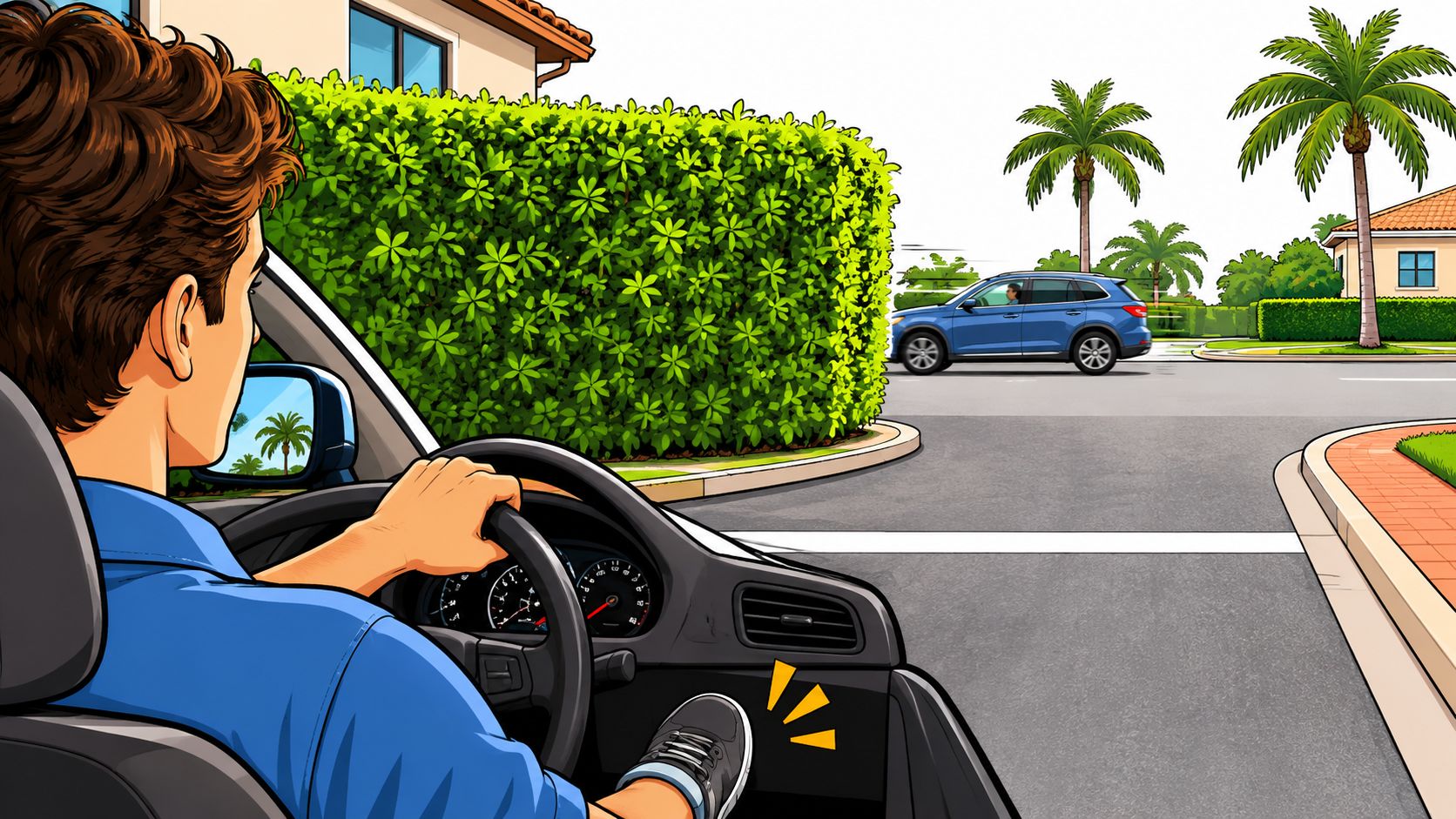
Say you approach a residential corner beside a solid wall. You can see your lane, but not the sidewalk or vehicles approaching along the cross street. Maintaining the posted speed because you haven’t seen a hazard confuses absence of visibility with absence of danger.
For a broader explanation of the basic-speed-law principle, The Law Office of Bryan Fagan explains why lawful speed depends on conditions rather than the sign alone. Use Florida’s statute for the Florida rule, and our guide to Florida speed limit laws to understand how posted limits fit into everyday driving decisions.
Practical rule: Your safe approach speed is the speed at which you can stop within the visible, unobstructed roadway before entering a conflict.
Look for a location-specific restriction
Transportation authorities can establish a location-specific safe speed following an engineering and traffic investigation, with appropriate signs installed. Look for an actual reduced-speed zone instead of assuming every visually restricted corner carries an identical limit.
Don’t let the lack of a special sign reassure you. A driver still has to respond to the conditions directly ahead.
Apply this test before the corner:
- Is the posted limit a ceiling? Yes. Don’t treat it as permission to maintain speed despite a blocked view.
- Can I stop in what I can see? If not, reduce speed before reaching the obstruction.
- Is there a reduced-speed sign? Observe the signed restriction and slow further when conditions require it.
The correct speed limit in a blind intersection is therefore not a number you can choose without looking. The legal maximum and the safe speed for that moment are different questions.
Sight Distance Needed at Each Speed
Sight distance needed by approach speed
The following Federal Highway Administration design benchmarks show the stopping and intersection sight distances associated with each approach speed.
| Approach speed (mph) | Stopping sight distance (ft) | Intersection sight distance (ft) |
|---|---|---|
| 25 | 155 | 280 |
| 30 | 200 | 335 |
| 35 | 250 | 390 |
| 40 | 305 | 445 |
| 45 | 360 | 500 |
| 50 | 425 | 555 |
| 55 | 495 | 610 |
These are engineering benchmarks, not instructions to estimate roadway distances precisely from behind the wheel. They explain why a seemingly modest increase in approach speed demands a much longer clear view.
Read across a row rather than looking only at the stopping column. Being able to stop your own vehicle isn’t the same as having enough visibility to judge approaching traffic and complete a crossing.
Stopping distance and intersection distance answer different questions
Stopping sight distance concerns the roadway needed to recognize a hazard, react, and bring the vehicle to a stop. It includes more than the distance traveled after your brakes engage.
Intersection sight distance concerns the clear view needed to detect conflicting traffic and make an intersection maneuver. That view extends along the intersecting roadway, not merely straight ahead over your hood.
A driver can therefore have a clear lane ahead and still lack a safe view of the cross street. That’s common beside a building corner: the pavement looks open, but the approaching vehicle remains hidden.
Our explanation of how to calculate stopping distance helps separate reaction distance from braking distance. Don’t use braking ability alone to decide whether an intersection approach is safe.
Apply the comparison to the corner
Compare the table’s highway-speed rows with its lower-speed rows. The additional distance isn’t spare pavement you can ignore. It’s room needed for recognition, decision-making, and vehicle movement.
A hedge can cut off the cross-street view even when it doesn’t extend into the roadway. A parked van can hide a cyclist. A crest can conceal a vehicle until it reaches the junction.
Use the table as a warning against judging safety by how comfortable the vehicle feels:
- A clear straight-ahead view isn’t enough. Check the intersecting approaches and pedestrian paths.
- A narrow opening isn’t a full sight line. Seeing a patch of empty road doesn’t establish that approaching traffic is absent.
- An obstructed view calls for earlier slowing. Don’t carry speed toward the corner while hoping the view will improve.
The table describes the visibility a speed needs. The sign describes the maximum the road authority permits. When your view can’t support your speed, reduce it.
Step-by-Step Approach and the Mistakes That Cause Crashes
Use a repeatable routine instead of improvising at the corner. The FHWA intersection-design guidance treats clear sight triangles as essential because drivers need room to perceive and react to conflicting vehicles and pedestrians.
A sight triangle is the area of visibility between intersecting approaches. Buildings, vegetation, signs, and parked vehicles can interrupt it even when the roadway itself is unobstructed.
Make the approach deliberate
The sequence starts before you reach the blocked view.
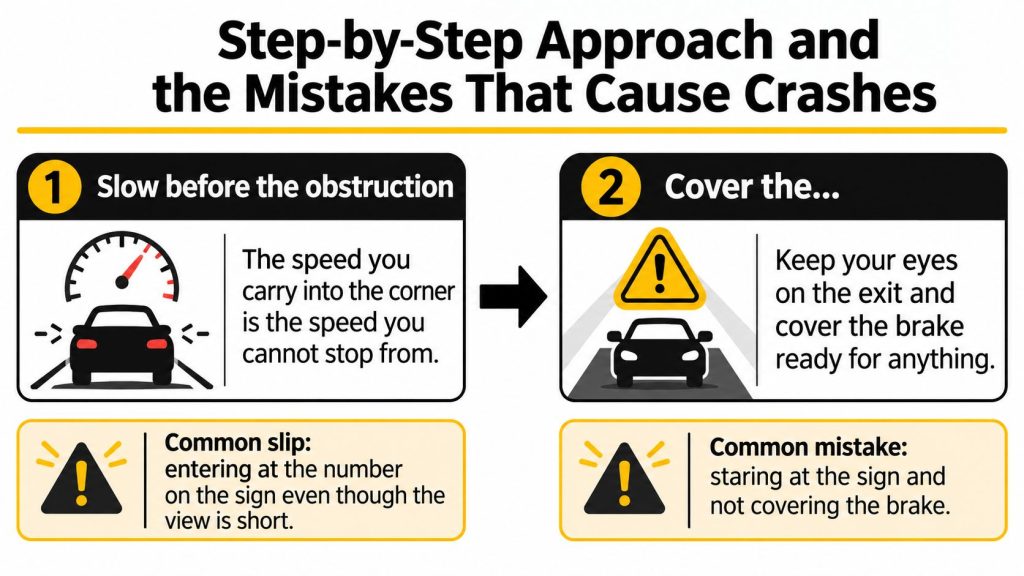
Slow before the obstruction.
Complete your main speed reduction while you still have useful forward visibility. The speed you carry into the restricted-view area determines how much room you’ll need if a conflict appears.The common slip is entering at the number on the sign even though the available view is short. Don’t postpone braking until you can finally see around the hedge.
Cover the brake.
Move your foot into a ready position over the brake as the potential conflict approaches, without riding the pedal. That avoids spending part of your response moving your foot from the accelerator.Keeping your foot on the accelerator until you identify a specific threat leaves you less prepared. Anticipate the possibility of a stop rather than waiting for proof that you need one.
Stop at the proper stopping point.
Where a stop is required, stop at the limit line or before the crosswalk, not wherever the view happens to be best. Keep the pedestrian route clear.A frequent mistake is rolling past the line to obtain visibility. Make the required stop first, then assess whether cautious repositioning is necessary.
Look left, right, and left again.
Search for cars, motorcycles, cyclists, and pedestrians, including people approaching along the sidewalk. Turn your head enough to check around vehicle pillars rather than relying on a fixed forward glance.
Don’t follow the car ahead just because it crossed successfully. Its driver may have accepted an unsafe gap, and the vehicle itself may be blocking your view.
If necessary, creep forward and stop again.
After the required stop, move only as far as needed to improve visibility, provided you can do so without entering an occupied crosswalk or a conflicting traffic path. Keep the vehicle under immediate stopping control.Creeping isn’t permission to continue rolling into the intersection. If gaining a view would put your vehicle in danger, wait rather than forcing approaching traffic to react.
Proceed only with a visible, usable opening.
Judge whether you can enter and clear the conflict area safely. Don’t begin because you’re tired of waiting or because another driver waves you forward.A wave doesn’t establish that every lane is clear. Apply the relevant right-of-way rules at intersections and make your own visibility check.
Correct the delivery-van mistake
Say a driver follows a delivery van toward a corner at 30 mph, with a hedge blocking the right-hand view. This is a hypothetical situation, not a recommended approach speed.
The van moves through, and the following driver starts to copy it. But the van has hidden the cross street, while the hedge prevents an independent check from the right.
The fix is to create space, reduce speed before the restricted view, and stop at the limit line where required. Let the van leave your sight line, then assess the intersection yourself.
If you had to guess whether the path was clear, you couldn’t see it.
At the stopping point, check what you can see, what you can hear, and whether anyone is still moving toward your path. Sound can warn you about a hidden vehicle, but silence doesn’t prove the road is empty.
Night, Rain and Hidden Pedestrians Lower Your Safe Speed
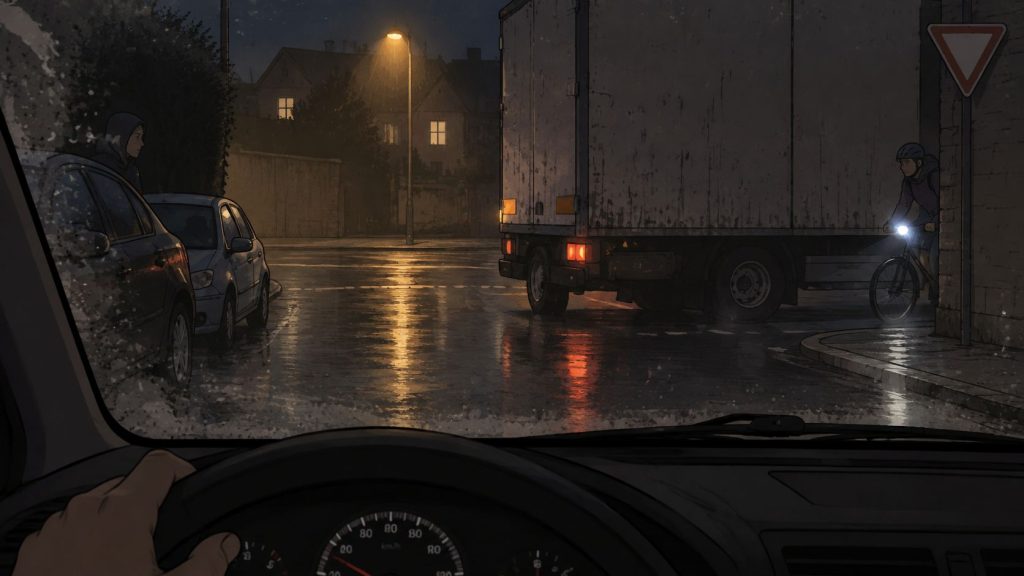
At night, a dark cross street can look empty when it isn’t. A pedestrian wearing dark clothing may remain difficult to recognize until your headlights reach them.
The National Highway Traffic Safety Administration’s pedestrian-safety guidance advises drivers to slow down, minimize blind spots, and use extra caution at night and in bad weather. At a blind corner, those conditions make an already restricted view less useful.
The problem can involve both the roadway and the view through your windshield.
Clear mirrors don’t clear the corner
Vehicle blind spots and roadway-limited visibility aren’t the same thing. Correctly adjusted mirrors won’t reveal a person hidden behind a wall, parked vehicle, or curve.
Rain adds reflections and moving water to the visual task. Fog reduces contrast, while a dirty windshield can scatter light and make it harder to distinguish a person from the background.
Make practical corrections before the approach:
- Clean the windshield. Clear both the inside film and outside dirt, and use the defogger when needed.
- Increase separation. Don’t let a large vehicle ahead become your moving visual obstruction.
- Search sidewalk openings. Watch the gaps between parked vehicles and the ends of walls or hedges.
- Reduce speed early. Don’t wait for a pedestrian or cyclist to emerge before deciding the view is inadequate.
Our night-driving tips address preparation and visibility habits. For someone dealing with the aftermath of a collision in hazardous conditions, Nares Law Group weather-related accident representation offers a legal resource distinct from preventive driver training.
Does having right of way make proceeding safe?
No. A clear legal priority doesn’t make an unseen pedestrian or approaching vehicle disappear, and it doesn’t remove your duty of care.
Allow additional decision and maneuvering room when a driver needs it. For certain intersection sight-distance calculations, the FHWA handbook for aging road users recommends a gap of at least 8.0 seconds, plus 0.5 second for each additional lane crossed.
That’s a design recommendation, not a universal stopwatch rule for every intersection. Its practical lesson is to leave time for seeing, deciding, entering, and clearing, rather than accepting the smallest apparent opening.
If darkness or weather reduces what you can verify, adjust before the corner. Stop when you can’t establish a clear path.
Why Small Speed Gaps Change Crash Risk
A few extra miles per hour can leave less time to respond when cross traffic appears. At a blind intersection, your safe speed depends on how far ahead you can see and how much road you need to stop, not on the posted limit alone.
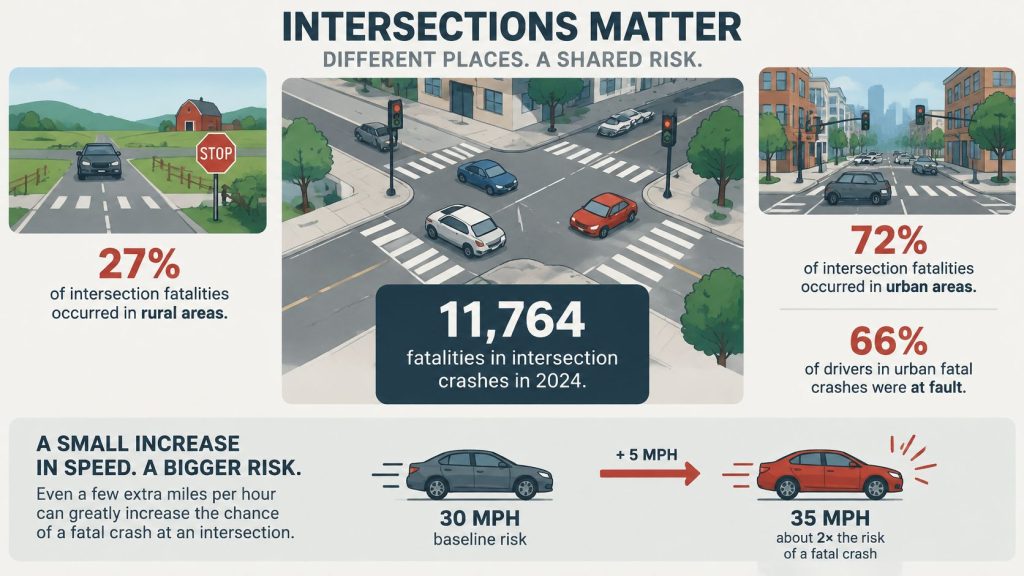
NHTSA intersection-crash analysis shows that fatal intersection crashes are concentrated in urban areas, as described in the agency’s intersection-crash analysis. Intersection crashes happen in both urban and rural settings, so caution belongs on neighborhood streets as well as highway approaches.
A lower posted limit doesn’t eliminate serious risk
A posted speed limit sets the legal maximum under suitable conditions. It does not tell you whether you can stop within the roadway you can see or react safely to a vehicle, cyclist, or pedestrian emerging from behind an obstruction.
Urban streets may have parked vehicles, frequent driveways, and pedestrians close to the corner. Rural roads can look open while a crest or vegetation hides cross traffic. In either setting, extra speed carries you farther before you can identify and respond to a hazard.
Driver decisions remain central
The linked NHTSA analysis estimated 2,307,000 intersection crashes in 2008, about 40% of the nation’s 5,811,000 crashes. Among 787,236 intersection-related crashes analyzed for critical reasons, approximately 96.1% received a driver-related critical-reason classification.
That classification does not mean speeding caused every crash or establish legal fault. It does show why driver decisions matter: recognizing traffic late, misreading another vehicle’s movement, or accepting a gap without checking the full crossing can turn a small speed difference into less time to respond.
A short view calls for a lower approach speed, not faster decision-making.
When visibility is limited, slow before reaching the corner. Give yourself time to identify a conflict and stop if the crossing is not clear.
Master Blind Corners with a Florida-Approved Course
If you’ve recently received a moving violation, start by choosing the course that matches your citation and eligibility. Florida’s Basic Driver Improvement Course, also called Florida Four-Hour Traffic School, is our 4-hour program for drivers with a recent moving violation.
The course helps drivers avoid points on their driver license. Completing the course results in no insurance rate increase due to the moving violation.
BDI School is a Florida HSMV-approved Basic Driver Improvement school. Completion certificates are issued electronically and reported directly to the FLHSMV.
Choose instruction that fits your requirement
Blind-intersection decisions involve more than recognizing signs. Drivers need to connect speed selection, pedestrian awareness, stopping position, and gap judgment before entering a conflicting traffic path.
Our course options include:
- Basic Driver Improvement. The program for drivers addressing a recent moving violation and protecting their driving record.
- Intermediate Driver Improvement. An 8-hour course for court-ordered drivers or people seeking a deeper understanding of safe driving habits.
- Mature Driver Course. A 6-hour refresher for drivers aged 55 and over, focused on safety awareness and maintaining insurance discounts.
Don’t select a program solely because its duration fits your schedule. Match the course to the citation, court direction, or driving goal you need to address.
Fit the learning around your day
Our learning format is fully online and self-paced, with instruction available in English, Spanish, and Portuguese. You can work through the material from your device without arranging travel to a classroom.
Use that flexibility to study deliberately. When an intersection scenario appears, decide where you’d slow, where you’d stop, and what you’d need to see before proceeding.
Review the available driving courses, select the program that matches your requirement, and register to begin. Learning a reliable routine is more useful than memorizing a supposed universal blind-corner speed.
BDISchool offers Florida-approved online traffic school courses that help drivers connect traffic rules with practical decisions at restricted-view intersections. Visit BDISchool, choose the course that matches your citation or learning goal, and start building safer approach habits today.