You cut the commute, combine errands, and leave the car parked most days. Then renewal arrives and the premium barely moves, or it rises. That feels wrong, but it happens because insurers don’t price mileage in isolation.
A car insurance discount for driving less can help, but only when your mileage fits the insurer’s rating model and you report it correctly. Florida drivers also have another practical lever: an approved driver improvement course that may complement mileage-based savings.
Why Driving Less Does Not Always Lower Your Premium Right Away
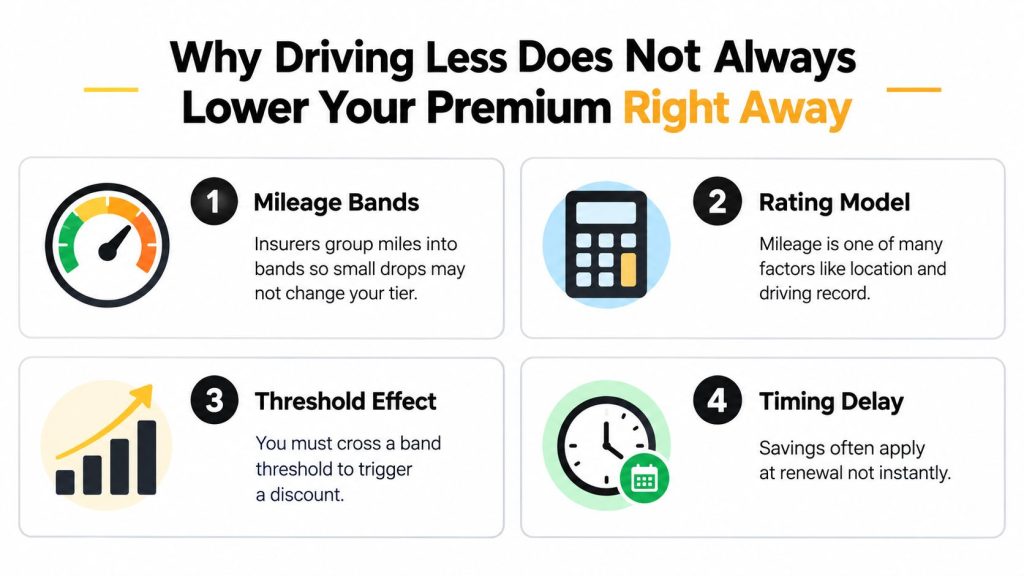
Driving less can reduce your risk exposure, but it doesn’t guarantee an immediate premium reduction. Insurers commonly place annual mileage into bands, so a modest drop may leave you in the same pricing tier.
Consider a Florida driver who changes from a regular commute to occasional errands. The odometer is climbing more slowly, but the insurer may still be using the annual mileage declared at the last application or renewal. The policy may also reflect location, vehicle, claims history, coverage limits, and driving record.
Mileage is only one rating input
A major UK analysis of 2.5 million car insurance quotes found a persistent low-mileage penalty. Drivers reporting fewer miles were often not rewarded, and some paid more. The analysis estimated that 19 million UK motorists drove below the national average of 7,134 miles per year, while lower-mileage drivers could be charged up to £389 more than higher-mileage drivers. One comparison found drivers declaring 5,000 to 6,000 miles paid an average of £233 more than drivers declaring 11,000 miles. Nearly 40% of quotes fell into the 5,000 to 8,000-mile range. These findings are specific to that market, but they make the central point clearly: fewer miles don’t automatically produce a lower price. (By Miles and MoneySuperMarket low-mileage analysis)
Your insurer may reward crossing a mileage threshold rather than every mile you eliminate. A driver just above a qualifying band might see no change, while a driver who moves into a lower band may receive a revised rate.
Timing matters
Insurers often assess mileage over a policy period. If you started driving less this month, the change may not affect the bill until the insurer accepts updated information, recalculates the policy, or reaches renewal.
Before assuming the price is wrong, review why it may still be high in this guide to why car insurance costs so much. Then ask the carrier exactly when a mileage update takes effect.
Practical takeaway: Driving less gives you a reason to request a review, not a promise of an automatic discount. Your three realistic paths are a traditional low-mileage discount, pay-per-mile insurance, and telematics-based usage insurance.
Understanding Your Three Options to Save When You Drive Less
Driving less gives you three practical paths to lower insurance costs: a traditional low-mileage discount, telematics usage-based insurance, or pay-per-mile coverage. Choose based on your annual mileage, how predictable your trips are, and whether you are comfortable sharing driving data. Compare the pricing structure, not just the advertised discount.
| Feature | Low-Mileage Discount | Pay-Per-Mile Insurance | Telematics UBI Program |
|---|---|---|---|
| Pricing structure | Traditional premium adjusted for an annual mileage band | Base rate plus a per-mile charge | Premium influenced by mileage and monitored driving behavior |
| Mileage measurement | Often self-reported or verified at renewal | Miles recorded continuously or through an approved system | App or device tracks usage and may track behavior |
| Common qualification point | Often below 7,500 miles per year, with some insurers using 5,000 or 10,000 | Designed for drivers whose mileage is substantially below ordinary use | Some programs cap mileage discounts above 7,500 miles |
| Best fit | Drivers who consistently fall into a qualifying band | Drivers who drive very little and want usage reflected directly | Drivers willing to demonstrate safe driving as well as limited mileage |
| Main risk | A small mileage change may not move you into another tier | More miles can increase the bill directly | Hard braking, speeding, late-night driving, or phone use can affect results |
A standard low-mileage discount works only if your insurer places you in a qualifying mileage band. Many insurers use 7,500 miles annually as a reference point, while others set different thresholds. Reported discounts range from 2% to 20%, with annual savings of about $134 to $597, depending on the carrier. Drivers above 15,000 miles commonly receive no low-mileage discount. These figures come from the MoneyGeek low-mileage insurance guide. Driving less alone does not guarantee a lower premium.
Pay-per-mile coverage ties the bill directly to vehicle use. You pay a base charge plus a fee for each recorded mile, so this option suits drivers who make only occasional trips. One comparison reports savings of up to about 50% for drivers logging around 3,000 miles per year. Another guide places potential savings around 20% to 40% compared with traditional coverage. Review the pricing details in the Compare.com usage-based insurance guide before switching.
Telematics UBI can reward low mileage and safe habits, but the monitoring rules matter. Apps or devices may record mileage, braking, speed, phone use, and driving times. Poor scores can reduce or erase the benefit, so read the program terms before enrolling. For a clear explanation of black-box monitoring, review the Fast Track Driving Lessons insurance guide.
Florida drivers should also ask about approved driver-training discounts. Completing a qualifying Florida course may stack with mileage-based savings, giving you another direct way to reduce the total premium.
How to Prove Low Mileage and Enroll for the Discount
Start with evidence, not an estimate. Your insurer needs a credible picture of how much the vehicle is driven, and accurate reporting protects you from problems if the carrier later checks the odometer.
Check your current mileage
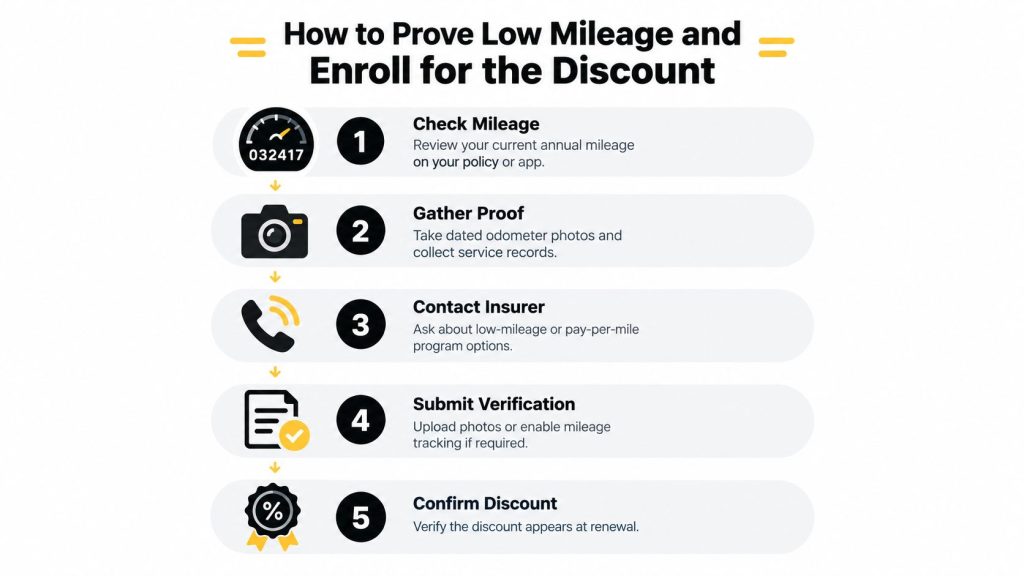
Look at the mileage listed on your policy, quote, insurer portal, or renewal documents. Compare it with the odometer and estimate whether your actual use has changed because of remote work, retirement, public transportation, a shorter commute, or a second household vehicle.
Don’t report an artificially low figure. Include errands, appointments, family trips, seasonal travel, and any regular drives you might overlook.
Gather simple proof
Take a dated odometer photograph and keep service invoices, inspection paperwork, or maintenance records that show mileage. A consistent record is more persuasive than a rough guess, especially when your current odometer reading doesn’t match the estimate on the policy.
Keep those records with your insurance documents. You may not need every item, but having them ready makes the review faster.
Ask focused questions before renewal
Call the insurer or agent and ask:
- Mileage band: Which annual mileage thresholds qualify for a reduction?
- Verification: Will you accept an odometer photograph, service record, app, or device?
- Effective date: Does the change apply immediately, at the next renewal, or after a review?
- Program type: Is this a standard discount, a pay-per-mile policy, or a telematics program?
- Duration: Is the reduction permanent, conditional, or an introductory offer?
- Behavior rules: Does the program assess braking, acceleration, speed, driving time, or phone use?
These questions expose the difference between a genuine mileage adjustment and a marketing headline.
Choose your monitoring method carefully
Self-reported mileage is simpler, but the insurer may verify it later. An app or device can create stronger ongoing evidence, but telematics may evaluate more than distance.
A driver who travels few miles but brakes harshly or drives late at night may not receive the result expected from mileage alone. If you enroll, place the phone correctly, avoid handling it while driving, leave extra following distance, and use smooth acceleration.
Confirm the result
After submitting documents or enabling monitoring, ask for written confirmation of the qualifying mileage band and expected policy treatment. Check the renewal documents to make sure the adjustment appears.
If you need flexible Florida driver education for a separate insurance-saving strategy, review the online driving certificate course before your next renewal date.
What to Expect for Real Savings and When They Actually Apply
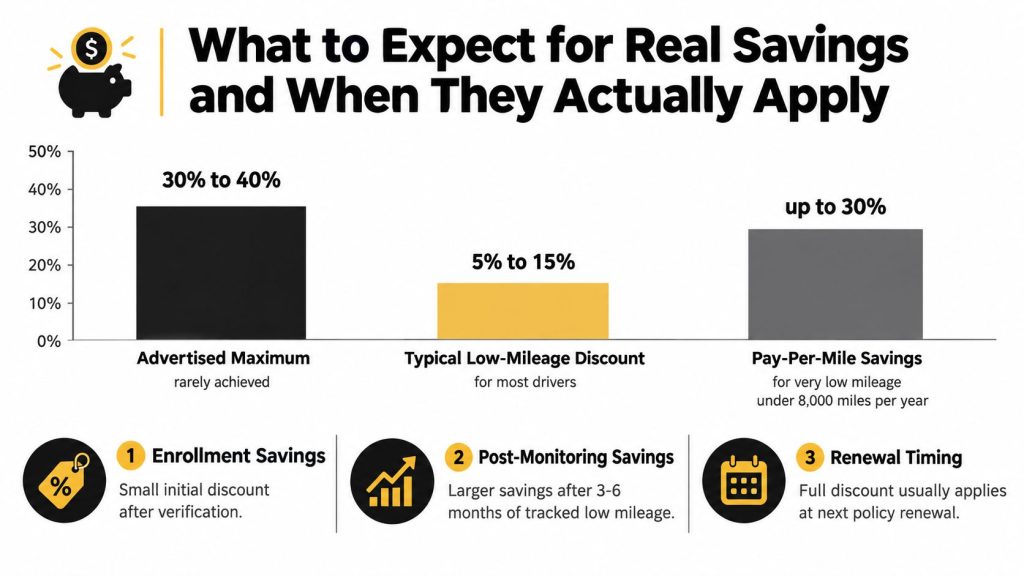
A lower odometer reading does not guarantee a lower bill. Insurers apply different rules to traditional discounts, telematics UBI, and pay-per-mile policies, so judge the actual renewal change rather than the advertised maximum.
Research on usage-based insurance found enrollment discounts were often about 5% upfront, while post-monitoring discounts averaged about 12%, with a standard deviation near 5%. Advertised maximums of 30% to 40% generally went to the best-scoring, low-mileage drivers. (UBC usage-based insurance research)
For ordinary low-mileage pricing, market summaries commonly place meaningful savings around 6% to 20% for drivers below 7,500 miles annually. Drivers above 15,000 miles generally do not qualify for a low-mileage discount. These figures describe market patterns, not a guaranteed Florida quote.
State rules change the result
A historical U.S. survey found drivers logging 5,000 miles per year paid 8.4% less on average than similar drivers logging 15,000 miles. The effect varied sharply by state, reaching an average 25% reduction in California and 0% in North Carolina because of a regulatory cap. (By Miles and MoneySuperMarket U.S. mileage report)
Telematics participation also produces mixed outcomes. Only 31% of UBI customers in Maryland saw any reduction in 2023, according to the cited guidance. Enrollment alone does not guarantee savings. (Real Cost Report telematics guidance)
Read the renewal notice, not the headline. The discount that matters is the reduction your insurer actually applies.
A recent driving change may miss the current billing cycle because mileage can be assessed over a 12-month period. Ask whether the carrier will re-rate now or wait until renewal. Then compare that result with the potential savings from a Florida defensive driving insurance discount. (Berry Insurance mileage guidance)
Smart Ways to Maximize Your Total Insurance Savings
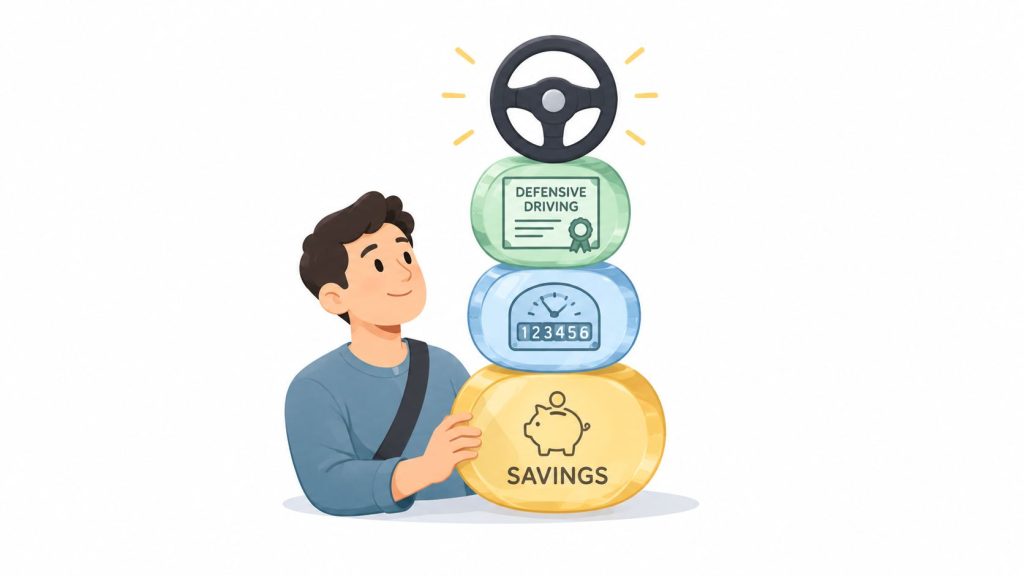
Mileage is only one lever. The stronger Florida strategy combines accurate usage reporting with safer driving and an approved course your insurer recognizes.
Stack carefully
First, report the correct mileage and update the vehicle’s use. If you no longer commute daily, tell the insurer whether the car is now used for pleasure, errands, or another accurate category.
Next, protect your telematics score if you choose UBI. Smooth braking, legal speeds, limited phone interaction, and avoiding unnecessary late-night driving help you present the low-risk behavior the program measures.
Finally, ask whether a Florida-approved course can sit alongside the mileage adjustment. BDISchool offers Basic Driver Improvement, Intermediate Driver Improvement, Aggressive Driver, and Mature Driver courses, with self-paced online access in English, Spanish, and Portuguese. Certificates are issued electronically and reported to the FLHSMV, but you should still confirm the insurer’s eligibility rules before enrolling for a discount.
For additional practical policy ideas, this guide to reduce auto premium in Dunedin is useful when reviewing mileage, coverage, and other available savings.
Course timing matters. Complete the program early enough for the certificate to reach the insurer before renewal, then ask the carrier to confirm whether the course discount is active and how long it remains available.
Use this guide to ways to lower car insurance as a review checklist. Don’t cancel valuable coverage to chase a lower price. A cheaper policy that leaves you underprotected isn’t a successful saving.
Start Driving Less and Paying Less Today
Begin with your odometer. Compare your actual annual use with the mileage band on your policy, then ask the insurer whether a traditional discount, pay-per-mile plan, or telematics program fits your driving pattern.
Submit reliable proof and confirm the effective date. If you choose monitoring, understand the behavior rules before you opt in.
Then add a Florida-approved driver improvement course to your renewal plan. Mileage can lower the risk factor, while education can help protect your record and create another possible discount path.
Your action plan: Check the mileage band, call the insurer, compare the three program types, and finish an approved course before renewal paperwork is finalized.
Don’t wait for the premium to correct itself. A documented mileage change and timely course completion give your insurer specific information to review, instead of leaving your savings to an outdated estimate.
BDISchool offers Florida-approved online driver improvement courses, including Basic, Intermediate, Aggressive Driver, and Mature Driver programs, with self-paced study in English, Spanish, and Portuguese. Visit BDISchool today, choose the course that fits your record and renewal timeline, and start building a safer driving profile with a certificate your insurer can review.