You’re stopped at a Florida intersection, your phone is clipped to the dashboard, and the map suddenly sends you toward a different exit. You tap the screen, glance up, and notice lights in your mirror. Was that legal because the car wasn’t moving, or did you just create a problem?
The answer depends on which Florida cell phone driving laws apply, where you are, what you did with the device, and whether a regulated zone is active. Florida doesn’t rely on one simple, statewide rule that answers every phone-use question. Its framework combines the texting ban, a zone-based handheld restriction, and the Florida Hands-Free Driving Law, which took effect on July 1, 2025.
That layered approach is why old summaries can mislead drivers. A driver who understands the difference between these rules can make better choices, respond more intelligently after a citation, and avoid treating a mounted phone as permission to interact with it whenever traffic stops. For a broader overview of Florida requirements, review this Florida state driving laws resource.
A Quick Look at Florida Cell Phone Driving Laws
Florida’s rules are easiest to understand through the same intersection scenario. Suppose you’re waiting at a red light and manually type a message into your phone. The texting statute may apply because it prohibits manually entering multiple characters for nonvoice interpersonal communication while operating a motor vehicle. Florida treats that texting rule as a primary offense, meaning an officer can stop you based on suspected texting without first observing another traffic violation.
Now change the location. You’re driving through a designated school zone, school crossing, or active work zone and holding the phone to change music, check directions, or interact with another feature. The zone-based rule reaches beyond texting. It restricts handheld use of a wireless communications device in those specially regulated areas, subject to limited actions allowed under the statute.
Finally, move the same conduct onto an ordinary Florida road after July 1, 2025. The newer Hands-Free Driving Law broadened the practical concern beyond the older texting-focused summary. It addresses handheld use of wireless communications devices while driving and permits limited actions such as activating, deactivating, initiating, or terminating a feature.
Practical rule: A phone mounted on the dashboard isn’t automatically a free pass. The safer question is whether you can complete the task without holding or repeatedly interacting with the device.
Three details control most real-world decisions:
- The action: Typing a message is different from using a built-in voice control.
- The location: School crossings, school zones, and active work zones receive special treatment.
- The device: The definition includes more than a traditional mobile phone.
The rest of the rules become much less intimidating once you separate those three questions. Don’t rely on a headline that says Florida either “has” or “doesn’t have” a hands-free law. Ask what the statute covers in the exact situation in front of you.
The Three Florida Phone Rules Side by Side
The three rules overlap, but they don’t do the same job. Start with the older texting statute, Florida Statutes §316.305. It prohibits operating a motor vehicle while manually typing or entering multiple letters, numbers, symbols, or other characters into a wireless communications device for nonvoice interpersonal communication. Text messages, emails, and instant messages fit that description, including reading or sending data on the device.
Because the texting law is a primary offense, an officer may stop a driver solely for suspected texting while driving. The rule is aimed at manual communication, not every possible interaction with a screen.
The zone-based provision is narrower geographically but broader in the type of handheld activity it addresses. In a designated school crossing, school zone, or active work zone, a driver may not use a wireless communications device in a handheld manner. This restriction was expressly enforceable through traffic stops effective January 1, 2020, and a first violation is treated as a moving violation with license points.
The 2025 Hands-Free Driving Law adds a broader statewide layer. It renamed the law and expanded the prohibition to handheld use while driving, with limited actions such as activating, deactivating, initiating, or terminating a feature. That means the practical concern isn’t limited to manually composing a message.
Florida Phone Laws at a Glance
| Law | What It Bans | Where It Applies | Enforcement |
|---|---|---|---|
| Florida texting statute, §316.305 | Manually entering multiple characters for nonvoice communication, including texting, email, and instant messaging | While operating a motor vehicle | Primary offense, so suspected texting can support a traffic stop |
| Zone-based handheld restriction | Handheld use of a wireless communications device | Designated school crossings, school zones, and active work zones | First violation is a noncriminal moving infraction with three license points |
| 2025 Hands-Free Driving Law | Handheld use while driving, subject to limited feature-related actions | Statewide framework, with special zone enforcement remaining important | Drivers must distinguish ordinary roads from specially regulated zones and follow any citation instructions |
A stop, citation, or crash can create separate reporting questions beyond the phone statute. If a collision is involved, this guide for injured drivers filing reports can help you identify the information typically needed for an online traffic-collision report.
The safest interpretation is also the simplest one. Set up navigation, music, and calls before moving, then use Bluetooth, voice commands, or an installed vehicle system instead of holding the device.
Where Each Rule Actually Applies on the Road
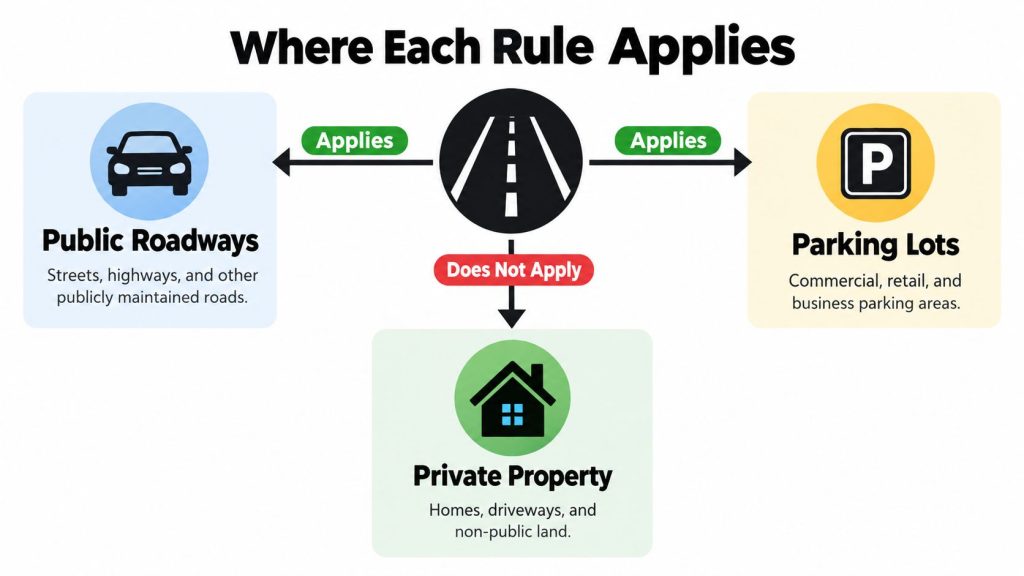
Location changes the analysis. A driver on an ordinary road, a driver passing a school-zone sign, and a driver moving through an active work zone may face different restrictions even if the phone action looks identical.
A designated school crossing or school zone is a regulated area under the zone-based handheld provision. Treat the first sign, crossing area, and school-related traffic control as a signal to put the phone away. If you’re dropping off a child and need to change the destination, pull over legally before interacting with the device.
An active work zone is more specific than a road that merely displays construction signage. Under the statute, construction personnel must be present or operating equipment on the roadway or immediately adjacent to it. A posted area without personnel or equipment doesn’t automatically create the same active-zone condition.
Sustained use and ordinary roads
The phrase sustained use matters because drivers often assume that a mounted phone makes every interaction acceptable. A quick permitted feature action isn’t the same as holding the device and continuing to browse, type, scroll, or manipulate it while driving. If a task takes repeated attention, complete it before departure or stop in a lawful location.
Consider three examples:
- School drop-off: You realize the map has the wrong entrance while traveling through a school zone. Don’t pick up the phone. Follow the hands-free route or leave the traffic stream before making changes.
- Fresh road construction: You see workers and equipment beside the roadway. Treat the area as active and don’t hold the phone, even if the signs appeared only recently.
- Traffic on I-95: A traffic jam doesn’t turn the driver’s seat into a workspace. Configure navigation and playlists before entering the roadway, then rely on voice control or Bluetooth.
The statewide 2025 framework makes ordinary-road use more important than older summaries suggest, while the school and work-zone rule remains the clearest enforcement risk for handheld interaction. When the status of a zone is unclear, the defensive choice is to behave as though the restriction is active.
Which Devices and Actions Are Covered
Florida uses a technology-neutral definition of a wireless communications device. The rule isn’t limited to the brand or shape of a smartphone.
Covered categories can include:
- Cell phones: Traditional smartphones and other phones capable of communication or data access.
- Tablets and laptops: Portable computers that can connect to the internet, access data, or support communications.
- Two-way messaging devices: Equipment designed to transmit or receive messages.
- Handheld electronic games: Devices capable of transmitting messages, accessing data, connecting to the internet, or supporting communications.
The practical test is how the device functions and whether you’re holding it. A driver can’t avoid the rule by calling something a tablet, gaming device, or messaging unit instead of a phone.
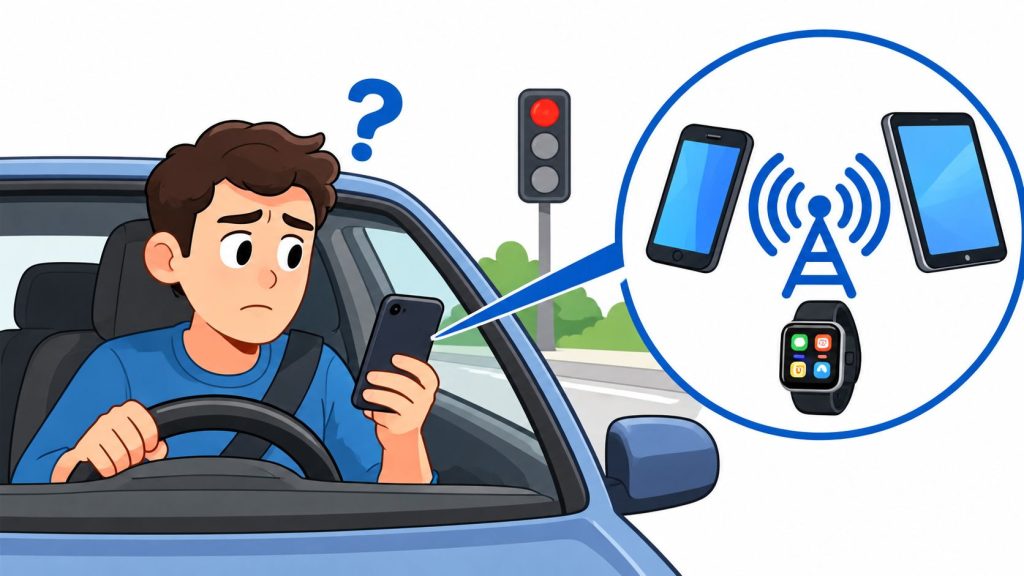
What hands-free use looks like
Florida excludes built-in vehicle safety, security, or convenience features that don’t require holding a device. Factory-installed systems, aftermarket Bluetooth, voice-operated controls, and comparable hands-free setups are the practical tools most drivers can use.
That doesn’t mean every dashboard interaction is risk-free or automatically lawful. A mounted phone can still demand sustained visual and manual attention, especially if you scroll through directions, search for a song, or compose a message.
A safer setup has three parts:
- Prepare before driving: Enter the destination, choose the playlist, and connect Bluetooth while parked.
- Use your voice: Call, answer, or change a feature through voice-operated controls when available.
- Stop for complex tasks: If voice control can’t complete the task, pull over legally before touching the device.
For a straightforward explanation of why manual phone interaction creates danger, review this texting and driving dangers guide. The legal details matter, but the habit that protects you most is simple: keep the device out of your hand.
Penalties, Points, and the Five-Year Look-Back
The financial and licensing consequences differ sharply between a texting citation and a handheld-use citation in a regulated zone. Read the citation carefully, because the classification determines what happens next.
A first texting violation is a noncriminal, nonmoving traffic infraction. The base fine is $30, with court costs and other fees added, and no driver-license points are assessed. A second or subsequent texting violation within five years of a prior conviction becomes a moving violation, carrying a $60 base fine, additional costs, and three license points. The five-year period is measured from a prior conviction, so an earlier case can affect how a later citation is treated.
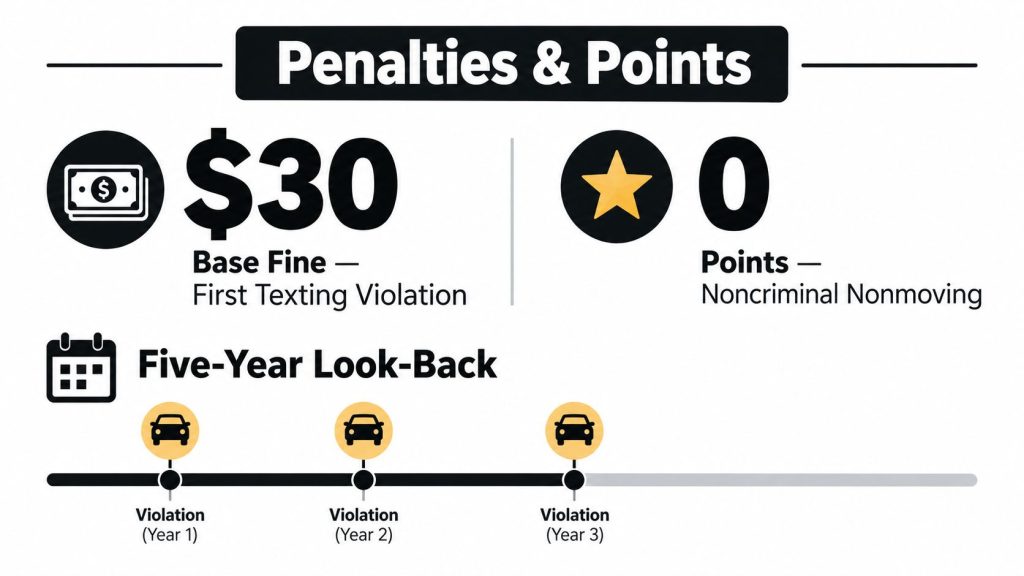
A first handheld-device violation in a designated school crossing, school zone, or active work zone is different. It is a noncriminal moving infraction carrying three license points. The statute also provides a compliance option for a first offense: the driver may elect to participate in a wireless communications device driving-safety program approved by the Florida Department of Highway Safety and Motor Vehicles.
What the course option requires
The election and completion requirements matter. After the driver completes the approved program, the court clerk may waive the penalty and associated costs, and the license-point assessment must be waived under the statutory mechanism. Don’t assume that taking any online class automatically produces this result. Confirm eligibility, election timing, program approval, and court procedures.
Before enrolling: Read the citation and contact the court clerk or relevant authority if you’re unsure which program satisfies your case.
The ticket is only one part of the cost. A moving violation can affect your driving record and may create insurance concerns, depending on the driver’s policy and insurer. Drivers comparing the broader cost of traffic violations can also review information about how to avoid the no-insurance fine, although that issue is separate from a phone citation.
For a plain-language explanation of the texting citation itself, see how much a texting and driving ticket can cost.
How a Florida-Approved Course Can Protect Your Record
The right course depends on the citation, the court order, and your eligibility. A course isn’t a universal substitute for reading the citation, but it can provide a structured way to satisfy an approved requirement or improve driving habits after a violation.
For an eligible standard moving violation, a Basic Driver Improvement course is the usual starting point. BDISchool offers a Florida-approved online BDI course designed for qualifying traffic violations, including violations related to texting while driving. The course is self-paced, and the provider offers instruction in English, Spanish, and Portuguese.

Match the course to the situation
- Basic Driver Improvement: A four-hour course for eligible drivers with a moving violation who need an approved defensive-driving option.
- Intermediate Driver Improvement: An eight-hour program for court-ordered drivers or people who need more extensive instruction.
- Aggressive Driver Course: An eight-hour course focused on habitual offenders and unsafe driving behavior, including road-rage patterns.
- Mature Driver Course: A six-hour refresher for drivers aged 55 and older who are seeking an insurance discount.
The school and work-zone handheld provision has its own specific compliance pathway. A cited driver may elect the FLHSMV-approved wireless communications device driving-safety program in place of the statutory penalty and points for a first offense, provided the applicable requirements are met.
That distinction prevents a common mistake. A general traffic-school enrollment and the specifically approved wireless-device program may not be interchangeable for every citation. Check the court instructions before registering, then complete the approved course within the required timeframe.
Online access helps busy professionals study around work and family responsibilities. It also gives Spanish- and Portuguese-speaking drivers a way to work through the material in a language offered by the provider. To understand the general process, review how traffic school works in Florida.
Safe Driving Habits and Your Next Step
The most reliable way to follow Florida’s phone rules is to remove the decision while you’re driving. Configure navigation, playlists, and calling preferences before you move. Mount the phone once, connect Bluetooth, and leave it alone.
Use this short checklist:
- Do: Set the destination before departure.
- Do: Use factory-installed or aftermarket Bluetooth and voice controls.
- Do: Treat school crossings, school zones, and active work zones as hands-free areas.
- Do: Pull over legally when a task needs sustained attention.
- Don’t: Type, read, scroll, or browse while driving.
- Don’t: Assume a red light or traffic jam makes handheld use safe.
- Don’t: Treat a posted construction area as identical to an active work zone, or assume the distinction makes phone handling a good choice.
If you received a citation, act before deadlines pass. Verify the exact program required, confirm your eligibility, and choose a Florida-approved course that fits your record and court instructions. Browse available options at BDISchool courses or DriverEducators courses.
BDISchool offers Florida-approved online defensive-driving and traffic-school courses for eligible drivers, including Basic Driver Improvement and other programs for court, safety, and insurance needs. Visit BDISchool to choose the course that matches your Florida phone-related citation and start studying on your schedule.