Your license is suspended, your notice mentions a court or FLHSMV requirement, and you need to get back on the road without creating another legal problem. The first decision matters most: Florida’s Advanced Driver Improvement course is not the same as traffic school for a ticket. Choosing the wrong class can leave your suspension unresolved.
The right course can provide the educational step required for reinstatement, but completion alone doesn’t automatically authorize you to drive. Confirm the mandate, use an approved provider, finish the required work, and submit proof exactly as directed.
Why Florida Requires the Advanced Driver Improvement Course
The Advanced Driver Improvement (ADI) course is a reinstatement tool. Florida requires it when a license has been suspended for point accumulation, habitual traffic offender status unrelated to DUI, or a court order, according to the Florida Highway Safety and Motor Vehicles ADI information.
That legal purpose separates ADI from a casual defensive-driving refresher. You aren’t taking it to brush up on road rules or voluntarily reduce the effect of an ordinary citation. Your driving privilege has been restricted, and the course may be a required condition before you can pursue reinstatement.
Practical rule: Read the suspension notice before enrolling. If it identifies ADI as a condition of reinstatement, a basic ticket course won’t satisfy that requirement.
The course is part of a legal process
Florida regulates driver-improvement schools and requires department approval. That means the course content and delivery must follow state-approved standards, rather than relying on a generic defensive-driving program that may not be accepted for your situation.
The distinction matters because a suspended license creates consequences beyond inconvenience. Driving before you’re legally authorized can expose you to additional penalties and make reinstatement more difficult. An online course can make the educational requirement easier to manage, but it doesn’t replace the obligation to verify your status with FLHSMV or the court.
Treat reinstatement as a checklist
Start with the notice or order that caused the suspension. Identify the authority that issued it, the course name required, any deadline, and the instructions for submitting completion evidence.
Then select a provider from an approved course catalog. BDISchool and DriverEducators offer online course options, including flexible access designed for drivers who need to study around work, family, or transportation problems. Before paying, make sure you’re selecting ADI, not BDI or another driver-improvement class.
The situation is serious, but it’s manageable when you handle it in the correct order. The course is the bridge between the mandate and your application for reinstatement, not a shortcut around the legal process.
Basic vs Advanced Driver Improvement in Florida
The fastest way to avoid an expensive mistake is to match the course to the legal problem. BDI generally addresses a qualifying moving citation, while ADI addresses a suspension or reinstatement requirement.
Florida’s Basic Driver Improvement course information is useful if you’re dealing with a ticket and want to understand that separate process. It shouldn’t be your choice when your notice specifically requires Advanced Driver Improvement.
Florida Driver Improvement Course Comparison
| Feature | Basic Driver Improvement (BDI) | Advanced Driver Improvement (ADI) |
|---|---|---|
| Main purpose | Satisfy a qualifying moving-violation election | Support license reinstatement after a qualifying suspension or court order |
| Typical course length | 4 hours, as described by FLHSMV’s driver-improvement information | 12 hours, when the 12-hour ADI program is required |
| Who may use it | Drivers with a non-criminal moving violation who don’t hold a commercial driver license and meet the election rules | Drivers whose notices or court orders require ADI |
| Effect on a qualifying citation | Completion can prevent points from being added and stop adjudication of guilt for the violation | It doesn’t turn a suspension into a ticket-dismissal election |
| Election or timing | Election must be made within 30 days of receiving the ticket, and voluntary use is limited to once in a 12-month period and no more than eight times in a lifetime, according to FLHSMV’s course guidance | Timing depends on the suspension or court instructions |
| Fine paperwork | The citation fine is reduced by 18%, and the certificate must be taken to the county Clerk of Court, according to FLHSMV’s traffic citation instructions | Certificate reporting follows the authority’s reinstatement instructions |
Use the notice, not guesswork
Choose BDI when you received a qualifying non-criminal moving violation and want to use the available course election. The process can protect the record from points for that violation, but eligibility and timing rules apply.
Choose ADI when your license is already suspended or a court has ordered the advanced program. ADI is not a substitute for BDI, and BDI isn’t a substitute for ADI. A completed certificate for the wrong course can still leave the underlying requirement open.
If the paperwork is unclear, contact the Clerk of Court or FLHSMV before enrolling. A provider can explain its course options, but the issuing authority controls what your specific case requires.
Legal Triggers and Eligibility Requirements
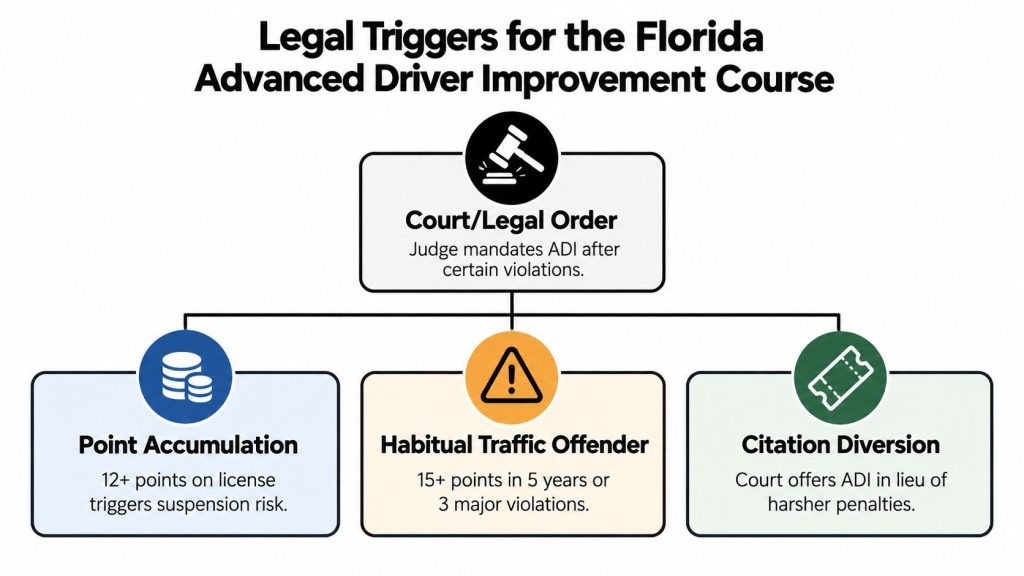
ADI becomes relevant when your legal status, not your personal preference, creates the requirement. Florida identifies three main triggers: suspension tied to point accumulation, habitual traffic offender status unrelated to DUI, and a court order.
Point accumulation means separate driving violations have produced enough points to affect your license. You don’t need to interpret every rule from memory. Look for language in the suspension notice that identifies accumulated points, reinstatement conditions, or a mandated advanced course.
A habitual traffic offender designation reflects a more serious compliance history. In plain English, the state or court is treating repeated violations as evidence that ordinary ticket handling is no longer enough. The ADI requirement addresses the educational component, but it doesn’t erase the violations that produced the suspension.
How to verify the mandate
Use this sequence:
- Read the suspension notice: Find the stated reason, required course, deadline, and reporting instructions.
- Check the issuing authority: Determine whether FLHSMV, a court, or another listed authority controls the next step.
- Confirm the course name: Make sure the requirement says ADI if that’s the course you intend to take.
- Review unresolved conditions: A course may be only one part of reinstatement. Fees, hearings, documentation, or other requirements may still apply.
- Keep every record: Save registration details, completion confirmation, certificate copies, and submission receipts.
For a plain-language explanation of the terminology that can appear around a citation, review what counts as a moving violation in Florida. That can help you distinguish the original violation from the later suspension requirement.
Don’t confuse ADI with a clean slate
Completing ADI satisfies an educational prerequisite when the mandate applies. It doesn’t automatically remove the underlying convictions, rewrite your driving history, or authorize driving before the proper authority confirms reinstatement.
If your situation also involves impaired driving, insurance consequences can become a separate issue. A focused resource on getting auto coverage after a DUI may help you address that insurance question while you handle the license process.
Inside the 12 Hour Online Curriculum
The online experience is built for a driver who has obligations outside the course. You can work through the material in stages, pause when needed, and return later instead of losing an entire day to a classroom schedule.

What the lessons address
A serious ADI curriculum should do more than repeat basic road signs. It should connect Florida traffic rules with the decisions that lead to crashes, violations, and unsafe habits.
Expect material covering areas such as:
- Advanced defensive driving: Recognize developing hazards, manage space, and make safer decisions before a conflict becomes urgent.
- Crash avoidance: Study following distance, scanning, lane management, and responses to sudden roadway changes.
- Aggressive driving: Examine how impatience, confrontation, and emotional escalation affect judgment.
- Impaired and distracted driving: Understand why divided attention and impairment reduce a driver’s ability to respond.
- Attitude and behavior: Identify the personal habits that turn ordinary traffic situations into dangerous encounters.
The point isn’t to punish you with a lecture. The point is to make the connection between conduct and consequences clear enough that you can change what happens behind the wheel.
Flexibility without losing accountability
BDISchool’s online format is available in English, Spanish, and Portuguese, and it can be accessed from a compatible device. That matters if English isn’t your first language or if your schedule changes from day to day.
Self-paced access doesn’t mean you should treat the course casually. Use a quiet location, keep your identification and case information available, and take notes on concepts you need to review. The guidance in how long online traffic school takes can help you plan study sessions without assuming that finishing quickly is the same as finishing correctly.
A good approach is to divide the work into realistic blocks. Complete a module, review the key rules, and stop at a natural break. Then resume with enough time to concentrate on the final assessment rather than rushing through material while distracted.
Enrollment and Certificate Reporting Steps
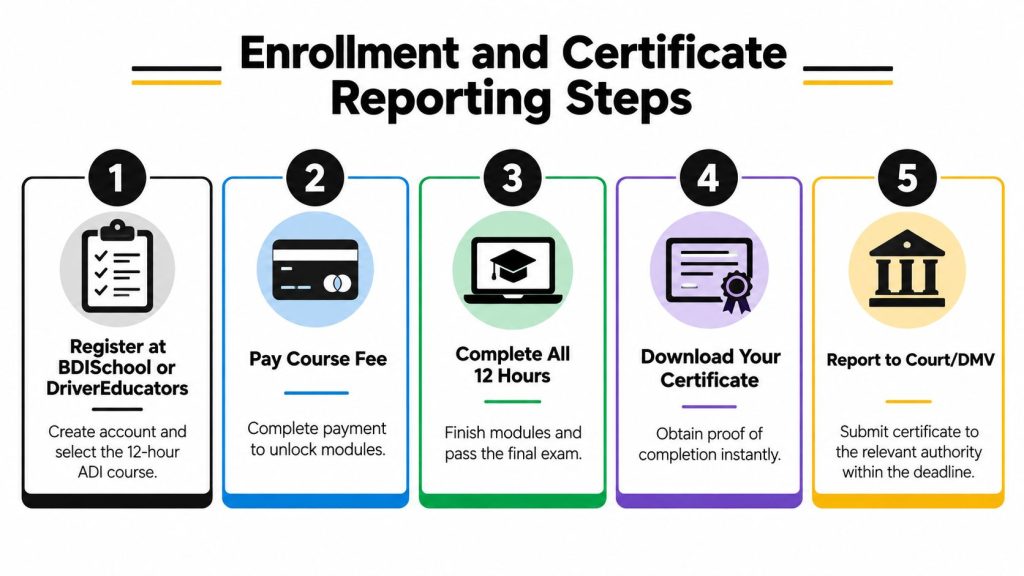
The course isn’t finished when you click the last lesson. Your certificate must reach the authority that controls your case, and the safest process is chronological.
Follow the correct order
Confirm the requirement. Verify with your suspension notice, court documents, FLHSMV, or the Clerk of Court that you need the ADI program. Don’t assume a course title based only on the fact that your license is unavailable.
Register with an approved provider. You can review available course choices through BDISchool’s course catalog or DriverEducators’ course catalog. Select the required ADI course and enter your information carefully.
Complete the required material. Work through the online lessons and all required course components. Plan for the full 12-hour program when that is the mandate, and complete the final assessment according to the provider’s rules.
Obtain the certificate. After successful completion, secure the electronic certificate or other completion document provided for your course. Download it, save it in more than one location, and check that your personal information is accurate.
Submit the proof correctly. Follow the suspension notice or court order. The certificate may need to go to FLHSMV or the relevant Clerk of Court, depending on who issued the requirement. Use the online traffic school registration guidance to reduce registration errors, but rely on your official notice for reporting instructions.
Close the administrative loop
Don’t assume electronic course reporting means your case is complete. Confirm whether you must submit a certificate yourself, whether the authority needs an original or electronic copy, and whether a separate reinstatement application or payment remains outstanding.
Keep proof of delivery and follow up with the authority after submission. Above all, don’t drive until your license status shows that you’re legally permitted to do so.
Completion is evidence that you met the course requirement. Reinstatement is the authority’s decision after all requirements are satisfied.
Protecting Your Record and Future Insurance Rates
The immediate objective is reinstatement, but the better objective is preventing another suspension. ADI should be treated as a reset in decision-making, not merely paperwork required to recover a license.
The course can help you identify patterns that contributed to the problem, such as speeding decisions, unsafe lane changes, aggressive reactions, poor attention, or failing to anticipate other drivers. That knowledge doesn’t erase your record, but it gives you a practical basis for changing future behavior.
Be realistic about insurance
Completing ADI isn’t a guaranteed insurance discount, and it doesn’t automatically remove prior violations from an insurer’s review. Insurance companies make their own underwriting decisions, so ask your carrier what documentation it accepts and whether it offers any relevant program.
Your strongest long-term protection is a cleaner pattern of driving. Avoid new violations, keep records of every completed course, and review your driving history when you need to understand what an insurer or licensing authority may see.
Older drivers may be asking about a different program. Florida’s mature-driver course is a six-hour program designed for drivers age 55 and older, according to the Florida Safety Council’s mature-driver course information. That course serves an insurance-discount and safety-refresher purpose, so it shouldn’t be confused with ADI reinstatement.
Driving schools also need a reliable way to build public trust and communicate course quality. For that separate business need, RecensioAI review generation for driving schools offers a review-focused resource.
The practical recommendation is simple: complete the mandated course, report it properly, and then change the driving behaviors that created the risk. A certificate can help restore eligibility, but safer decisions protect your future record.
Frequently Asked Questions About Florida ADI
Can I take the ADI course on my phone?
Online access may allow study from a phone or another compatible device, but check the provider’s technical requirements before registering. A larger screen is often more comfortable for extended reading and assessments.
What if I fail the final exam?
Review the provider’s current retake policy before starting. If you don’t pass, follow the platform’s instructions rather than opening a second enrollment or assuming the certificate has been issued.
How long does FLHSMV take to process my certificate?
Processing time depends on the authority, submission method, and whether your case has other unresolved requirements. Don’t rely on an assumed timeline. Confirm receipt and check your official license status before driving.
Does ADI remove the violations from my record?
No. ADI addresses the mandated educational or reinstatement step. It isn’t the same as electing BDI for a qualifying citation, and it doesn’t promise deletion of the underlying driving history.
Can I drive as soon as I finish?
No. Course completion doesn’t automatically restore driving privileges. Wait until FLHSMV or the relevant court confirms that every reinstatement condition has been met.
How do I know whether I need BDI or ADI?
A qualifying moving violation may allow BDI election, subject to Florida’s timing and eligibility rules. A suspension for point accumulation, habitual traffic offender status unrelated to DUI, or court order points toward ADI, but your official notice controls.
What if I’m not comfortable studying in English?
Choose a provider that offers the course material in a language you understand. BDISchool’s stated online course options include English, Spanish, and Portuguese, which can make the material easier to follow accurately.
Can a provider guarantee reinstatement?
No responsible provider should promise that a course alone will restore your license. The provider supplies the educational requirement, while FLHSMV or the court determines whether your full case is ready for reinstatement.
Register for the Florida ADI course only after confirming that ADI is the requirement on your notice or court order. Visit BDISchool to review its online, self-paced course options, choose the appropriate program, and start completing the step that moves your reinstatement process forward.