Florida law allows a right turn on red after a complete stop and yielding to pedestrians and cross-traffic, unless a specific sign prohibits the turn. The rule applies at intersections where the right turn is permitted, but it isn’t a blanket permission to turn whenever the road looks open.
You’re stopped at a red light, a line of cars is behind you, and someone in the next lane has already started edging forward. You may be wondering whether to turn, wait, or risk frustrating the driver behind you. The safest answer starts with the law, then depends on the sign placement, crosswalk, traffic flow, and your ability to see clearly.
Florida’s right-on-red rule is simple to state but easy to mishandle. A rolling stop, a missed pedestrian, or a small No Turn on Red sign can change the outcome. Good driver education helps you recognize those details before pressure from surrounding traffic turns a routine intersection into a citation or collision.
The Core Rule for Right Turns on Red
Florida permits a driver facing a steady red signal to turn right after coming to a complete stop. The driver must yield the right-of-way to pedestrians and other traffic moving as directed by the signal at that intersection, as provided by Florida’s traffic signal statute.
That permission has conditions. You must stop first, check the intersection, and proceed only when the turn is allowed and safe. If a posted sign prohibits the movement, you must wait for the appropriate signal even if no vehicles are approaching.
Practical rule: Right on red is a permission, not an obligation. You never have to turn simply because the driver behind you is impatient.
A driver who treats the rule as “red means slow down, then go” is missing the most important part. Florida law requires a complete stop, not a brief reduction in speed. You also have to account for pedestrians crossing from either side, vehicles with the right-of-way, bicycles near the curb, and traffic that may enter your path unexpectedly.
The same basic principle appears in Florida guidance on right-of-way rules. The law gives you a possible movement through the red signal, but it leaves you responsible for judging whether the movement can be completed without interfering with others.
This is why drivers can receive citations even when they believe they were “basically stopped.” They may have rolled beyond the stop line, failed to yield, or turned where a sign applied. Learning the rule as a sequence, rather than as a shortcut, makes the decision easier and more consistent.
Breaking Down the Florida Statutes
Florida’s core right-on-red rule appears in section 316.075 of the Florida Statutes. The statute permits a driver stopped at a red signal to make a right turn after stopping at the stop line, the crosswalk, or the nearest point that provides visibility, while yielding to pedestrians and other traffic and obeying posted local prohibitions. You can review the operative language in the 2026 Florida Statutes.
The stopping point matters because it balances two needs. You need to stop before entering the path of people crossing, but you also need a position that lets you see approaching traffic. If the stop line is present, stop behind it. If a crosswalk is the controlling point, don’t occupy it. If neither provides a useful view, the statute refers to the nearest point where visibility is available.
A rolling stop isn’t a legal stop
A rolling stop happens when the vehicle keeps moving, even slowly, while the driver looks for a gap. It can feel harmless on an empty road, but it doesn’t satisfy the stop-and-yield structure of the rule.
A complete stop means the vehicle has stopped before you assess whether to turn. Keep the car stationary while you scan the sign environment, crosswalk, and traffic lanes. If you can’t see because of a large vehicle, landscaping, darkness, or the angle of the intersection, waiting is the responsible choice.
The statute also preserves local control. A city or other local government may prohibit right turns on red at a particular intersection by posting a visible sign. That means the statewide rule gives you a starting point, not a guarantee that every intersection operates the same way.
The legal decision has three parts
Think of the statute as a three-part test:
- Stop at the proper location. Stop behind the stop line or before the crosswalk, or at the nearest point that provides visibility.
- Confirm that the turn is permitted. Look for a visible sign that prohibits right on red or otherwise controls the movement.
- Yield before entering. Give pedestrians and traffic with the right-of-way enough space to proceed without conflict.
Florida law also describes the maneuver as one that must be completed in a careful and prudent manner at an intersection where right-hand turns are permissible. The related state provision explains that a notice of violation or traffic citation may not be issued solely for failing to stop at red in that specific lawful circumstance, as described in the Florida statutory provision on right turns. That language doesn’t excuse an unsafe turn or a failure to yield.
Executing the Maneuver Safely and Legally
Approach a red light with your foot ready to brake and your attention on the entire intersection, not only the traffic signal. A safe right turn begins before the vehicle reaches the line.
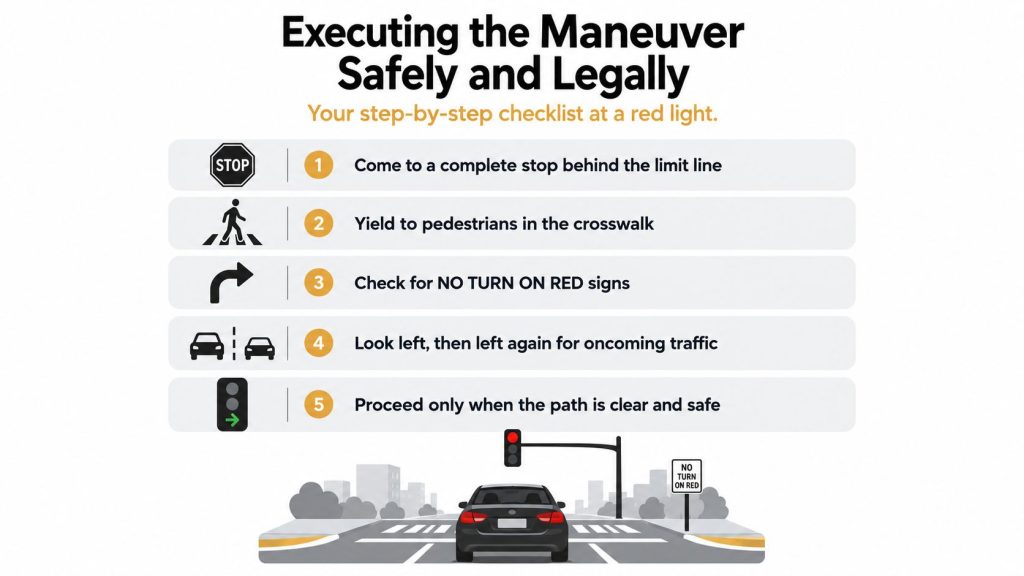
Florida traffic guidance says drivers may turn right on red at most intersections after stopping when the way is clear. The practical requirements are to stop completely, check for posted prohibitions, and make sure the intersection is clear, as described in this Florida traffic signal guidance.
Use this sequence at the wheel:
- Stop behind the line or crosswalk. Keep the front of your vehicle out of the pedestrian path.
- Read the signs. Search near the signal, on the corner, and above the lane for a No Turn on Red notice.
- Scan the crosswalk. Look left and right for people who are already crossing or stepping into the crosswalk.
- Check the traffic approach. Look left for vehicles with the right-of-way, then check again because a gap can close quickly.
- Check the curbside area. Watch for bicycles, scooters, and pedestrians near the right edge of the road.
- Turn only when the path is clear. Enter the turn smoothly, without rushing because another driver is waiting behind you.
A vehicle may block your view of a person crossing or an approaching car. Before turning, use an active head check rather than relying only on the mirrors. This guide to checking a blind spot while driving reinforces why a deliberate visual scan matters.
If the intersection remains difficult to read, keep your wheels straight and wait for green. That choice protects you from turning into a hidden road user and avoids the pressure to commit before you have enough information.
Navigating Local Bans and Camera Confusion
Florida’s statewide permission to turn right on red does not apply in exactly the same way at every intersection. A local government can prohibit the movement at a particular location, and the posted sign controls there. The rule can change from one signal to the next, even along the same road.
A sign may be difficult to notice while you are watching traffic, pedestrians, lane markings, and unfamiliar road geometry. Treat local signage as part of the intersection’s legal instructions. A clear opening in traffic cannot override a No Turn on Red notice.
Camera enforcement can change locally
Red-light cameras add confusion because some drivers treat the camera itself as proof that every right turn is forbidden. That is not how the rule works. A camera does not make a permitted turn illegal, and it does not remove the duty to obey a stop requirement, yield, or posted prohibition. For more detail, see this guide to whether red-light cameras flash and how camera triggers work.
Local policy can also differ from the statewide rule. Miami Beach’s announcement about right-turn camera enforcement describes a suspension of red-light cameras for right turns while at least one intersection remained fully prohibited. That example shows why the camera’s presence, absence, or status does not answer the legal question by itself. The specific sign and intersection policy still matter.
Intersection habit: Read the sign before judging the gap. An open lane does not cancel a local prohibition.
A camera notice may leave several facts unclear. Did the vehicle stop completely? Was a right turn prohibited at that location? Did the vehicle enter the crosswalk or fail to yield? Review the notice carefully and compare it with the intersection’s signs and conditions rather than assuming another location follows the same policy.
Don’t let pressure make the decision
A driver behind you may honk or follow too closely. That pressure does not change your legal duty. If a notice arrives, photograph the intersection signage and record the exact location before responding. A prohibition at one intersection does not automatically apply to the next, and the notice may depend on details that are easy to forget later.
Protecting Your Record with Traffic School
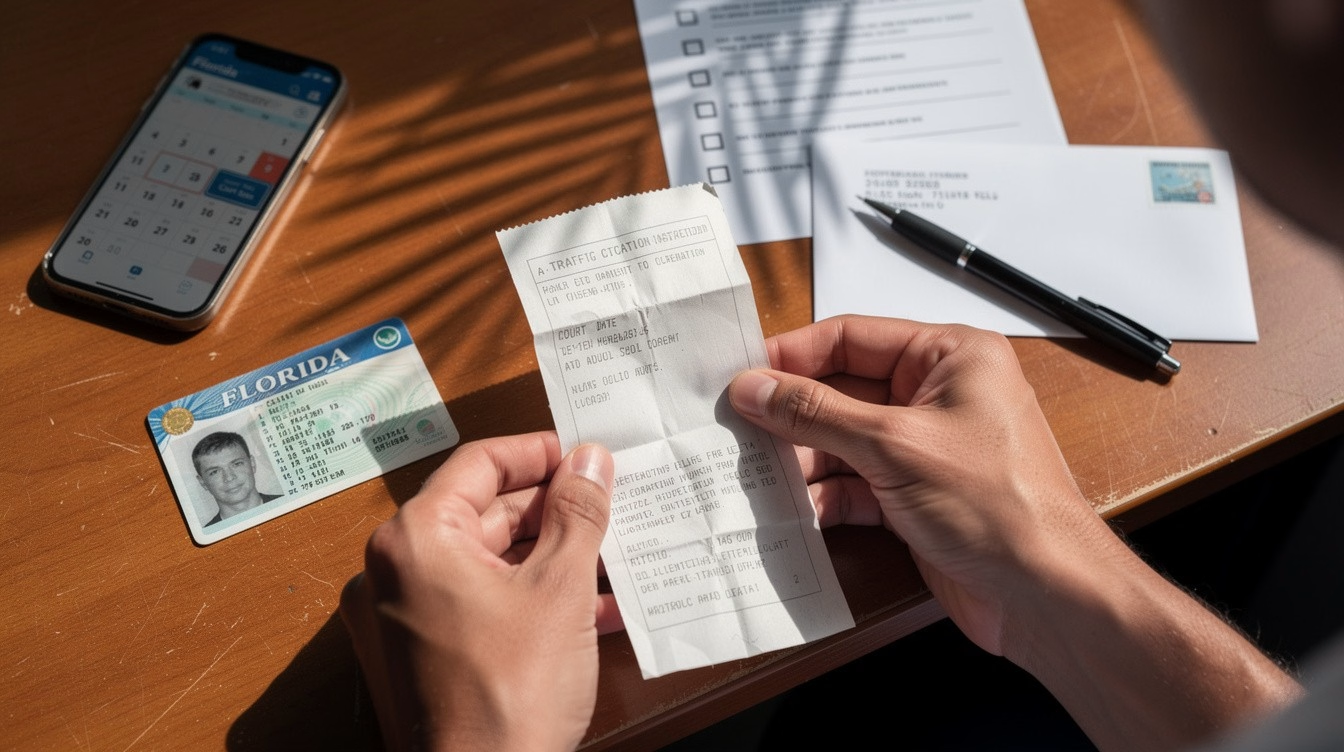
A right-on-red mistake can create more than an uncomfortable moment at an intersection. A citation may lead you to review your driving record, court requirements, insurance consequences, or available driver improvement options. The exact response depends on the notice and your circumstances, so read the citation carefully and follow the instructions attached to it.
Traffic school can be useful when you need structured instruction after a moving violation or want to strengthen weak areas before they produce another problem. A Florida-approved course can revisit stop requirements, right-of-way decisions, defensive scanning, distracted driving, and other habits that affect everyday intersections.
Choose instruction that fits your situation
Online programs give busy drivers a way to study at their own pace instead of waiting for a fixed classroom schedule. Look for a course that clearly identifies its Florida approval, explains completion requirements, supports the language you need, and reports completion through the required process when applicable.
BDISchool provides online Florida traffic school options that include driver improvement and defensive driving education, with course materials available in English, Spanish, and Portuguese. The programs cover Florida traffic laws, safe driving decisions, and practical collision-avoidance skills, making them relevant for both drivers handling a citation and motorists refreshing their knowledge.
Before enrolling, confirm which course your citation, court, or personal goal requires. A basic improvement course may fit one situation, while a more detailed or court-directed program may be appropriate for another. The important step is to select the correct approved course rather than assuming every traffic school option serves the same purpose.
You can also learn how traffic school works in Florida before choosing a program. Understanding the process helps you avoid missed deadlines and focus on the driving habits that caused the original uncertainty.
Building Lifelong Safe Driving Habits
The best way to remember Florida’s right-on-red rule is to reduce it to a calm decision sequence:
- Stop: Bring the vehicle to a complete stop at the correct point.
- Sign: Confirm that no posted prohibition applies.
- People: Yield to pedestrians in the crosswalk and anyone entering your path.
- Traffic: Give the right-of-way to cross-traffic and check the curbside area.
- Go: Turn only when you can see that the movement is legal and safe.
This checklist works because it separates the legal question from the traffic question. A turn can be legally permitted in general but unsafe at that moment. Conversely, an empty intersection still doesn’t authorize a turn where a sign prohibits it.
Defensive driving principle: If you can’t see enough to yield, you don’t have enough information to turn.
Good instruction teaches more than isolated answers. It helps new drivers, returning drivers, visitors, and experienced motorists understand why stop lines, crosswalks, signs, and sightlines matter. That understanding builds judgment that carries over to left turns, lane changes, merging, and other situations where a quick decision can affect everyone nearby.
If a recent ticket exposed a gap in your knowledge, use it as a reason to improve rather than move on. A focused online course can help you refresh Florida law, practice safer decision-making, and approach the next red light with less uncertainty.
BDISchool offers Florida-approved online driver improvement and defensive driving courses that address the stop-and-yield decisions behind right turns on red. Visit BDISchool to choose a course, study at your convenience, and build safer habits that support your driving record.